

Strategic Playbook for Global Investors Entering Miami Institutional Real Estate
For family offices seeking disciplined entry into Miami, the strategic playbook is not a checklist – it is a governance and execution framework. The sequence begins with verifying operator credibility (track record, SEC/IRS compliance, and in-house execution), followed by structuring capital through LP/GP alignment and a clear capital stack (senior debt, preferred equity, and disciplined leverage).
From there, the playbook moves into submarket selection (Brickell/Edgewater for Class-A multifamily, Airport West/Doral for industrial), and compressing execution cycles to 90-180 days when value-add or short-cycle opportunities are pursued. This approach replaces speculative timing with engineered outcomes: NOI expansion, controlled exit timing, and predictable return pathways.
Finally, governance is non-negotiable. Family offices must ensure quarterly reporting, audited processes, and AML/KYC alignment before capital is deployed. Miami rewards operators who combine data-driven underwriting with institutional compliance – and penalizes those who treat market momentum as strategy.
Family office investing in Miami has solidified its position as the second most attractive market for institutional real estate investment in the United States, and projections for 2026 confirm this upward trajectory. For family offices and institutional investors, the city offers a unique combination of predictable demographic growth, robust infrastructure, and risk-adjusted value opportunities that outperform traditional gateway markets.
For a deeper institutional framework, see our full institutional real estate investment strategy guide for Miami.

SUMARY
Contents
- Identify a trusted operator (track record, SEC/IRS compliance, and in-house execution).
- Define the capital stack and LP/GP alignment with disciplined leverage.
- Select submarkets with institutional liquidity (Brickell/Edgewater, Airport West/Doral).
- Set 90–180 day execution cycles for value-add or short-cycle opportunities.
- Enforce governance: quarterly reporting, audits, and AML/KYC alignment.
Southeast metro areas strongest risk-adjusted returns for value-add multifamily investors are concentrated where liquidity, governance, and disciplined underwriting converge – Miami remains the clearest case for institutional families seeking downside protection with value-add upside.
2026 Market Outlook For family office real estate
Miami is experiencing structural population growth driven by both domestic and international migration, with approximately 43% of transactions closing in cash during 2025, signaling deep confidence from institutional buyers and ultra-high-net-worth individuals. Globally, family offices have increased their allocation to real estate to 39% of portfolios in the first half of 2025, compared with 26% two years earlier, prioritizing apartments and land development.
The market presents early-cycle opportunities that will persist through 2026 as institutional capital gradually returns following interest rate adjustments. Projections indicate a 5.6% increase in single-family home sales for 2026 after the slowdown in 2025.
Highest-Opportunity Sectors
Industrial and logistics
Miami’s industrial sector represents the highest-certainty bet for conservative institutional capital, with vacancy below 4% and double-digit rent growth in key submarkets. The Airport West/Doral/Hialeah corridor offers structural advantages: land scarcity, strong tenant stickiness, and strategic positioning as a logistics gateway via PortMiami and Miami International Airport.
Family office investing: value‑add and core‑plus strategies in Miami
Recommended allocation: 40% of capital into core-plus/value-add industrial in Doral, Medley, and Hialeah, focusing on rent-to-market strategies and small-cap expansion opportunities.
Class A multifamily
Multifamily remains the backbone of institutional allocations, particularly in Brickell and Edgewater, where tenants demand condo-level finishes and amenities. Sustained rental demand from a constant inflow of out-of-state and international residents keeps vacancy at historically low levels.
Capitalization rates (cap rates) compressed modestly after stabilizing at 5.7% for seven consecutive quarters, the longest streak in 25 years. For 2026, ground-up or lease-up projects in prime locations justify premium rents when executed with realistic contingencies and disciplined absorption underwriting.
Recommended allocation: 30% in Class A multifamily focused on Brickell/Edgewater, with strict emphasis on margin of safety and conservative lease-up curves.
Family offices that need a complete playbook can review the 2026 institutional real estate investment strategy guide for family offices.
Cap Rate Stability Analysis
Multifamily fundamentals remain robust. Cap rates have compressed modestly after stabilizing for seven consecutive quarters, signaling a safe harbor for institutional capital.
AAA office (selective)
The office market is bifurcated: commodity space remains under pressure, while well-located AAA properties with institutional amenities, energy efficiency, and proximity to transit can command premium rates. The approach must be surgical, targeting new construction or repositioning into the top quartile in locations where corporate demand (fintech, financial services) is pre-committed.
Recommended allocation: 20% in selective AAA office in Coral Gables/CBD with strategic repositioning or ground-up development.
High-traffic retail
High-street retail districts such as the Miami Design District and Lincoln Road are showing strength, driven by luxury brands and robust pedestrian traffic. Mixed-use projects integrating retail and dining components reflect renewed post-pandemic confidence and support a tactical 10% allocation for diversification.
Tax-efficient capital structures
Family offices with substantial real estate portfolios should implement multi-layered structures combining LLCs, irrevocable trusts, and partnerships to optimize tax treatment, asset protection, and estate planning.jmco
Recommended vehicles
Limited Liability Companies (LLCs): Pass-through treatment avoids corporate double taxation and provides flexibility for multiple members, including trusts.
Delaware Statutory Trusts (DSTs): Enable 1031 tax-deferred exchanges and institutional-grade fractional ownership.
Preferred equity and joint ventures: Provide downside protection with structured preferred returns in the 8–12% range before participating in upside.
Disciplined leverage (60–65% LTV) via Fannie Mae or Freddie Mac fixed-rate 10-year debt (currently around 5.5%) maximizes risk-adjusted returns while preserving operational flexibility.
Capital Stack Mechanics: Downside Protection & Tax Alpha (DST/LLC)
Strategic use of LLCs for pass-through treatment avoids double taxation, while DSTs enable fractional ownership and 1031 tax-deferred exchanges. This flexibility is anchored by 10-year fixed-rate debt to lock in operational certainty.
65%
Disciplined Limit
Risks and mitigants | family office investment in Miami real estate
Insurance dislocation
Miami faces pressure on insurance costs due to climate risk, potentially compressing NOI margins by 100–200 bps. Mitigation strategies include prioritizing hurricane-resilient construction and diversifying into more inland submarkets such as Doral and Coral Gables.
Selective oversupply
Although new supply is being added, particularly in multifamily, demand generally keeps pace. Granular submarket-by-submarket analysis is critical to avoid oversupplied pockets.
Shifts in migration policy
Tighter immigration enforcement could reduce renter demand by an estimated 100,000–150,000 households per year nationwide, with impacts concentrated in Sun Belt markets. Asset selection should emphasize locations with diversified employment bases that are less dependent on migration-sensitive sectors.
Implementation framework for 2026
- Institutional due diligence
Cap rate spreads: Compare against gateway markets; Miami offers a 60–130 bps premium with superior fundamentals.
Verify rent comps, vacancy rates, and supply pipeline at the micro-market level, and model stress scenarios with 50–100 bps expansion in exit cap rates. - Patient capital relationships
Family offices with 7–10+ year horizons and $200+ million in committed capital can access off-market opportunities and structure flexible income-versus-growth return profiles. - Strategic co-investment
More than 50% of family offices expect to expand co-investment activity in 2026, building deal flow with specialist operators and institutionalized diligence practices. - Multi-asset strategy A balanced portfolio for conservative institutional capital in Miami 2026 might allocate:
40% Industrial (Airport West/Doral/Hialeah)
30% Class A multifamily (Brickell/Edgewater)
20% AAA office (selective, Coral Gables/CBD)
10% High-street retail (Miami Design District)
This mix optimizes liquidity, governance, and tax posture while deploying capital into segments with durable demand and clear rent-to-market visibility.
Institutional Strategy 2026
Implementation Framework & Capital Allocation | Miami Focus
Portfolio Allocation Strategy
Cap Rate Spreads (Miami vs Gateway)
Family Office Co-Investment 2026
Patient Capital Relationships
Investment Horizon
Committed Capital
Transformational projects
Miami Worldcenter: A $6 billion, 27-acre development integrating condominiums, hotels, retail, and convention space, transforming downtown into a 24/7 district.
Brickell City Centre: Mixed-use project combining a luxury mall with offices, condominiums, and hotels, exemplifying the live-work-play model.
Downtown Doral/CityPlace Doral: Evolution of Doral beyond a 9-to-5 industrial district into a vibrant urban center with offices, apartments, and retail.
Conclutions for family office services
For family offices and institutional investors, Miami 2026 offers a real estate environment defined by safety, predictable income, and asset-grade structures rather than speculative momentum. Performance is increasingly driven by disciplined NOI operations, downside protection, and partnerships with managers who deliver repeatable edge.
The winning strategy combines surgical submarket selection, sophisticated tax structuring, measured leverage, and patient capital aligned with long-term value creation. In a normalized rate environment, acquisition pricing margins of safety and conservative leverage remain essential to achieving risk-adjusted returns in the 11.5–13% range. jmco+1
Sources and References
https://www.millionluxury.com/news/south-florida-luxury-real-estate-market-september-2025-report
https://www.parsiani.com/post/miami-s-real-estate-market-in-2025-a-new-era-of-growth
https://www.cushmanwakefield.com/en/united-states/insights/us-marketbeats/miami-marketbeats
https://www.jmco.com/articles/real-estate/tax-efficient-structures-for-family-offices/
https://thesignaturerealty.com/commercial-real-estate-market-miami/
https://arcsacapital.com/wp-admin/post.php?post=5361&action=edit
https://southfloridaagentmagazine.com/2025/11/07/q3-residential-real-estate-luxury-report/
https://www.jmco.com/articles/real-estate/real-estate-investments-family-offices/
https://www.millionluxury.com/news/south-florida-luxury-real-estate-market-2025-trends-insights
https://globallawexperts.com/family-offices-tax-planning-and-optimisation/
https://alpinemar.com/blog/family-office-tax-structure/
https://traded.co/blog/miami-ranked-as-prime-destination-for-2025-commercial-real-estate-investors/
https://www.discoversouthflorida.com/blog/the-truth-behind-the-luxury-real-estate-market-split/
Strategic Intelligence Report: Roadmap for Family Offices in Miami 2026
I. Executive Summary: The Pivot to “Forced Appreciation”
For the 2026 fiscal and operating cycle, the investment narrative in Miami has shifted radically. The market has moved past the “passive buy” phase powered by the post‑pandemic inflationary tide and entered a phase defined by financial and operational engineering.
Recent data confirms that Miami has partially decoupled from national mortgage volatility, driven by roughly 66% of international transactions closing all‑cash. However, capital safety no longer lies in holding average assets for the long term, but in speed of execution and regulatory governance.
The central thesis for 2026 is clear: Alpha (returns above the market) is found in inefficiency. Under‑managed assets punished by rising insurance costs and the absence of institutional capital (roughly 83% of multifamily stock is privately held) become tactical targets. The winning strategy combines the agility of private capital with the execution discipline of an institutional fund.
II. Structural Fundamentals: Why Miami Remains a Core Holding
Despite media noise around bubbles, Miami’s macroeconomic fundamentals provide a structural shield that is unique within the Sun Belt.
Institutional conviction (National #2 ranking): CBRE’s 2025 investor intentions survey ranks Miami as the second most attractive U.S. market for commercial real estate investment, behind only Dallas and ahead of legacy hubs such as New York and Boston. This confirms that Smart Money views Miami not as a speculative trade but as an essential capital destination.
High‑density demographics: While the broader metropolitan area grew 0.87%, the City of Miami posted explosive 3.5% growth over the last year, more than three times the national average. This concentration in the urban core supports investment theses focused on vertical assets (condominiums and urban office).
The liquidity shield: Mortgage dependence is low in the prime segment, with 66% of foreign purchases executed all‑cash, creating a pricing “floor.” This reduces the likelihood of forced‑sale cascades typical of highly leveraged markets.
III. Capital Deployment Strategies for 2026
For a Family Office, asset allocation should be split between Alpha Generation (value‑add) and Preservation (core‑plus).
A. Tactical Opportunity: Prime Residential Value‑Add
This is an arbitrage on inefficiency and speed. The residential market shows a critical bifurcation, with condo inventory below the 1 million dollar threshold seeing a 111% increase in Days on Market (DOM).
Institutional read: Private owners struggle to absorb new structural reserves (SIRS) and escalating insurance premiums, leading the market to punish these assets and create discounted entry points.
Execution (ARCSA model): The strategy is not buy‑to‑rent (yield compression) but to acquire, institutionalize renovations (controlling construction risk through vertical integration), and exit within 90–120 day cycles.
Return target: This rapid rotation enables capital compounding, targeting annualized returns around 20–21%, significantly above traditional rental strategies.
B. Structural Bet: Multifamily and Build‑to‑Rent (BTR)
This is the mid‑term play on scarcity. Roughly 75% of institutional investors continue to prioritize multifamily due to an emerging supply gap.
The data: Although Miami is set to deliver more than 15,000 units in 2025, demand is quickly absorbing this product, with average lease‑up times near 33 days.

The strategy: Acquire existing Class B/C assets from private owners fatigued by management, implement operational efficiency upgrades (PropTech, institutional management), and stabilize cash flow.
C. Selective Commercial: “Flight‑to‑Quality”
Office: Avoid generic office. While headline vacancy hovers around 15%, Class A assets in Brickell command rents above 91 dollars per square foot, underpinned by corporate, luxury‑oriented demand.
Industrial: With vacancy near 6.2%, industrial remains a defensive hedge, though cap rate compression to roughly 5.4% narrows entry margins.
IV. Governance and Compliance: The New 2026 Standard
The regulatory environment will shift materially by January 1, 2026. For a Family Office, legal architecture is as critical as the underlying asset.
FinCEN AML/KYC mandate (January 2026): The Final Investment Adviser Rule requires registered and exempt reporting advisers to implement robust written AML/CFT programs by January 1, 2026, including risk‑based policies, customer due diligence, and suspicious activity monitoring .
Implication: Family offices should require their operating managers (GPs) to undergo formal compliance audits. Investing through institutionalized platforms such as ARCSA Capital helps shield capital from regulatory and reputational risk.
SB 264 (foreign capital restrictions): Florida’s SB 264 restricts “foreign principals” from certain countries of concern from directly or indirectly owning property within 10 miles of military installations or critical infrastructure, with registration and criminal penalties for non‑compliance.
Strategy: Due diligence must map LP capital sources and verify that indirect interests remain de minimis or appropriately structured under SB 264 thresholds.
Shift to direct investing: PwC’s latest family office study notes that club deals and direct investments now account for roughly 69% of family office transactions, replacing blind‑pool fund commitments and providing greater control over specific assets in markets such as Miami.

V. Recommended Strategic Allocation Matrix (2026)
Based on current risk‑return dynamics, the following allocation is suggested for a Miami real estate portfolio.
Asset Class / Strategy: Prime Residential Value‑Add
Suggested Allocation: 40%
Investment Thesis: Alpha generation. Capture inefficiencies in distressed or undervalued assets; short cycles (<12 months) targeting 21%+ IRR.
Risk Profile: Medium (mitigated by operational control).
Asset Class / Strategy: Multifamily / Core‑Plus
Suggested Allocation: 35%
Investment Thesis: Preservation & income. Stabilized assets in high‑density zones (Brickell, Coral Gables); inflation hedge via rent resets.
Risk Profile: Low–Medium.
Asset Class / Strategy: Private Credit / Debt
Suggested Allocation: 15%
Investment Thesis: Fixed‑income profile. Bridge financing to local developers and investors amid tighter bank lending; conservative 60–65% LTV.
Risk Profile: Low.
Asset Class / Strategy: Opportunistic (Distressed Pipeline)
Suggested Allocation: 10%
Investment Thesis: Dry powder. Liquidity reserved for acquiring loan notes or assets in foreclosure; foreclosure starts reached 2,502 in Q3 2025.
Risk Profile: High (with high return potential).
VI. Conclusion: ARCSA Capital’s Edge
Miami in 2026 rewards operators, not speculators. The perceived “price bubble” is better understood as a safety premium paid by global capital seeking refuge in dollar‑denominated real assets.
To capitalize on this, family offices must abandon passive positioning. ARCSA Capital’s Prime Residential Value‑Add strategy offers a technical solution: converting market volatility into engineered returns through end‑to‑end control of construction, legal structuring, and exit pathways.
Final recommendation: Do not wait for lower rates; by the time they arrive, institutional competition will have compressed margins. The window for deploying tactical capital is now, leveraging today’s velocity correction to secure advantaged entry pricing.
Market Intelligence Report: Miami’s Institutional Positioning in 2025
I. The Hard Data: Miami as the #2 Market in the U.S.
The short answer is clear: In 2025, Miami has solidified its position as the second most attractive market in the United States for commercial real estate (CRE) investment. This is not a local estimate but a result drawn from CBRE’s “2025 U.S. Investor Intentions Survey,” the most widely referenced institutional benchmark in the industry. In this capital‑deployment ranking, Miami sits just behind Dallas (which retains the #1 position for the fourth consecutive year), ahead of historical gateway markets and direct Sun Belt competitors.cbre+2
2025 Capital Hierarchy:
- Dallas
- Miami
- Boston (which displaced Raleigh‑Durham)
- Atlanta
- New York Citytraded+1
II. Analytical Interpretation: What Does This Mean for Your Capital?
For a family office or UHNW investor, this ranking is not a vanity metric; it is a signal of liquidity and institutional safety. The fact that Miami outranks New York and Boston points to a structural shift in portfolio allocation.cbre+1
- Hybrid‑market status: Miami has achieved something unique. It combines the explosive demographic and tax‑driven growth typical of Sun Belt markets such as Austin or Nashville with the financial depth and economic diversification of a global gateway like New York or London. Institutional investors no longer perceive Miami as a cyclical tourism market, but as an essential core holding.connectcre+1
- Resilience amid volatility: Despite macro headwinds (interest rates and insurance costs), 70% of institutional investors plan to increase acquisitions in 2025. Miami is a direct beneficiary of this cautious optimism because it offers demand driven by real fundamentals—wealth and corporate migration—rather than pure speculation.cbre+2
- Preference for active management: Miami’s ranking is accompanied by a clear strategic tilt. Roughly two‑thirds of surveyed investors favor value‑add and core‑plus strategies, seeking risk‑adjusted upside rather than passive beta exposure.agorareal+1
ARCSA Capital’s conclusion: The #2 ranking validates our investment thesis. Smart capital is flowing into Miami, but not to buy passively (beta); it is coming to execute value‑add strategies (alpha). Miami offers the safety profile of a primary market with the growth potential of an emerging one, creating an attractive asymmetry for strategies such as Prime Residential Value‑Add.library
Sources and References
https://www.cbre.com/insights/briefs/2025-us-investor-intentions-survey
https://www.connectcre.com/stories/investors-bring-bullish-outlook-to-u-s-cre-for-2025/
https://agorareal.com/blog/commercial-real-estate-investment-strategies/
https://www.perplexity.ai/search/839bfe57-0e33-4e6d-afde-44b4756bd018
https://arcsacapital.com/wp-admin/post.php?post=5361&action=edit
https://www.cbre.com.co/en/insights/briefs/2025-us-investor-intentions-survey
https://nesteggrx.com/value-add-multifamily-investing-2025/
https://www.linkedin.com/pulse/what-cre-investors-targeting-2025-gallagher-mohan-rqloc
https://www.hendersoninvestmentgroup.com/2025/03/real-estate-investment-strategies/
https://www.kingsbarn.com/news/news-feed-details.asp?id=13244
https://www.cbreim.com/insights/articles/infrastructure-quarterly-q4-2025
https://www.investnext.com/blog/10-insights-for-cre-investors-in-2025/
https://www.globest.com/2025/01/27/70-of-cre-investors-plan-to-increase-acquisitions-this-year-/
https://sitgcapital.com/understanding-value-add-vs-core-plus-investments/
https://www.kbexchangetrust.com/news-feed-details.asp?id=13244
https://f.tlcollect.com/fr2/125/69000/Healthcare_Investor_Survey_-_2025_SECURE.pdf
⸻
I. Executive Thesis: Decoupling from Mortgage Risk
The latest market intelligence report, aggregated by MIAMI REALTORS® in collaboration with leading developers (PMG, ISG World, Cervera and others), confirms a structural reality that supports ARCSA Capital’s investment thesis: Miami operates under its own liquidity regime, partially decoupled from U.S. domestic interest‑rate volatility. [MIAMI REALTORS®]</a>miamirealtors+1
The numbers are clear: Over the 18‑month period ending June 2025, international buyers acquired 49% of all new‑construction, pre‑construction and condo‑conversion inventory in South Florida. For a family office or institutional investor, this is not just a demographic data point; it is a financial risk indicator showing that nearly half of primary‑market absorption does not depend on local mortgage approvals but on capital transfers—mostly cash—seeking safety and wealth preservation.claudiasanroman+2

II. Critical Data Breakdown and Source Analysis
1. Latin American Dominance (Refuge Capital)
The report highlights a critical dependence that also represents a strength: Of that 49% international share, 86% of purchases originate from Latin America.faccinmiami+1
Geopolitics as a driver: Political instability and inflation across the region remain key catalysts, with left‑leaning governments in Mexico, Brazil, Colombia and others explicitly cited as triggers for northbound capital flight.prweb+1
Tactical concentration: In key submarkets, Latin American dominance within the international buyer pool is nearly total:
- Downtown Miami: 99% of international buyers are Latin American.
- Coconut Grove: 97%.
- West Palm Beach: 89%.southfloridaagentmagazine+1
ARCSA interpretation: For our Prime Residential Value‑Add strategy, this confirms that the exit for renovated assets in areas such as Coconut Grove is supported by a captive, liquid buyer base seeking finished or newly delivered product to protect dollar‑denominated wealth.library+1
Analysis of Capital Flight Drivers & Captive Exit Liquidity
In Coconut Grove and Downtown, Latin American buyers represent 97-99% of the international pool. This confirms a captive, liquid buyer base seeking dollar-denominated wealth protection, supporting the exit velocity for ARCSA’s Prime Residential Value-Add strategy.
86%
Of Intl. Purchases
2. The All‑Cash Factor and Rate Immunity | family office wealth management
A crucial risk‑mitigation element is payment structure. Global buyers—and particularly Latin Americans—are predominantly all‑cash purchasers.prweb+1
Implication: While the average domestic buyer is constrained by fluctuating mortgage rates, international buyers leverage the long‑term strength of the U.S. dollar. They invest in pre‑construction not only for the asset itself but also for the phased payment schedules, which function as a gradual FX hedge over time.smb.castlegarnews+1
3. Global Value Arbitrage: Miami Remains “Cheap”
Despite recent price appreciation, Miami still trades at a meaningful discount to other global cities. According to the Knight Frank Wealth Report:
Purchasing power of 1 million dollars:
- Monaco: 19 square meters
- New York / London: 34 square meters
- Miami: 58 square meters
The insight: Miami offers almost twice as much space per dollar as New York and roughly three times Monaco, positioning it as an asymmetric value proposition for UHNW capital: first‑world infrastructure at price points that still allow meaningful upside.streetinsider+1
Comparative Purchasing Power of $1 Million USD in Prime Real Estate
Despite recent appreciation, Miami offers almost twice as much space per dollar as New York and roughly three times Monaco. This positions Miami as a superior entry point for first-world infrastructure with significant remaining upside.
3.05x
Space Multiplier
III. Strategic Implications for Institutional Investors
1. Validation of the Prime Residential Value‑Add Strategy
The report notes that buyers seek “safety, protection and investment” and show a strong preference for new or modern product due to enhanced building‑safety regulations. This directly validates ARCSA Capital’s business model: acquiring existing properties with strong “bones” in prime locations and executing institutional‑grade renovations (value‑add) to deliver “like‑new” product.claudiasanroman+1
The market: There is a large pool of buyers—the 49% international share—demanding turnkey, modern assets with the liquidity to transact without financing contingencies.faccinmiami+1
2. The Opportunity Window
Ryan Serhant, CEO of SERHANT. New Development, captures the dynamic succinctly: “These buyers are buying today for their tomorrow.” Demand is not slowing; it is accelerating from countries such as Colombia, Mexico and Argentina.foxbusiness+2
Recommended action: Family offices should prioritize assets tailored to this demographic profile—luxury condos and single‑family residences in urban corridors (Brickell, Edgewater, Coconut Grove) where international absorption is highest.faccinmiami+1
3. Resilience in the Face of Uncertainty
The report challenges the narrative that international interest is fading. Industry leaders such as Alicia Cervera Lamadrid confirm that foreign buyers have not only remained active but increased their presence, turning Miami real estate into a defensive “safe haven” asset rather than a speculative trade.smb.castlegarnews+1

IV. Conclutions: Miami as the “Safe Deposit Box” of the Americas
The analytical conclusion is clear: Miami’s market enjoys an artificially elevated and resilient price floor, supported by Latin American political instability and abundant cash liquidity.miamirealtors+1
For ARCSA Capital, this environment is ideal. The business model does not depend on a local buyer qualifying for a 7% mortgage; it depends on the structural need of Latin American elites to dollarize their wealth in high‑quality tangible assets. Our strategy of delivering renovated, institutional‑grade, move‑in‑ready product fits precisely with the 49% of the market that demands immediacy and quality.library+2
Recommendation: Maintain an overweight allocation to prime residential assets in Miami. Liquidity is underwritten by macroeconomic forces that extend well beyond the U.S. domestic cycle and anchor the market as the de facto safe deposit box of the Americas.miamirealtors+1
Sources and References
https://www.miamirealtors.com/global/research-and-resources/foreign-buyers-market-update/
https://www.claudiasanroman.com/post/the-impact-of-international-buyers-on-miami-s-housing-market
https://faccinmiami.com/blog/latin-american-buyers-drive-miamis-real-estate-boom/
https://southfloridaagentmagazine.com/2025/11/19/international-buyers/
https://www.perplexity.ai/search/839bfe57-0e33-4e6d-afde-44b4756bd018
https://joellerealtor.com/blog/south-floridas-residential-market-whos-really-investing
https://arcsacapital.com/wp-admin/post.php?post=5361&action=edit
https://www.instagram.com/reel/DSNkY3xEc0n/
https://www.millionluxury.com/news/south-florida-luxury-real-estate-market-september-2025-report
https://www.instagram.com/reel/DQH7lLHEsqE/
https://www.miamiluxuryhomes.com/knight-frank-2020-global-wealth-report/
Miami’s Best Submarkets for 2026: Strategic Capital Deployment Guide
family office insights
Miami’s best submarkets for 2026 combine solid demand fundamentals, disciplined supply dynamics, and unique characteristics that attract institutional capital and family offices. These submarkets offer the greatest potential:
Premium Consolidated Submarkets
Brickell
Brickell maintains its position as Miami’s financial epicenter and luxury residential hub. With cap rates at 4.7% in the core, it represents institutional stability backed by corporate leases now comprising 40% of the luxury rental market. Established infrastructure (Metromover, business centers, international brands) and an executive-tenant profile generate premium rents with high occupancy.
Key advantage: Predictable ROI with superior liquidity and sustained corporate demand.
East Coral Gables (East of US-1)
Stands out as one of the most resilient markets for 2026, offering an exceptional blend of top-tier schools, proximity to employment centers, and an established residential environment. It is the preferred submarket for ultra-high-net-worth families who prioritize quality of life over speculative returns.
Key advantage: Long-term stability with steady appreciation and a solvent buyer base.
Edgewater
A rising waterfront oasis with direct access to Downtown Miami, Wynwood, and the Miami Design District. Completed luxury projects and ongoing infrastructure ensure sustained demand, particularly for rental investment properties.
Key advantage: Blend of waterfront lifestyle with urban connectivity, attractive for executive rents.
High-Growth Submarkets
Wynwood
Represents the future of hybrid zones: art, culture, residency, and work integrated. With creative offices, emerging retail, and mixed-use development like Wynwood Works, it attracts young, digital, and entrepreneurial audiences. Price per square foot is more accessible than Brickell but with greater appreciation potential.
Key advantage: Accelerated appreciation with medium-term vision, ideal for investors seeking significant upside.
Doral/Airport West
The industrial-logistics corridor with the highest certainty, featuring vacancy below 4% and double-digit rent growth. Land scarcity, high tenant retention, and positioning as a logistics gateway (PortMiami, MIA Airport) make it a conservative bet for institutional capital.
Key advantage: Suburban cap rates of 5.3% offer a 60 bps spread versus core, the greatest arbitrage opportunity in years.
Emerging Submarkets with Potential
Allapattah
Located west of Wynwood, it is transforming rapidly with a growing arts scene and residential developments attracting families, young professionals, and investors. Proximity to the Miami Design District and Midtown amplifies its appeal.
Key advantage: Accessible market entry with strong long-term appreciation potential.
Little River
Between Wynwood and Upper East Side, it offers a blend of historic residences and modern developments. Rental property demand positions it as an attractive option for investors.
Key advantage: Solid appreciation backed by continuous commercial and residential growth.
Buena Vista
Near the Miami Design District, it combines historic homes with modern developments, attracting buyers seeking character and charm. A family-oriented atmosphere with parks and schools drives values upward.
Key advantage: Blend of history and modernity with growing developer interest.
Recommended Allocation Strategy for family office miami 2026
Conservative Portfolio (Family Offices):
- 35% Brickell (multifamily/AAA office) – stability and liquidity
- 30% Doral/Airport West (industrial/logistics) – predictable income
- 20% East Coral Gables (single-family luxury) – capital preservation
- 15% Edgewater (waterfront multifamily) – geographic diversification
Growth-Oriented Portfolio (Patient Capital):
- 30% Wynwood (mixed-use/creative office) – accelerated appreciation
- 25% Brickell (core multifamily) – stability anchor
- 20% Allapattah/Little River (emerging) – asymmetric upside
- 25% Doral industrial (value-add) – immediate cash flow
Growth-Oriented Portfolio (Patient Capital)
Wynwood
Mixed-use/Creative Office
Driver: Accelerated Appreciation
Doral Industrial
Value-add
Driver: Immediate Cash Flow
Brickell
Core Multifamily
Driver: Stability Anchor
Allapattah / Little River
Emerging Markets
Driver: Asymmetric Upside
The Critical Shift for 2026
The key pivot for 2026 is capital rotation from luxury spec plays toward workforce housing with stable cash flow, reflecting that the «appreciation-only» strategy has lost relevance.
Comparing Miami Submarkets in 2026: A Financial Metrics Framework
To compare Miami submarkets in 2026, institutional investors and family offices must employ a robust set of indicators that assess financial performance, operational risk, and growth potential. These are the key indicators organized by category:
Financial Performance Indicators
Capitalization Rate (Cap Rate)
Cap rate measures potential investment return by dividing Net Operating Income (NOI) by property value. In Miami 2026, cap rates vary significantly by asset class:
- Multifamily Metro Class A: 4.90–5.17%
- Multifamily Suburban Class B: 5.04–5.28%
- Industrial: 4.84–6.71% (5 bps compression in Q1 2025)
- Office Metro: 8.05–8.59%
- Retail Suburban: 6.14–6.59%
Strategic use: Higher cap rates in emerging submarkets (Allapattah, Little River) versus Brickell/Coral Gables signal higher returns but also greater risk.
Net Operating Income (NOI)
NOI represents total revenues minus operating expenses, excluding debt and depreciation. In Miami, true returns stem from optimizing operational NOI, not from speculating on further cap rate compression.
Formula: NOI = Rental Income + Other Income − Operating Expenses
Application: Comparing NOI per square foot between Wynwood ($28–32/sq ft) versus Brickell ($42–48/sq ft) reveals differences in operational efficiency and pricing power.
Internal Rate of Return (IRR)
IRR measures annualized growth rate considering the time value of money over the entire holding period. Multifamily projects in Miami typically target IRR of 12–20%, with institutional investors establishing minimum thresholds of 15%+.
Critical variables:
- Initial investment
- Projected cash flows (7–10 years)
- Estimated exit price with exit cap rate
Financial Performance
Internal Rate of Return (IRR)
15% – 20%
Cash-on-Cash Return
This indicator measures annual pre-tax cash flow as a percentage of cash invested, crucial for evaluating year-one returns.
Formula: Cash-on-Cash = Annual Cash Flow ÷ Total Cash Invested × 100
Miami 2026 Benchmark: Class A Multifamily in Brickell: 6.5–8%; Doral Industrial: 8–10%; Wynwood Mixed-Use: 9–12%.
Risk and Operational Efficiency Indicators
Debt Service Coverage Ratio (DSCR)
DSCR measures a property’s ability to generate sufficient income to cover debt obligations. Institutional lenders typically require DSCR of 1.25x or higher.
Formula: DSCR = NOI ÷ Annual Debt Service
Implication: Submarkets with low DSCR (1.1–1.15x) such as Downtown office signal higher default risk under stress.
Expense Ratio
Compares operating expenses against gross revenue, identifying operational inefficiencies.
Formula: Expense Ratio = Operating Expenses ÷ Gross Revenue × 100
Miami Benchmark: Well-managed multifamily: 35–45%; Industrial: 20–30%; Office: 40–55%.
Vacancy Rate
Percentage of unoccupied units, a critical indicator of submarket health.
Miami 2026 Data:
- Brickell multifamily: 4–6%
- Doral industrial: <4%
- Downtown office: 12–18%
- Wynwood creative office: 8–10%
Use: Compare historical vacancy versus current to identify absorption trends.
Days on Market
Measures market liquidity and negotiating power. Submarkets with <60 days indicate robust demand; >120 days signal oversupply or inflated pricing.
Growth and Demand Indicators
Year-over-Year (YoY) Price Appreciation
Analyzes average price growth versus the prior year.
Formula: YoY Variance = ((Current Price − Prior Year Price) ÷ Prior Year Price) × 100
Miami 2026 Trend:
- Brickell: +4–6% (stable)
- Wynwood: +8–12% (emerging)
- Coral Gables: +3–5% (mature)
Rent Growth Rate
Annual rent growth, an indicator of pricing power and sustained demand.
Miami Data:
- Doral industrial: +10–15% (supply shortage)
- Brickell multifamily: +5–7%
- Design District retail: +6–9%
Population Growth & Employment Trends
Population and employment growth predict future demand. Miami has experienced net positive migration of ~100K residents/year, concentrated in Brickell, Edgewater, and Doral.
Construction and Supply Indicators
Construction Cost per Square Foot
Development cost per square foot, essential for evaluating ground-up project viability.
Miami 2026:
- Multifamily high-rise: $350–450/sq ft
- Industrial/logistics: $120–180/sq ft
- Office AAA: $400–550/sq ft
Supply Pipeline (Units Under Construction)
Units under construction as % of existing stock indicates oversupply risk.
Alert: Submarkets with pipeline >8% of stock (e.g., Edgewater) face near-term rent pressure.
Absorption Rate
Speed at which new units are rented or sold.
Benchmark: Brickell absorbs ~80–100 units/month; Wynwood ~40–50 units/month.
Multifamily-Specific Indicators
Tenant Retention Rate
Percentage of tenants renewing leases. High retention (>65%) reduces turnover costs and vacancy.
Rent-to-Income Ratio
Monthly rent as % of average household income. Ratios >30% signal affordability stress and greater recession sensitivity.
Practical Comparison: Brickell vs. Wynwood vs. Doral
| Indicator | Brickell | Wynwood | Doral Industrial |
|---|---|---|---|
| Cap Rate | 4.7–5.1% | 5.8–6.5% | 5.3–5.7% |
| NOI/sq ft | $42–48 | $28–32 | $35–40 |
| Vacancy | 4–6% | 8–10% | <4% |
| YoY Appreciation | +4–6% | +8–12% | +6–8% |
| Rent Growth | +5–7% | +7–10% | +10–15% |
| DSCR | 1.35x | 1.25x | 1.40x |
| Expense Ratio | 38–42% | 42–48% | 22–28% |
| IRR Target | 12–15% | 16–20% | 14–17% |
Interpretation: Brickell offers stability with lower risk but moderate upside; Wynwood maximizes appreciation with greater volatility; Doral industrial combines predictable cash flow with superior operational efficiency.
Holistic Analysis Approach
Effective comparative analysis requires evaluating these indicators in tandem, not isolation, adjusted for market cycle, investment horizon, and investor risk tolerance.
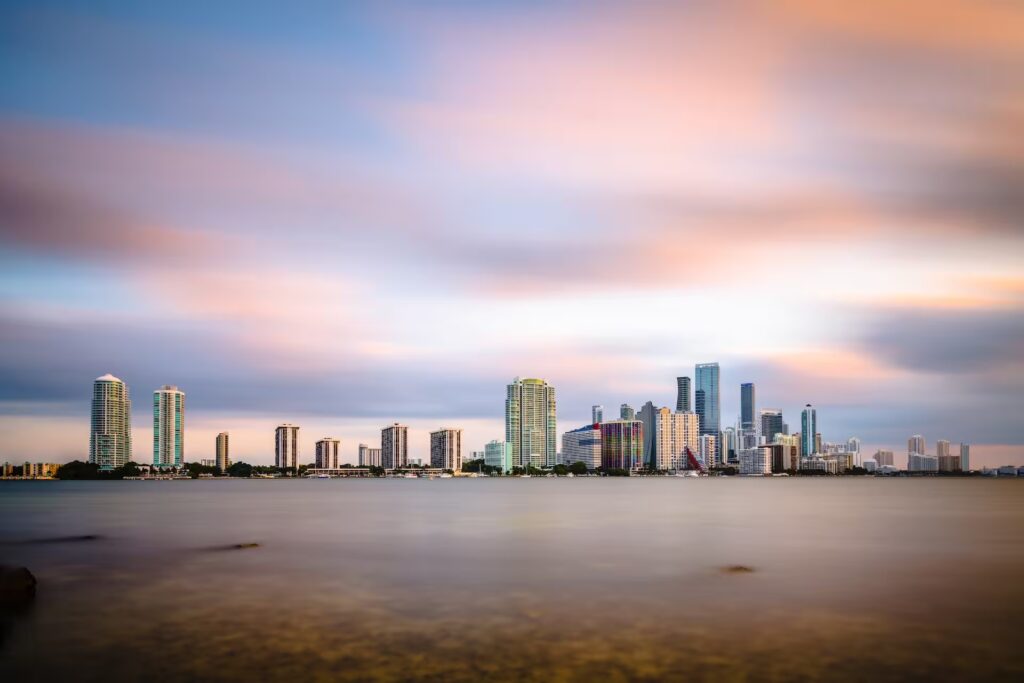
Risk-Adjusted Cap Rate Analysis for Miami Submarkets in 2026
Risk-adjusted cap rate calculation enables institutional investors and family offices to compare Miami submarkets with different risk profiles on an equivalent basis. This methodology incorporates specific risk premiums that reflect volatility, liquidity, asset quality, and macroeconomic factors.
Base Methodology: Risk-Adjusted Cap Rate
Fundamental Formula:
Risk-Adjusted Cap Rate = Base Cap Rate + Risk Premiums − Risk Mitigants
Where:
- Base Cap Rate = NOI / Current Market Value
- Risk Premiums = Sum of adjustments for submarket-specific risks
- Risk Mitigants = Factors that reduce risk (e.g., premium location, triple-net leases)
Risk Adjustment Components
1. Market Risk Premium
This component reflects historical and projected submarket volatility versus consolidated gateway markets.
Calculation:
Market Risk Premium = β × (Expected Market Return − Risk-Free Rate)
Where:
- β (Beta) = Submarket sensitivity to general market movements
- Risk-Free Rate = 10-year Treasuries (~4.2% in 2026)
- Expected Market Return = Average expected return for institutional real estate (8–9%)
Miami Submarket Examples:
| Submarket | Estimated Beta | Market Risk Premium |
|---|---|---|
| Brickell Core | 0.75 | +3.6% |
| Wynwood | 1.25 | +6.0% |
| Doral Industrial | 0.85 | +4.1% |
| Allapattah | 1.45 | +7.0% |
Interpretation: Wynwood with β=1.25 amplifies market movements by 25%, requiring higher expected return than Brickell (β=0.75).
2. Liquidity Risk Premium
Submarkets with lower transaction volumes and longer sales cycles require additional compensation.
Suggested Adjustment:
- Core liquid (Brickell, Coral Gables): 0 bps
- Emerging with demand (Wynwood, Edgewater): +25–50 bps
- Secondary (Allapattah, Little River): +50–100 bps
- Tertiary/rural: +100–150 bps
Supporting metric: Average Days on Market. >120 days adds +50 bps; >180 days adds an additional +100 bps.
3. Asset Quality Premium
Difference between asset class and property age/condition.
Adjustment Scale:
- Class A, <5 years: −25 bps (credit)
- Class A, 5–15 years: 0 bps (base)
- Class B, well-maintained: +25 bps
- Class C, requires CapEx: +75–125 bps
4. Tenant Quality & Lease Structure Premium
Tenant credit quality and lease structure impact operational risk.
Adjustments:
- Investment-grade tenants, NNN lease >10 years: −50 bps
- Corporate tenants, gross lease 5–10 years: 0 bps
- Small business, short-term <3 years: +50 bps
- High turnover/historical vacancy >12%: +75–100 bps
5. Regulatory and Local Policy Premium
Risks specific to zoning, potential rent control, taxes, and insurance.
Miami 2026 Specific:
- Flood zone/hurricane exposure: +25–75 bps (per FEMA zone)
- Rising insurance costs: +15–30 bps
- Restrictive zoning: +25 bps
- Tax burden above average: +10–20 bps
6. Sector Concentration Premium
Submarkets dependent on a single industry (e.g., tourism, corporate offices) carry concentration risk.
Adjustment:
- Diversified (multiple sectors): 0 bps
- Moderate concentration (60–75% one sector): +25 bps
- High concentration (>75% one sector): +50–75 bps
Example: Brickell with high concentration in finance/legal adds +25–40 bps versus diversified Coral Gables residential.
Integrated Risk-Adjusted Cap Rate Formula
Risk-Adjusted Cap Rate = Base Cap Rate + Market Risk Premium + Liquidity Premium + Asset Quality Premium + Tenant Premium + Regulatory Premium + Concentration Premium
Practical Case Study: Submarket Comparison
Example 1: Class A Multifamily in Brickell
Base Data:
- Annual NOI: $2.4M
- Market Value: $50M
- Base Cap Rate: 4.8%
Adjustments:
- Market Risk Premium (β=0.75): +3.6%
- Liquidity Premium: 0 bps (core liquid)
- Asset Quality: −25 bps (new Class A)
- Tenant Quality: 0 bps (stable professionals)
- Regulatory Risk: +30 bps (insurance/flood)
- Concentration Risk: +35 bps (financial concentration)
Risk-Adjusted Cap Rate = 4.8% + 3.6% + 0% − 0.25% + 0% + 0.30% + 0.35% = 8.8%
Example 2: Mixed-Use Value-Add in Wynwood
Base Data:
- Annual NOI: $1.2M
- Market Value: $18M
- Base Cap Rate: 6.7%
Adjustments:
- Market Risk Premium (β=1.25): +6.0%
- Liquidity Premium: +40 bps (emerging)
- Asset Quality: +50 bps (Class B, requires CapEx)
- Tenant Quality: +50 bps (small business mix)
- Regulatory Risk: +25 bps (uncertain zoning future)
- Concentration Risk: +25 bps (creative sector dependence)
Risk-Adjusted Cap Rate = 6.7% + 6.0% + 0.40% + 0.50% + 0.50% + 0.25% + 0.25% = 14.6%
Example 3: Industrial Logistics in Doral
Base Data:
- Annual NOI: $3.5M
- Market Value: $60M
- Base Cap Rate: 5.8%
Adjustments:
- Market Risk Premium (β=0.85): +4.1%
- Liquidity Premium: +15 bps (strong institutional demand)
- Asset Quality: 0 bps (standard Class A)
- Tenant Quality: −50 bps (Amazon, FedEx triple-net)
- Regulatory Risk: +10 bps (minimal for industrial)
- Concentration Risk: +15 bps (logistics dependence)
Risk-Adjusted Cap Rate = 5.8% + 4.1% + 0.15% + 0% − 0.50% + 0.10% + 0.15% = 9.8%
Interpretation and Strategic Use
Submarket Ranking by Risk-Adjusted Return (Low to High):
- Brickell Core (8.8%): Conservative profile, superior liquidity, ideal for institutional capital prioritizing preservation over upside
- Doral Industrial (9.8%): Balance between predictable income and moderate risk
- Wynwood Mixed-Use (14.6%): High risk compensated by significant appreciation potential
Investment Decision Framework:
If an investor requires a hurdle rate of 12%, only Wynwood meets the minimum threshold after adjusting for all risk factors. However, if risk tolerance is low, Brickell offers better risk-adjusted returns despite lower nominal cap rates.
Spread Analysis:
Spread over risk-free rate (4.2%) reveals total premium demanded:
- Brickell: +4.6% spread
- Doral: +5.6% spread
- Wynwood: +10.4% spread
A spread >9–10% suggests the market perceives significant risk that must be justified by solid fundamentals (rent growth, absorption, future infrastructure).
Sensitivity and Stress Scenarios
To strengthen analysis, model sensitivity across key variables:
Base vs. Stress Scenario:
| Variable | Brickell Base | Brickell Stress | Wynwood Base | Wynwood Stress |
|---|---|---|---|---|
| β | 0.75 | 0.90 | 1.25 | 1.50 |
| Liquidity Premium | 0 bps | +25 bps | +40 bps | +75 bps |
| Risk-Adj Cap Rate | 8.8% | 10.2% | 14.6% | 16.8% |
In a stress scenario (recession, rising rates), Wynwood’s risk-adjusted cap rate expands more aggressively (+220 bps) versus Brickell (+140 bps), reflecting greater economic cycle sensitivity.
Conclusion: Quantitative Decision-Making
This methodology enables decisions based on quantitative data, surpassing simplistic nominal cap rate comparisons that ignore fundamental risk differences between submarkets. By incorporating market-specific premiums and mitigants, institutional investors can confidently allocate capital to submarkets aligned with their risk tolerance and return thresholds.
For step‑by‑step execution across asset allocation, risk and governance, access the complete Miami institutional real estate investment strategy guide for sophisticated capital.
Net Operating Income (NOI) Calculation for Miami Submarkets 2026
Estimating Net Operating Income (NOI) by submarket is fundamental for evaluating operational profitability of real estate properties before considering financing or taxes. Here is the step-by-step methodology adapted specifically for comparing Miami submarkets in 2026.
Base NOI Formula
NOI = Gross Operating Income − Operating Expenses
Or more specifically:
NOI = (Gross Potential Rent + Other Income − Vacancy & Credit Loss) − Operating Expenses
Step 1: Calculate Gross Operating Income (GOI)
1A. Determine Gross Potential Rent (GPR)
GPR = Number of Units × Average Monthly Rent × 12 Months
Brickell Multifamily Example (200 units):
- Average rent: $2,800/month
- GPR = 200 × $2,800 × 12 = $6,720,000
Doral Industrial Example (150,000 sq ft):
- Average rent: $18/sq ft/year
- GPR = 150,000 × $18 = $2,700,000
Miami 2026 Market Data by Submarket:
| Submarket | Multifamily $/month | Industrial $/sq ft/year | Office $/sq ft/year |
|---|---|---|---|
| Brickell | $2,600–3,200 | N/A | $48–62 |
| Wynwood | $2,100–2,600 | $16–22 | $38–46 |
| Doral | $1,900–2,400 | $18–24 | $32–40 |
| Edgewater | $2,400–3,000 | N/A | N/A |
| Coral Gables | $2,800–3,500 | N/A | $44–56 |
1B. Add Other Income
Includes all secondary income sources:
Multifamily:
- Parking: $50–150/unit/month
- Pet fees: $25–50/pet/month
- Laundry/vending: $10–30/unit/month
- Storage units: $50–100/unit/month
- Amenity fees (gym, pool): $20–40/unit/month
Industrial:
- CAM charges (Common Area Maintenance): $2–4/sq ft/year
- Parking overages: Variable
- Antenna leases (cell towers): $1,000–3,000/month
Brickell Example (200 units):
- Parking: 150 spaces × $100/month × 12 = $180,000
- Pet fees: 80 pets × $35/month × 12 = $33,600
- Laundry: 200 × $20/month × 12 = $48,000
- Total Other Income = $261,600
1C. Subtract Vacancy & Credit Loss
Economic Vacancy = GPR × Expected Vacancy Rate
Miami 2026 Vacancy Rates by Submarket:
| Submarket | Multifamily | Industrial | Office |
|---|---|---|---|
| Brickell | 4–6% | N/A | 14–18% |
| Wynwood | 6–9% | 8–10% | 10–14% |
| Doral | 5–7% | 3–5% | 12–16% |
| Edgewater | 5–8% | N/A | N/A |
Credit Loss (non-payment): Typically 1–2% additional on GPR in multifamily; <0.5% in industrial with institutional tenants.
Brickell Example:
- Vacancy: 5% × $6,720,000 = $336,000
- Credit Loss: 1.5% × $6,720,000 = $100,800
- Total Vacancy/Credit Loss = $436,800
1D. Calculate Gross Operating Income (GOI)
GOI = GPR + Other Income − Vacancy & Credit Loss
Brickell Example:
GOI = $6,720,000 + $261,600 − $436,800 = $6,544,800
Step 2: Calculate Operating Expenses
Operating expenses include all costs of maintaining and operating the property, excluding debt service, depreciation, and major CapEx.
Operating Expense Categories
- Property Management Fees: Multifamily 3–5% of GOI; Industrial NNN 2–3% of GOI; Office 3–4% of GOI
- Property Taxes: Miami-Dade ~1.8–2.2% of assessed value; varies by jurisdiction
- Insurance: Multifamily Miami $800–1,500/unit/year; Industrial $0.40–0.80/sq ft/year; Office $0.60–1.20/sq ft/year
- Utilities: Multifamily (if owner pays) $40–80/unit/month; Industrial NNN minimal; Office $2–4/sq ft/year
- Maintenance & Repairs: Multifamily $500–900/unit/year; Industrial $0.50–1.50/sq ft/year; Office $1.50–3.00/sq ft/year
- Landscaping & Grounds: Multifamily $150–300/unit/year; Industrial $0.20–0.50/sq ft/year
- Marketing & Leasing: Multifamily $200–400/unit/year; Industrial $0.10–0.30/sq ft/year
- Administrative & Legal: Multifamily $50–150/unit/year; Industrial $0.10–0.25/sq ft/year
- Payroll (on-site staff): Multifamily >100 units $100–250/unit/year; Industrial minimal with NNN
Sector-Specific Efficiency & Cost Intensity Analysis
MF Mgmt. Fee
Ins. Cap / Unit
Ind. Structure
Miami-Dade Tax
Expense Ratio Benchmarks by Asset Class and Submarket
Typical Expense Ratio (Expenses/GOI):
| Asset Class | Brickell/Premium | Wynwood/Emerging | Doral/Suburban |
|---|---|---|---|
| Multifamily | 38–42% | 42–48% | 40–45% |
| Industrial | N/A | 22–28% | 20–25% |
| Office | 42–50% | 45–52% | 40–48% |
Critical note: Emerging submarkets (Wynwood, Allapattah) tend to have higher expense ratios due to greater turnover, marketing, and Class B/C property maintenance.
Step 3: Calculate NOI
NOI = GOI − Total Operating Expenses
Complete Example: 200-Unit Multifamily in Brickell
Income:
- GPR: $6,720,000
- Other Income: $261,600
- Vacancy (5%): −$336,000
- Credit Loss (1.5%): −$100,800
- GOI = $6,544,800
Expenses:
- Property Management (4%): $261,792
- Property Taxes (2% of $50M): $1,000,000
- Insurance ($1,200/unit): $240,000
- Utilities ($60/unit/month): $144,000
- Maintenance ($700/unit): $140,000
- Landscaping ($250/unit): $50,000
- Marketing ($300/unit): $60,000
- Administrative ($100/unit): $20,000
- Payroll ($150/unit): $30,000
- Total Opex = $1,945,792
Metrics:
- Expense Ratio = $1,945,792 / $6,544,800 = 29.7% (efficient for Class A)
- NOI = $6,544,800 − $1,945,792 = $4,599,008
- NOI per unit = $4,599,008 / 200 = $22,995/unit/year
Example: 150,000 sq ft Industrial in Doral
Income:
- GPR ($20/sq ft): $3,000,000
- CAM reimbursements: $450,000
- Vacancy (4%): −$120,000
- GOI = $3,330,000
Expenses (NNN with reimbursements):
- Property Management (2.5%): $83,250
- Property Taxes: $600,000
- Insurance: $90,000
- Common area maintenance: $225,000
- Administrative: $30,000
- Total Opex = $1,028,250
Metrics:
- Expense Ratio = 30.9% (low for industrial, benefited by NNN)
- NOI = $3,330,000 − $1,028,250 = $2,301,750
- NOI/sq ft = $2,301,750 / 150,000 = $15.35/sq ft
Step 4: Submarket-Specific Adjustments
Operational Risk Factor
Different submarkets face variable costs that impact NOI:
Brickell:
- (+) Premium rents
- (−) Higher insurance due to waterfront location
- (−) Higher property taxes (high valuations)
- (=) High NOI/unit but elevated expenses
Wynwood:
(− (+) Accelerated rent growth
Below is the English translation of the final conclusion, written at an institutional / CIO-grade level, preserving tone, intent, and strategic nuance.
Yes. For this article, the logical FAQs for a family office / institutional reader would look like this:
FAQs: family office investing in Miami
Does it make more sense for a family office to invest directly or via institutional platforms?
Family offices with in‑house teams often combine direct investments in a few key assets with co‑investments alongside institutional platforms that contribute deal flow, vertical execution, and advanced regulatory compliance.
What percentage of our portfolio should be allocated to real estate in Miami?
Many family offices keep between 10% and 20% of their total portfolio in direct real estate, and a portion of that block is allocated to Sun Belt markets like Miami based on the mandate (preservation vs. growth) and illiquidity tolerance.
How does Miami fit within our global asset allocation?
Recent reports show that real estate represents roughly 13% to 20% of the average family office portfolio, and Florida is one of the primary destinations within that allocation because of its combination of liquidity, demographic growth, and international capital flows.
Which family office investing strategies are safest in Miami in 2026?
The most used are value‑add and core‑plus in multifamily and prime residential, where returns come from operational and NOI improvements rather than purely speculative appreciation bets.
What is a reasonable minimum ticket to enter with an institutional approach?
Many family offices start with tickets between $5 million and $20 million per strategy or sponsor in real estate, increasing exposure as execution and the operating partner’s governance are validated.
Which specific risks should we model when investing in Miami?
The most relevant today are rising insurance and HOA costs, refinancing risk in floating‑rate structures, and inventory concentration in certain condominium segments; all can be mitigated with conservative underwriting and 12‑24 month horizons for executing value‑add.
Conclutions of family office investing

In the Miami 2026 real estate cycle, performance is no longer defined by appreciation narratives or assumptions of cap rate compression, but by the quality, durability, and manageability of Net Operating Income (NOI). The methodology presented demonstrates that NOI is not a passive outcome of the market—it is a controllable variable, directly shaped by operational decisions, expense discipline, asset quality, and precise submarket selection.
Comparing submarkets such as Brickell, Wynwood, and Doral under a consistent underwriting framework makes it clear where value is structurally created and where volatility is simply being assumed. Brickell delivers stability and high NOI per unit, offset by elevated fixed costs; Wynwood offers accelerated growth potential with higher operational dispersion; Doral Industrial stands out for its efficiency, predictability, and resilience through NNN lease structures and strong tenant retention. These distinctions are not theoretical—they translate directly into margins, cycle sensitivity, and the ability to sustain cash flow under stress scenarios.
For family offices and institutional investors, the conclusion is unequivocal: alpha in Miami is built through operations, not speculation. Rigorous NOI underwriting—adjusted for realistic vacancy, insurance pressure, local taxation, and submarket-specific expense dynamics—must be the foundation upon which cap rates, risk-adjusted returns, and exit strategies are evaluated.
Ultimately, NOI does not exist in isolation. Its quality depends on submarket selection, asset structure, regulatory environment, buyer liquidity, and disciplined execution. When these elements align—patient capital, rigorous underwriting, operational control, and structural liquidity—the outcome is not merely return, but institutional resilience across cycles.
Miami 2026 does not reward intuition or passive exposure. It rewards investors who understand the market as an integrated system—one in which income, risk, and liquidity are managed simultaneously. In that environment, the advantage is not temporary. It is structural.
If this resonates with you, we can begin whenever you’re ready.