


Capital rarely fails because of a lack of options. It fails because of poor selection discipline. When family offices search for the best real estate funds for family offices, the question is not simply which manager has the most attractive projected return. The real question is which vehicle can preserve capital, withstand scrutiny, align with multigenerational mandates, and execute with repeatable precision. The best real estate funds for family offices are not just about returns — they are about preserving wealth across generations with controlled risk.
That distinction matters. Many funds present polished decks, broad market narratives, and optimistic underwriting. Far fewer offer a structure that survives institutional due diligence across legal architecture, operational control, tax efficiency, reporting standards, and downside planning. For family offices, especially those allocating across borders, real estate is not just an asset class. It is a repository of legacy capital, and it must be treated accordingly.
Contents
What makes the best real estate funds for family offices
The best funds tend to share one characteristic before any discussion of returns begins: control. Not marketing control, but actual control over sourcing, underwriting, execution, reporting, and exit. A family office should be wary of managers who outsource too much of the value chain and then present the result as institutional certainty.

In practice, fund quality is shaped by how many critical variables the manager can truly command. A disciplined real estate operator controls acquisition standards, renovation timelines, legal documentation, cost oversight, disposition strategy, and investor reporting. The more fragmented the process, the more room there is for slippage between the original underwriting memo and the realized outcome. Family office allocators often consult research from Urban Land Institute when benchmarking private real estate fund performance.
This is why smaller but highly specialized private funds can be compelling. Size alone is not a sign of superiority. A very large vehicle may face deployment pressure, style drift, and a tendency to pursue volume over selectivity. For family offices, selective access often matters more than scale. Restricted deal flow, off-market sourcing, and special situations can produce stronger risk-adjusted outcomes than broad-based asset accumulation. When evaluating the best real estate funds for family offices, fee structures and alignment of interest are often more decisive than projected IRR.
Fund selection is about mandate fit, not headline yield
There is no universal answer to the best real estate funds for family offices because family offices do not all solve for the same objective. Some prioritize current income and lower volatility. Others seek capital appreciation through shorter-duration repositioning strategies. Some need US dollar exposure with tax-efficient structures. Others want downside resilience above all else.
A fund can be excellent and still be wrong for a particular family office. A core stabilized income fund may suit a preservation-oriented mandate but feel too slow for an office targeting compounded private market returns. A development fund may offer meaningful upside but exceed the risk tolerance of a principal focused on wealth transfer and liquidity discipline.
The selection process should begin with internal clarity. Is the mandate defensive, opportunistic, or barbell? Is the family office allocating for annual distributions, NAV growth, inflation hedging, estate planning, or geographic diversification? Until those priorities are explicit, manager selection tends to drift toward branding rather than substance.
The four filters sophisticated allocators use
The first filter is strategy purity. A fund should do one thing exceptionally well. When a manager claims expertise across development, distressed debt, multifamily operations, hospitality repositioning, industrial logistics, and land banking, caution is warranted. Institutional capital favors managers with a narrow edge, not a wide vocabulary. The best real estate funds for family offices typically combine preferred return structures with co-investment rights that protect principal capital.
The second filter is governance. Family offices should study fund documents, side letter flexibility, valuation policy, audit standards, cash controls, and reporting cadence. Governance is where premium managers separate themselves. Elegant strategy without disciplined oversight is simply concentrated risk wearing a tailored suit.
The third filter is alignment. The general partner’s economics should be tied to realized performance, not merely asset gathering. Meaningful GP co-investment matters. So does a fee structure that rewards execution rather than duration for its own sake. A long hold period can be strategic, but it can also mask underperformance.
The fourth filter is jurisdictional and tax intelligence. For US and international family offices alike, structure matters almost as much as asset quality. A parallel fund, offshore vehicle, blocker structure, or cross-border tax planning framework may materially affect net outcomes. Sophisticated investors do not evaluate gross return in isolation. They evaluate what remains after tax leakage, legal friction, and repatriation complexity.
Why niche private funds often outperform broad platforms
Large diversified real estate platforms can offer familiarity, but familiarity is not always an advantage. Broad platforms often operate with committee layers that slow decision-making, increase competition for internal capital, and dilute local specialization. They can still be appropriate for certain mandates, particularly where brand recognition and institutional scale are primary objectives. But they are not automatically the superior choice. Identifying the best real estate funds for family offices requires understanding how each vehicle handles capital calls, distributions, and exit timelines.
Niche private funds often have a sharper operating edge. In sectors like prime residential value-add, distressed acquisitions, or off-market repositioning, speed and local intelligence are decisive. The best opportunities rarely remain available long enough for a slow-moving platform to process them. They are won by managers with direct market access, disciplined underwriting, and authority to act.
This is particularly relevant in dislocated or supply-constrained submarkets. In Florida, for example, a manager with deep local sourcing relationships and operational oversight can identify mispriced or distressed residential assets before they become broadly shopped. That is not a theoretical advantage. It is often the entire source of the return premium. When comparing options, the best real estate funds for family offices consistently demonstrate disciplined underwriting and transparent reporting.

ARCSA Capital Works Directly With Family Offices
Qualified families can review our partnership terms, information rights, structuring options and completed-asset results before committing.
Request InformationRed flags family offices should not ignore
A polished presentation can conceal structural weakness. One common red flag is dependence on brokered deal flow. If the manager cannot consistently source outside the open market, the probability of acquiring at full pricing rises. Another warning sign is vague language around downside planning. Sophisticated managers can articulate exactly what happens when costs rise, exits slow, or leverage terms tighten.
A second concern is reporting opacity. Family offices should expect precise capital account visibility, asset-level updates, distribution detail, and independent oversight. If reporting is infrequent, overly simplified, or curated more for marketing than transparency, the allocator is being asked to tolerate avoidable blindness.
A third issue is strategy drift. A manager who began in one niche but now raises capital on a much broader thesis may be responding to fundraising incentives rather than operating competence. Drift usually appears before underperformance does.
How to compare funds without reducing the process to a spreadsheet
Quantitative review matters, but spreadsheets are not sufficient. IRR, equity multiple, loss ratio, hold period, leverage level, and fee load all deserve close analysis. Yet family offices know that historical performance without context is an incomplete signal.
The more important question is whether the track record came from a repeatable system. Was performance driven by one favorable market cycle, or by a process that can operate through varying conditions? Did the manager generate returns through asset selection, operational execution, balance sheet discipline, or multiple expansion? Which of those drivers remains under the manager’s control today?
This is where manager interviews matter. The best allocators press beyond performance tables and ask how decisions are made, who has veto authority, what exceptions have been made to underwriting standards, and where prior mistakes originated. High-quality managers answer with precision. They do not rely on charisma to bridge analytical gaps.
The role of liquidity, duration, and reinvestment velocity
Family offices often say they can tolerate illiquidity, but that statement deserves refinement. Most can tolerate planned illiquidity, not indefinite duration risk. There is a difference. A 7-to-10-year blind-pool commitment may suit some mandates, especially where estate planning and long-term appreciation are central. Others prefer shorter-duration funds with accelerated realization cycles and more frequent capital recycling.
Reinvestment velocity is often underappreciated. A strategy capable of executing, monetizing, and redeploying capital multiple times within a year can materially alter compounding potential, provided the manager maintains discipline and does not compromise standards for speed. Faster cycles are not inherently superior, but when supported by sourcing access and operational control, they can create a powerful efficiency advantage.
That is one reason some family offices favor tightly managed value-add or special situations funds over passive long-hold vehicles. They are not merely buying real estate exposure. They are buying an execution engine.
What sophisticated family offices tend to prefer
In the current environment, many sophisticated allocators are gravitating toward funds that combine hard-asset exposure with institutional governance and targeted specialization. They want real estate strategies that are understandable, auditable, tax-aware, and insulated from retail-style volatility. They also want managers who can explain exactly where the edge comes from.
That usually leads them toward private funds with clear asset focus, defensive entry basis, operator-led execution, and legal structures designed for cross-border capital. For many, the appeal is not only return potential. It is the combination of capital protection, reporting discipline, and structural order.
A firm such as Arcsa Capital is positioned within that logic: highly selective deal flow, prime residential value-add specialization, regulated fund architecture, and a framework built for accredited and institutional investors who expect more than access. They expect control. Ultimately, the best real estate funds for family offices are those that match the family’s liquidity needs, tax profile, and governance standards.
The best real estate fund is rarely the one that sounds largest, loudest, or most fashionable. It is the one that fits the family office mandate with enough precision that capital can remain both productive and protected. In private markets, that level of fit is not marketing. It is architecture.
Family Offices: 6 Points at a Glance
Family offices select real estate managers on different criteria than institutions do. Six factors decide the fit, and each is verifiable before capital moves.
- Duration match. Whether the fund term fits the family’s liquidity plan rather than the sponsor’s fundraising cycle.
- Governance access. Whether family offices receive information rights and, in larger commitments, committee observation.
- Fee transparency. A promote calculated net of fees and expenses, with a funded clawback.
- Structural fit. A vehicle compatible with the family’s tax residence and succession planning.
- Reporting cadence. Asset-level reporting on a timetable that supports the family’s own filings.
- Relationship depth. Direct access to the operating team, not only to investor relations.
Institutions optimise for process. Family offices optimise for control, discretion and continuity, which is why the same fund can be an excellent institutional allocation and a poor family one.
What Regulators and Public Filings Reveal About Family Offices
Real estate funds in the United States are offered to accredited and qualified investors under exemptions that require disclosure but not approval. No regulator assesses suitability for a particular investor type.
For family offices that distinction matters more than for institutions, because a family office typically lacks a dedicated diligence team and relies more heavily on documents and on the sponsor’s public record.
Adviser registrations and exempt offering filings published by the U.S. Securities and Exchange Commission allow family offices to verify a sponsor and its offering history before any diligence meeting takes place.

Common Mistakes Investors Make With Family Offices
Five errors appear repeatedly when family offices allocate to private real estate.
- Committing to a ten-year vehicle when the family’s liquidity horizon is materially shorter.
- Accepting a promote calculated on gross proceeds rather than net of fees and expenses.
- Structuring the investment before confirming which family members will hold the interest and where they reside.
- Relying on the relationship with the founder rather than on documented processes that survive a departure.
- Treating the first commitment as a transaction instead of the beginning of a monitoring obligation.
Each is avoidable at the document stage, and each has cost family offices more than any market movement.
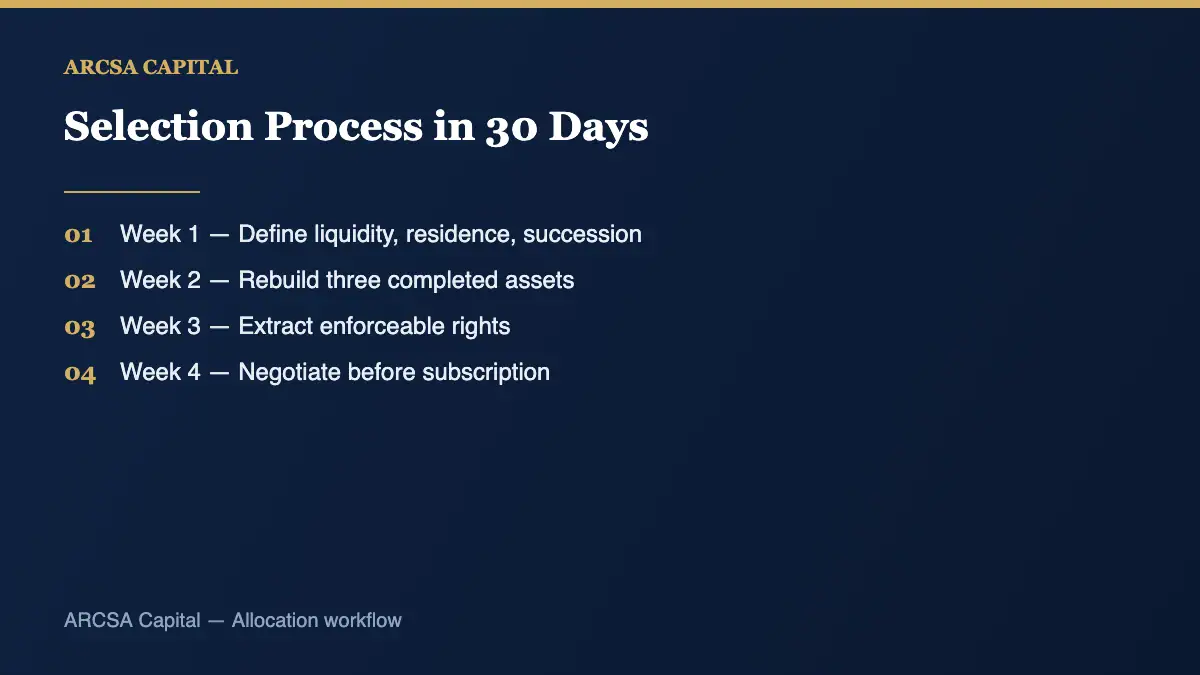
How to Evaluate Family Offices in 30 Days
Week One: Define the Constraints
Document the family’s liquidity horizon, tax residences, succession plan and governance preferences. Every subsequent judgement follows from this.
Week Two: Test the Manager
Rebuild three completed assets using the sponsor’s own inputs and compare projected with realised outcomes.
Week Three: Read for Rights
Extract information rights, transfer provisions, removal thresholds and extension options. These are what family offices can actually enforce.
Week Four: Negotiate and Decide
Raise required amendments in writing before subscription. Side-letter terms are far easier to obtain during a first close.
Frequently Asked Questions About Family Offices
What size commitment gives negotiating leverage?
It varies by fund, but leverage comes as much from timing as from size. Family offices committing during a first close routinely obtain information rights and fee terms unavailable later.
Should a family office prefer funds or direct deals?
Direct deals offer control and concentrate risk; funds distribute exposure under one operating standard. Most family offices use funds for markets where they lack operating presence and direct deals where they do.
How much monitoring is realistic?
A quarterly review of asset-level reporting and an annual re-application of the selection criteria. Family offices that maintain that rhythm build comparable evidence across managers over time.
Key Takeaways on Family Offices
- Duration and liquidity fit matter more to a family than headline return.
- Information rights and structural fit are negotiated before subscription or not at all.
- A relationship with a founder is not a substitute for documented process.
- Family offices benefit most from applying the same criteria to every manager, every year.
Applied consistently, these six criteria give a family office something an institution takes for granted: a repeatable basis for comparing managers. The decision stops depending on who was met most recently and starts depending on documented, comparable evidence.
Building an Allocation Programme Rather Than a Series of Commitments
The most common structural weakness is that each allocation is evaluated in isolation. Family offices that build a simple comparison sheet — fee basis, preferred return, term, extension options, leverage limit, reserve policy, reporting frequency — quickly discover that funds quoting identical target returns differ by several percentage points in net outcome.
That sheet also improves negotiation. An investor able to point to specific terms available elsewhere is in a materially stronger position than one arguing in the abstract, and sponsors have most flexibility during a first close.
Kept over several cycles, the sheet becomes the institutional memory that family offices usually lack. It converts a sequence of individual decisions into an allocation programme, which is precisely the discipline that separates families who compound in private real estate from those who simply participate in it.
The final element is succession. Where an interest will pass to the next generation, the holding structure should be settled at subscription rather than revisited later, because most private vehicles restrict transfers and the remedies after a death are limited.
Request the Family Offices Documentation Pack
Partnership agreement, fee schedule, structuring options and realised results prepared for family review.
Request InformationOr model your own scenario in the investment simulator
Or receive the ARCSA Capital investment thesis by email, with the entry, stabilisation and exit assumptions behind the strategy:
