

A residential asset can appear attractive on a broker’s spreadsheet and still fail an institutional investment committee. The distinction is not cosmetic. It is the difference between buying a property with an expectation of appreciation and acquiring a controlled operating asset with a defined basis, verified scope, legal review, capital plan, and planned exit.
So, what is institutional flipping in real estate? It is the systematic acquisition, rehabilitation, repositioning, and resale of residential properties by professionally managed investment firms using institutional capital, formal governance, disciplined underwriting, and repeatable operating controls. The objective is not simply to renovate and sell quickly. It is to create value through a process that can be measured, audited, and repeated across market cycles.
For accredited investors, family offices, and cross-border capital, this distinction matters. A short holding period alone does not make a strategy institutional. Institutional quality comes from how risk is identified before closing, how execution is controlled after closing, and how capital is protected when the market does not follow the original plan.
Contents
What Institutional Flipping in Real Estate Actually Means
Institutional flipping applies a private equity framework to residential value-add transactions. A manager identifies an asset trading below its recoverable value because of distress, deferred maintenance, estate complexity, tenant vacancy, title issues, poor presentation, or an owner’s need for speed and certainty. The firm then purchases at a basis supported by a conservative underwriting model, improves the asset, and exits through a sale once the repositioning is complete.
The word institutional describes the operating architecture behind the transaction. Rather than relying on a single investor’s judgment or an informal contractor arrangement, the process is governed by acquisition criteria, investment committee approvals, independent diligence, documented budgets, reporting standards, and legal structures designed for sophisticated capital.
This model is particularly relevant in prime residential markets, where a well-executed renovation, corrected property condition, or refined market positioning can materially improve liquidity. Yet prime location does not eliminate risk. It raises the cost of mistakes. A delayed permit, inaccurate comparable sale, unrecorded lien, or overbuilt finish package can impair the economics of an otherwise desirable asset.
How the Institutional Value-Add Cycle Works
The cycle begins before an asset becomes visible to the broad market. Many of the most compelling opportunities originate through proprietary relationships with brokers, attorneys, servicers, owners, estate representatives, and local operators. Off-market sourcing is not inherently superior, but it can reduce auction dynamics and create the conditions for more thoughtful negotiation.
Once identified, the asset enters underwriting. The firm evaluates acquisition price, construction scope, contingency reserves, carrying costs, insurance, taxes, selling costs, timeline, and an exit valuation supported by current market evidence. A disciplined model also tests adverse scenarios: a longer renovation, a softer resale market, a higher-cost scope, or a slower buyer pool.
After approval and closing, value creation becomes an execution question. The manager controls the rehabilitation plan, vendor selection, draw process, quality standards, project cadence, and disposition preparation. This is where many nominally attractive flips lose their margin. A strong acquisition basis can be eroded by unmanaged change orders, weak field supervision, or a renovation misaligned with the buyer profile for that neighborhood.
The final phase is monetization. Unlike a long-duration rental strategy, institutional flipping typically seeks a defined, accelerated exit once the asset has been repositioned and brought to market. In a well-controlled program, short hold periods may permit capital to be redeployed through multiple cycles per year. However, speed is a result of preparation, not a substitute for it. Selling prematurely into a weak market or accepting a poorly structured offer can be as damaging as holding too long.
Why It Differs From a Conventional House Flip
Conventional flipping is often entrepreneur-led and transaction-specific. It may rely heavily on the local operator’s experience, personal capital, and ability to manage a small number of projects directly. That approach can work, but it can also concentrate operational, liquidity, and key-person risk.
Institutional flipping is designed as a portfolio-level strategy. Capital is generally committed through a managed vehicle, investments are evaluated against consistent criteria, and each transaction is integrated into a broader risk framework. Investors are not underwriting paint colors or following individual contractor invoices. They are evaluating the manager’s sourcing advantage, governance, legal architecture, operating controls, and discipline across a pipeline of opportunities.
The difference also appears in documentation. An institutional platform typically maintains formal acquisition files, title and insurance review, environmental and property-condition diligence where appropriate, budget controls, entity-level governance, financial reporting, and compliance oversight. For international investors, this level of structure can be especially valuable because physical distance makes informal management less acceptable.

See How ARCSA Capital Applies Institutional Flipping
Qualified investors can review our sourcing pipeline, underwriting model and committee process for value-add residential assets in South Florida.
Request InformationThe Sources of Return and the Limits of the Strategy
The economic thesis rests on basis discipline and execution. Value may be created by acquiring below replacement cost or below stabilized market value, correcting physical deficiencies, improving design and presentation, resolving a special situation, and marketing the completed asset to a broader and more qualified buyer pool.
But institutional flipping is not a risk-free formula. Sale prices can move. Renovation costs can rise. Permitting can delay timelines. Financing conditions can narrow buyer demand. A market with strong long-term demographics can still experience short-term liquidity pressure.
For this reason, sophisticated managers focus less on optimistic projections and more on margin of safety. They seek conservative acquisition assumptions, meaningful contingency reserves, short and controllable construction scopes, and exits supported by verifiable comparable sales rather than aspirational listing prices. The central question is not whether a property can be made more attractive. It is whether the expected value creation justifies the operational and market risk required to achieve it.
Governance Is the Real Institutional Edge
The strongest institutional advantage is often invisible in the finished home. It sits in the governance layer: who approves the investment, who can authorize a budget increase, how conflicts are managed, what reporting is produced, and how investor capital is segregated and monitored.
A credible manager should be able to articulate its investment mandate with precision. That includes target asset type, location parameters, leverage policy, maximum project exposure, renovation thresholds, expected hold period, disposition authority, and risk escalation procedures. Ambiguity may sound flexible, but for private capital it often becomes a source of avoidable risk.
For investors allocating from Latin America or other international jurisdictions into Florida real estate, the legal and tax structure deserves equal scrutiny. Vehicle design, investor eligibility, reporting obligations, withholding considerations, and coordination with U.S. and home-country advisers can materially affect the quality of the investment experience. A parallel-fund structure may offer efficiencies for certain investors, but its relevance depends on the investor’s facts, jurisdiction, and advisory framework.
At ARCSA Capital, the premise is that prime residential value-add investing should be managed as institutional private equity: selective sourcing, disciplined underwriting, controlled execution, and traceable governance from acquisition to exit.
Questions an Institutional Investor Should Ask
Before assessing any institutional flipping program, an investor should move beyond projected returns and examine the system behind them.
Where does the deal flow originate?
A manager should distinguish between broadly marketed inventory and proprietary or relationship-driven opportunities. Off-market access is valuable only when it leads to better terms, greater certainty, or less competitive pricing. It should never be used as a vague label for deals that lacked adequate market exposure.
How is downside risk underwritten?
Ask to see how the model handles cost overruns, timeline extensions, lower exit values, and higher carrying costs. The quality of a strategy is often revealed by its downside case, not its base case.
Who controls the execution process?
Clarify whether construction oversight, procurement, budget approval, and sale decisions are internal or outsourced. Outsourcing is not automatically a weakness, but responsibilities, incentives, and accountability must be explicit.
What reporting and compliance standards apply?
Sophisticated capital should expect clear legal documentation, periodic financial reporting, asset-level visibility, and a governance framework appropriate to the vehicle and investor base. Compliance is not administrative decoration. It is part of capital preservation.
Institutional flipping is best understood as a precision strategy, not a renovation trend. When sourcing, underwriting, legal structure, and execution operate as one disciplined system, residential real estate becomes a controlled channel for value creation. The prudent investor’s task is to determine whether that system exists before capital is committed.
Institutional Flipping: 7 Points at a Glance
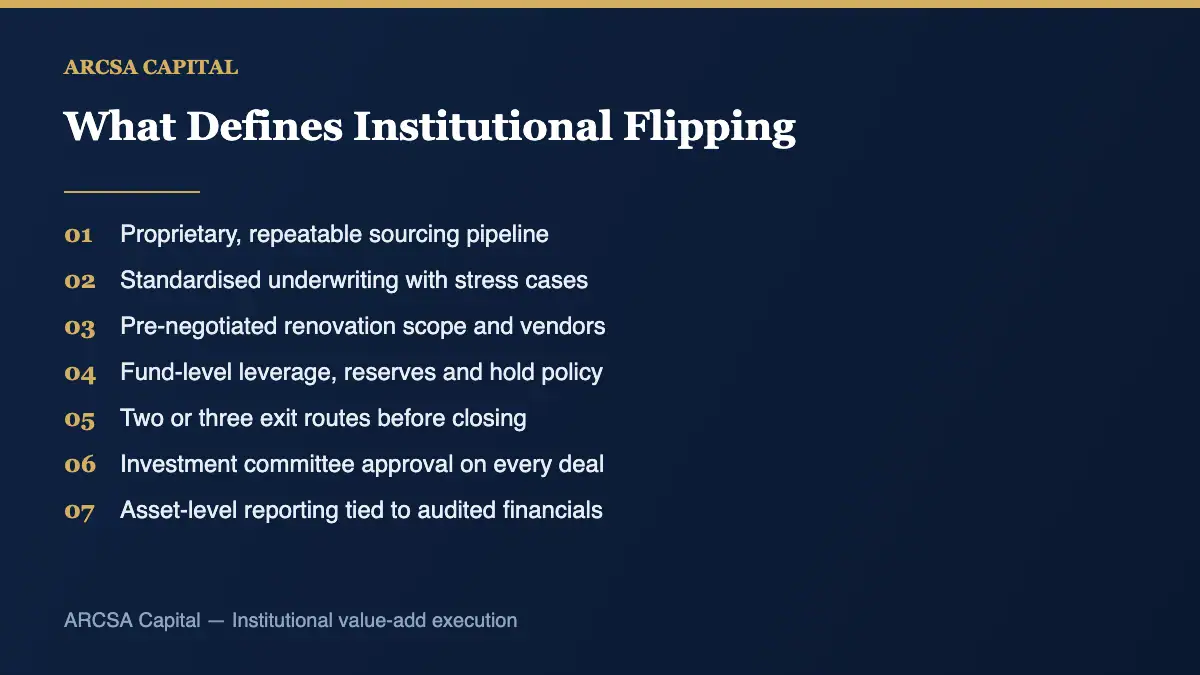
Before committing capital to a value-add vehicle, an allocator should be able to describe institutional flipping in operational terms rather than marketing terms. The seven points below summarise what separates institutional flipping from opportunistic retail activity.
- Repeatable sourcing. Institutional flipping depends on a proprietary pipeline, not on listed inventory or auction luck.
- Standardised underwriting. Every asset is priced against a written model with documented assumptions and stress cases.
- Controlled renovation scope. Budgets, vendors, and timelines are pre-negotiated rather than improvised per property.
- Capital discipline. Leverage, reserves, and hold periods are set at the fund level, not per deal.
- Exit optionality. A second and third exit route exist before acquisition closes.
- Independent oversight. An investment committee approves acquisitions, budget deviations, and dispositions.
- Auditable reporting. Asset-level results reconcile to audited fund financials each period.
Any single point can be met by a competent local operator. Institutional flipping is defined by meeting all seven simultaneously, at scale, and repeatedly.
What Regulators and Public Filings Reveal About Institutional Flipping
Institutional flipping in the United States is executed almost entirely through private fund structures sold to accredited and qualified investors. That means the strategy sits inside a regulated disclosure regime even though the underlying assets are single properties rather than securities.
For an investor, the practical consequence is that the sponsor behind an institutional flipping programme leaves a public paper trail: adviser registrations, Form D filings, and, where applicable, disciplinary history. These sources describe the manager, not the deal, and they are the fastest way to separate an established platform from a first-time syndicator.
Filings and adviser records published by the U.S. Securities and Exchange Commission allow an investor to verify the entity behind an institutional flipping programme before reviewing a single property. Verification outside the sponsor’s own data room is part of the discipline.
Common Mistakes Investors Make With Institutional Flipping
Most disappointing outcomes in institutional flipping are not caused by the real estate. They are caused by structural assumptions that were never tested.
- Treating an institutional flipping fund as a portfolio of independent trades rather than a single operating business.
- Underwriting renovation cost from national averages instead of the sponsor’s own historical variance.
- Ignoring the velocity assumption: institutional flipping returns collapse when holding periods extend by even two months.
- Accepting gross return figures that exclude financing cost, carry, and disposition expense.
- Assuming the exit market is liquid because it was liquid during the fundraising period.
Each of these is testable before commitment. A sponsor running genuine institutional flipping will have the data to answer all five without preparation.
How to Evaluate Institutional Flipping in 30 Days
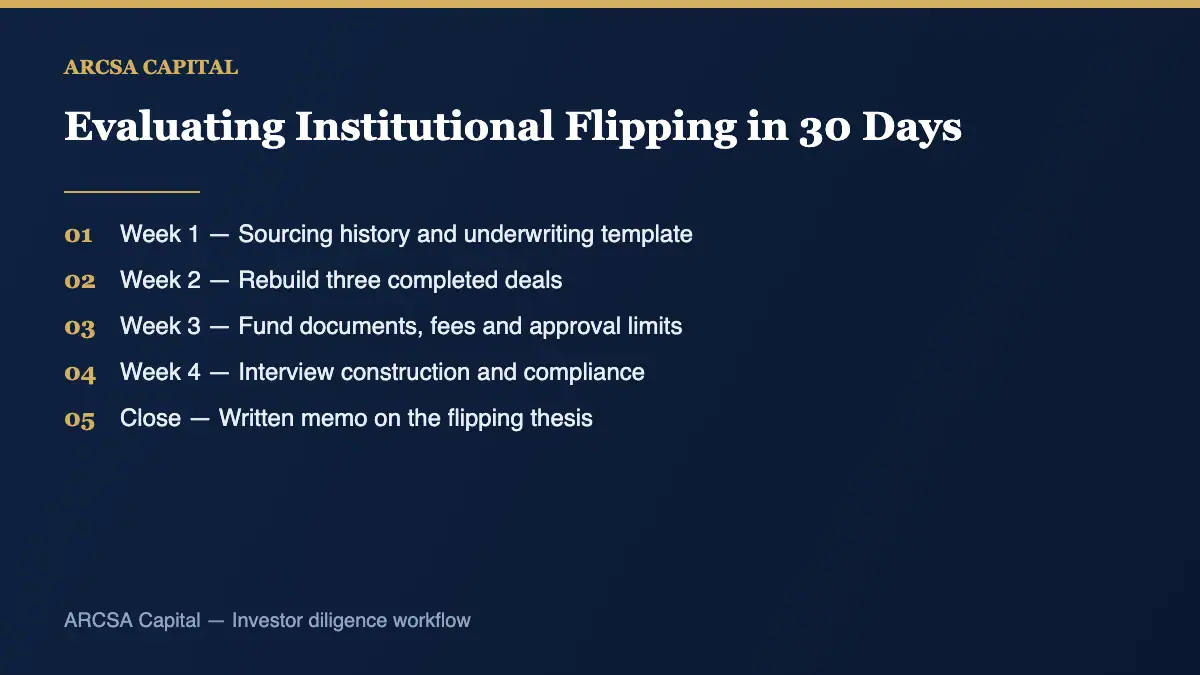
Week One: Understand the Engine
Request the sourcing history, the underwriting template, and the last twenty completed assets. Institutional flipping is a process business, so the process documentation is the product.
Week Two: Test the Assumptions
Rebuild three completed deals from acquisition to exit using the sponsor’s own inputs. Compare projected and realised holding periods, renovation cost, and net proceeds.
Week Three: Verify the Structure
Read the fund documents for approval thresholds, fee stack, leverage limits, and reserve policy. Confirm that institutional flipping decisions require committee approval rather than sponsor discretion alone.
Week Four: Interview and Decide
Speak with the construction lead and the compliance function separately from investor relations. Close with a written memorandum on whether the institutional flipping thesis is supported by evidence.
Where Institutional Flipping Fits in a Portfolio
Allocators rarely treat institutional flipping as a core holding. It behaves as a return-seeking sleeve with a short duration profile, sitting between opportunistic real estate and private credit in most portfolio maps. Capital is committed, deployed quickly, returned, and recycled, which produces a different cash-flow pattern from a ten-year closed-end fund.
That short duration is the main portfolio argument. An institutional flipping programme can return capital within twelve to twenty-four months, which reduces the blind-pool exposure that concerns many family offices. It also means the reinvestment decision arrives frequently, so the quality of the sponsor relationship matters more than in a long-hold strategy.
The counterargument is concentration. Because institutional flipping depends on one operating team executing one process in one or two markets, manager risk is high relative to a diversified core fund. Most institutions size the allocation accordingly and diversify across sponsors rather than across geographies within a single sponsor.
Market Conditions That Favor Institutional Flipping
Institutional flipping performs best when there is a persistent spread between distressed or off-market acquisition pricing and retail resale pricing, and when transaction velocity in the resale market is stable. Both conditions have to hold; a wide spread with slow absorption produces inventory, not profit.
Rising rate environments compress the strategy in two ways at once: financing cost rises while buyer affordability falls. Experienced institutional flipping platforms respond by lowering leverage, shortening scope of work, and widening the acquisition discount required at entry rather than by chasing volume.
Supply-constrained metropolitan markets with strong in-migration remain the most reliable environment for institutional flipping, because absorption stays predictable even when pricing moderates. That is why the strategy concentrates in a small number of U.S. markets rather than being applied nationally.
Frequently Asked Questions About Institutional Flipping
Is institutional flipping the same as house flipping?
No. A conventional flip is a single transaction executed by an individual. Institutional flipping is a fund-level programme with standardised underwriting, committee approval, vendor contracts, and audited reporting across dozens or hundreds of assets.
What return drivers matter most?
Acquisition discount, renovation cost control, and velocity. Institutional flipping compounds through repetition, so a shorter holding period contributes more to annualised return than a higher exit price.
What is the main risk?
Execution drift. When renovation timelines extend or exit markets slow, institutional flipping returns compress quickly because the strategy has little income to absorb a longer hold.
Key Takeaways on Institutional Flipping
- Institutional flipping is an operating platform, not a series of opportunistic trades.
- Velocity and cost control drive returns more than headline purchase discounts.
- Governance and reporting are what make institutional flipping auditable for a fund investor.
- Verify the sponsor through public filings before evaluating any individual property.
Assessed this way, institutional flipping becomes measurable. The investor is no longer buying a story about undervalued property; the investor is underwriting a repeatable process with documented inputs, defined authority, and reported results.
One final note on sizing. Because institutional flipping recycles capital quickly, an investor who commits a fixed amount may find that same amount deployed two or three times within a single fund life. Return expectations should therefore be expressed as an annualised figure on invested capital rather than as a multiple on committed capital, or the strategy will appear either better or worse than it is.
Read alongside the fund documents, the questions in this guide give an investor a defensible basis for a decision. That is the practical purpose of understanding institutional flipping: not to predict the outcome of any single property, but to judge whether the platform executing the strategy can repeat what it has already done.
Request Our Institutional Flipping Track Record
Access completed-asset data, holding periods and realised results before evaluating a commitment.
Request InformationOr model your own scenario in the investment simulator
Or receive the ARCSA Capital investment thesis by email, with the entry, stabilisation and exit assumptions behind the strategy:
