

A residential asset in Florida rarely becomes truly interesting when it hits the open market. By then, pricing has been tested, the broker narrative polished, and the spread for sophisticated capital compressed. The most compelling off market residential deals Florida are transacted privately — between operators with relationships, local knowledge, and the infrastructure to close quickly without contingencies.
For institutional investors and family offices deploying capital into Florida residential, understanding how off market residential deals Florida work is not optional. It is the difference between competing at scale or chasing the same assets as every other buyer with a Bloomberg terminal and a wire transfer. This guide breaks down how ARCSA Capital approaches these opportunities — from sourcing to governance — with the precision that fiduciary capital requires.
Contents
Why off market residential deals Florida matter
Florida’s residential market has absorbed extraordinary capital inflows since 2020. The result is a compression of cap rates and exit spreads in the listed market that makes return targets harder to underwrite at institutional standards. Off market residential deals Florida represent the portion of the market where motivated sellers — estates, developers with overleveraged positions, institutional landlords repositioning — transact before public exposure. According to the Florida Realtors, a significant share of high-value residential transactions in South Florida never appear on MLS.
The structural advantage of off market residential deals Florida is not simply price. It is information asymmetry. When you are the only buyer at the table, you negotiate structure, not just valuation. You can negotiate seller financing, lease-back arrangements, or phased closings that improve your IRR without requiring the asset to be mispriced. The Urban Land Institute consistently documents that off-market transactions in liquid real estate markets produce superior risk-adjusted returns precisely because competitive dynamics are removed. Explore ARCSA’s broader real estate private equity framework for context on how these deals fit within a diversified Florida portfolio.

Sourcing off market residential deals in Florida requires a system
Sourcing off market residential deals Florida is not a function of calling brokers and asking if they have anything off-book. It requires a structured pipeline: direct outreach to estate attorneys and fiduciaries, relationships with developers at the point of capital distress, monitoring of notice of default filings, and consistent engagement with foreclosure and pre-foreclosure inventory before it becomes publicly marketed. The National Association of Realtors data consistently shows that the fastest-moving residential markets — Miami-Dade, Broward, Palm Beach — have the highest concentrations of off-market activity among high-net-worth sellers who prioritize discretion over maximum price discovery.
Consistency in sourcing also requires a track record of closing. Sellers of off market residential deals Florida — whether estates, developers, or institutional holders — do not bring deals to operators they have not vetted. ARCSA Capital’s deal flow in Florida residential comes primarily from counterparties who have seen the firm execute: on time, with clean capital, and without renegotiating at the wire. Review our real estate investment strategy for the acquisition criteria that govern every Florida residential position.

What an Off-Market Residential Program Costs to Maintain
Investors rarely ask this, and it explains more about sponsor behaviour than almost any other question. Maintaining genuine off market residential origination requires people making contact continuously, a database of owners and properties kept current, legal capacity to review title quickly and capital sitting available rather than deployed.
That standing cost has a consequence worth understanding. A sponsor carrying it must transact regularly to justify it, which creates pressure to buy. The managers who handle this well set acquisition criteria in advance and accept slower quarters rather than relaxing them, because an off market residential program that starts buying to stay busy has stopped being an advantage.
For an investor, the useful question is therefore not whether a sponsor has off market access, but what they did during the last quarter when nothing met their criteria. Sponsors who declined to buy and said so plainly are describing a discipline. Sponsors whose acquisition pace never varies regardless of market conditions are describing something else, and the recorded basis on their most recent deals will usually confirm it.
Looking for Genuine Off Market Residential Flow in South Florida?
ARCSA Capital originates through attorneys, lenders and local owners, and closes with committed capital rather than financing contingencies.
Request InformationUnderwriting off market residential deals Florida
Every off market residential deals Florida opportunity that enters ARCSA Capital’s pipeline is underwritten against three independent scenarios: base case, downside, and stress. The base case models current rent dynamics, absorption rates, and exit cap rates using NCREIF benchmarks for comparable Florida residential assets. The downside models a 15% correction in exit values with extended holding periods. The stress case models a full liquidity event — forced sale at trough — and asks whether the capital structure survives without permanent impairment.
What makes off market residential deals Florida particularly interesting from an underwriting perspective is the availability of non-public data. When you are the first buyer at the table, you frequently have access to operating history, tenant files, deferred maintenance schedules, and seller motivations that never appear in a formal offering memorandum. That information advantage is a core driver of the return premium that off-market sourcing produces. ARCSA Capital integrates this data into a proprietary underwriting model calibrated to Florida residential dynamics. See how we structure the real estate investment process end to end.

The legal and governance layer is not optional
Every off market residential deals Florida transaction requires the same legal rigor as a publicly marketed asset — and frequently more. Title searches, lien analysis, HOA covenant review, and environmental clearances must be completed on an accelerated timeline without cutting corners. The Florida Department of Business and Professional Regulation sets the licensing and disclosure requirements that govern residential transactions in the state, and off-market deals do not exempt buyers or sellers from compliance obligations.
For institutional capital, governance matters as much as legal compliance. Every off market residential deals Florida acquisition at ARCSA Capital goes through investment committee review, independent legal counsel, and a formal documentation package before capital is deployed. LP reporting, waterfall mechanics, and exit optionality are defined at the point of acquisition — not when a liquidity event approaches. That structure is what separates disciplined private equity real estate from opportunistic capital that creates legal exposure under pressure. Learn more about the private equity real estate governance model ARCSA applies to every Florida residential position.
📷 Cover photo: free-to-use image. Source: Pexels.com. Available under the Pexels License.
Off Market Residential: 7 Points at a Glance
Every sponsor claims off market access. Very few can describe the machinery that produces it. The seven points below explain how off market residential sourcing actually works in Florida and how an investor can tell a real pipeline from a marketing phrase.
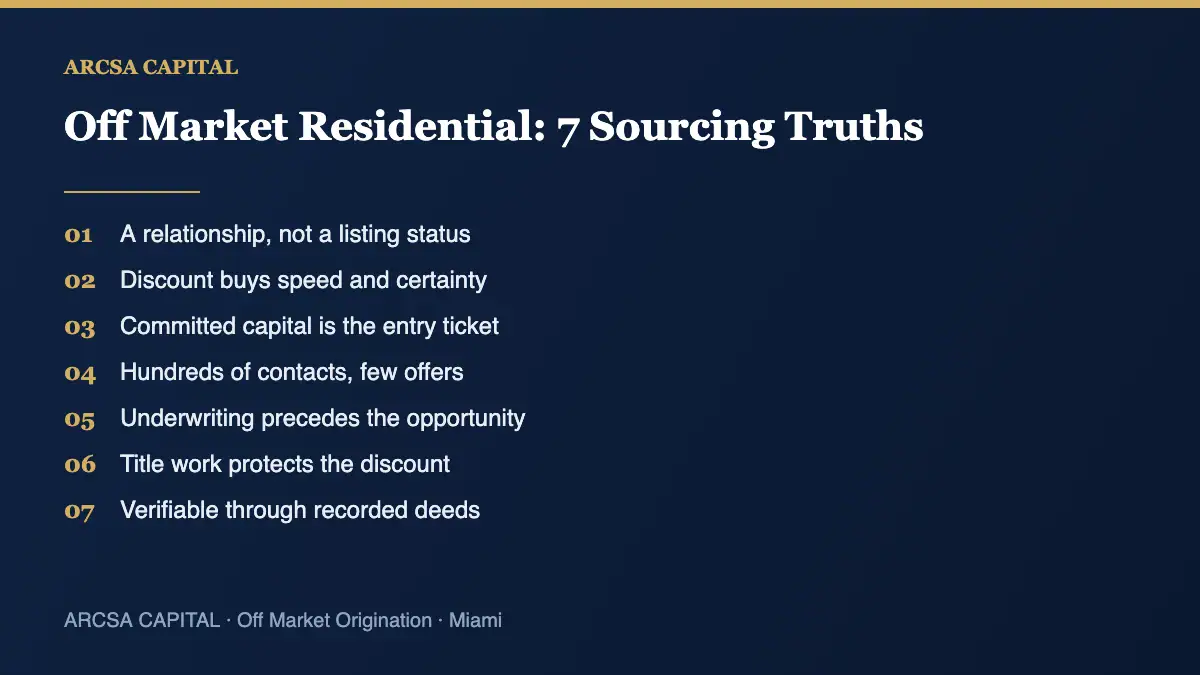
- Off market is a relationship, not a listing status. Genuine off market residential flow comes from probate attorneys, divorce counsel, lenders holding non-performing notes, property managers and small landlords who call one buyer first.
- The discount pays for certainty, not for secrecy. Sellers accept a lower price because the buyer closes fast, pays cash and does not renegotiate after inspection. Remove any of those three and the off market residential discount disappears.
- Committed capital is the entry ticket. A buyer who must raise money for each transaction cannot credibly promise a fourteen day close, which is precisely what the seller is buying.
- Volume of contacts, not volume of offers. Off market residential pipelines are built on hundreds of conversations that go nowhere, and the discipline is in declining almost all of them.
- Underwriting has to precede the opportunity. When a seller wants an answer in forty eight hours, the analysis framework must already exist. Improvised underwriting is how off market discounts turn into off market mistakes.
- Title work is where the discount is lost. Distressed and inherited property carries liens, open permits and heirship issues, so an off market residential purchase without a full title search is not a discount, it is a gamble.
- Verifiable by public record. Any claimed off market residential track record can be confirmed through county deeds and permits, which makes this one of the few sponsor claims an investor can audit directly.
The practical conclusion is that off market residential sourcing is an operating capability rather than a stroke of luck. It requires people, systems and standing capital, and those three things either exist inside a sponsor or they do not.
What Regulators and Public Filings Reveal About Off Market Residential
Florida is unusually favorable for this work because the public record is deep and accessible. Deeds, mortgages, lis pendens filings, probate dockets, code enforcement actions and permit history are all public at county level, which allows a disciplined buyer to identify likely sellers before a property is ever listed.
That accessibility is also what makes the claim auditable. When a sponsor describes an off market residential pipeline, an investor can pull the recorded deeds and confirm both the purchase prices and the dates. A sponsor whose recorded transactions consistently show acquisition below the contemporaneous market has an origination capability; one whose deeds match listing prices bought on market and called it something else.
The same records reveal execution quality. Permit history shows whether renovation work was permitted and inspected, and code enforcement records show whether the work created problems. For off market residential strategies specifically, where properties are often acquired in poor condition, that permit trail is the closest thing to an operational audit available to an outsider.
Property records, permit history and tax assessments for every parcel in the county are published by Miami-Dade County, and reviewing them is the fastest way to verify any off market residential claim a sponsor makes.
The Five Channels That Produce Off-Market Residential Deals
A pipeline is the sum of its channels, and each one behaves differently in volume, quality and predictability. Understanding them is what allows an investor to judge whether a sponsor described a system or an anecdote.
Probate and estate counsel
Heirs settling an estate frequently prefer certainty and speed over maximum price, particularly when several family members must agree and the property sits in another state. Relationships with probate attorneys produce steady off market residential opportunity, though the timeline is dictated by the court rather than by the buyer.
Lenders and note holders
Community banks and private lenders holding non-performing loans often prefer a quiet resolution to a public foreclosure. These conversations produce fewer transactions than probate but usually larger ones, and they reward a buyer who can close without financing.
Direct outreach to owners
Systematic contact with owners identified through public records — long tenure, out-of-state address, code enforcement history, tax delinquency — is the highest volume and lowest conversion channel. It is also the most scalable, and it is where most genuine off market residential programs generate the bulk of their pipeline.
Property managers and small landlords
Managers know which owners are tired before anyone else does. A tired landlord with a vacant unit and a repair bill is the archetypal off market residential seller, and the manager who has fielded those complaints for two years is the person who hears about it first.
Broker relationships before listing
Agents will call a reliable buyer before preparing a listing when they believe the transaction will close quietly and quickly. This is technically off market only briefly, but for a buyer with capital ready it consistently produces the cleanest transactions in the pipeline.
A sponsor drawing from all five channels has a durable off market residential pipeline. A sponsor drawing from one has a relationship, and relationships end. When evaluating an operator, the distribution of sources across their last ten acquisitions tells you more about the next ten than any projection could.
Common Mistakes Investors Make With Off Market Residential
These six errors are what turn a promising off market acquisition into an ordinary or losing transaction.
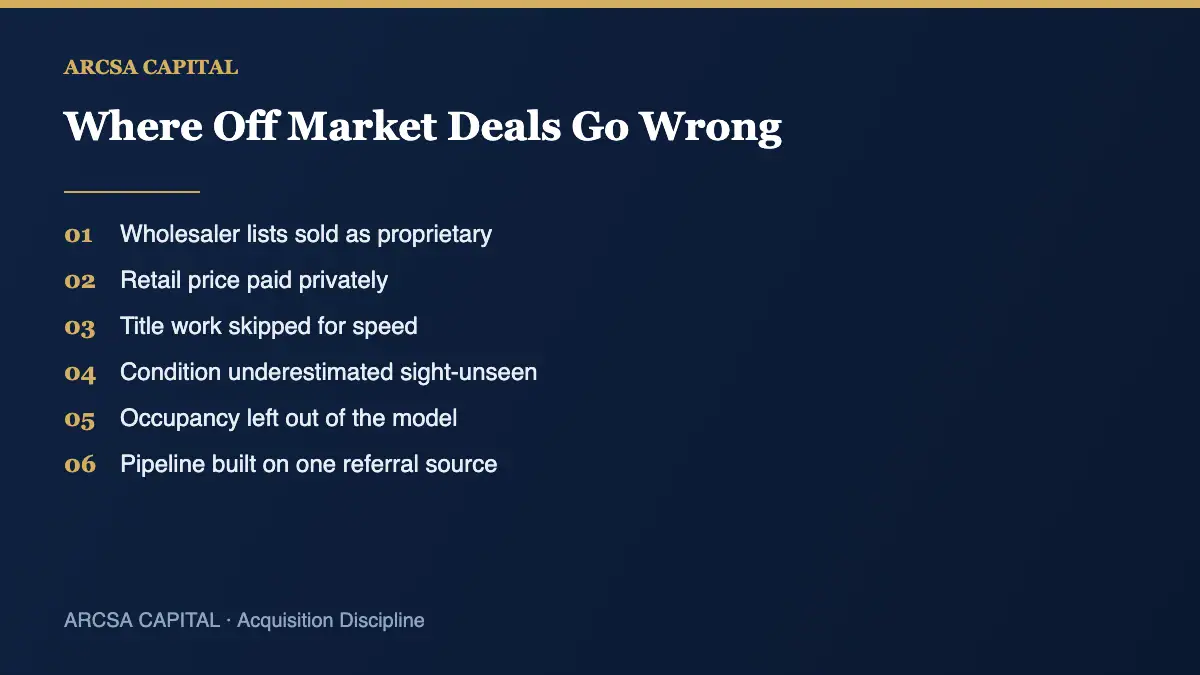
- Confusing wholesaler inventory with proprietary flow. A property that arrived by mass email is not off market residential origination; it is a listing with extra steps and a fee attached.
- Paying the off market price for an on market asset. The discount exists to compensate for speed and condition risk. Without both, the buyer is simply paying retail privately.
- Skipping title work to meet the closing date. Speed is the product being sold, but a title search is the one step that cannot be compressed safely.
- Underestimating condition on a sight-unseen purchase. Off market residential assets are frequently acquired with limited access, so the renovation reserve must assume the worst plausible interior.
- Ignoring occupancy. Inherited and distressed property often comes with occupants, and both the cost and the calendar of resolving that belong in the model.
- Building a pipeline on one referral source. A single attorney or a single lender relationship is not a pipeline; it is a dependency.
Each of these is survivable once. What separates a durable off market residential program is that the process catches them every time, because there is a checklist and someone whose job is to enforce it.
How to Evaluate Off Market Residential in 30 Days
Week 1 — Ask exactly where the deals come from
Request the source of the last ten acquisitions by category: probate, lender referral, direct outreach, broker relationship. A sponsor with a genuine off market residential pipeline can answer in one sentence per deal.
Week 2 — Verify the basis against recorded deeds
Pull the deeds for three of those transactions and compare recorded prices with contemporaneous market data. This confirms or dismantles the origination claim in a single afternoon.
Week 3 — Review the permit trail
Check whether renovation work on those same properties was permitted and closed. Unpermitted work is a liability the next buyer will discover during their own diligence.
Week 4 — Test the closing capability
Ask how the last acquisition was funded and how many days elapsed from agreement to closing. Off market residential access depends entirely on that number being small and repeatable.
Frequently Asked Questions About Off Market Residential
Why would a seller accept less than market value?
Because they are buying something other than price. Speed, certainty of closing, no financing contingency, no repair negotiation and often discretion. For an heir settling an estate or an owner facing a deadline, an off market residential offer that closes in two weeks can be worth more than a higher offer that might close in sixty days.
Is off market the same as distressed?
No, although they overlap. Distressed describes the condition of the asset or the owner finances. Off market describes how the transaction was sourced. Plenty of off market residential purchases involve perfectly sound properties whose owners simply preferred a private sale.
How large is the typical discount?
It varies with condition, urgency and market temperature, and any sponsor quoting a fixed percentage across all deals is describing a target rather than a result. The more useful question is what the recorded basis was relative to comparable sales at the time, which is verifiable.
Can an individual investor access this flow?
Rarely at scale. The relationships take years to build and the closing capability requires capital standing ready. Most individual investors access off market residential opportunity through an operator who already has both, which is precisely the service a fund structure provides.
Key Takeaways on Off Market Residential
- Off market residential sourcing is an operating capability built on relationships, systems and committed capital.
- The discount compensates the seller for speed and certainty, so it disappears when either is missing.
- Title work and renovation reserves are where off market discounts are preserved or lost.
- Any claimed track record is verifiable through recorded deeds and permit history.
- Ask where the last ten deals came from; the answer separates originators from buyers of wholesaler lists.
ARCSA Capital originates off market residential transactions in South Florida through direct relationships with attorneys, lenders and local owners, then underwrites, renovates and repositions them with in-house construction management. Reviewing a live acquisition alongside its recorded basis and permit trail is the fastest way to judge the capability rather than the claim.
Verify an Off Market Residential Track Record With ARCSA Capital
Review a live acquisition with its recorded basis, title findings and permit trail before you commit capital.
Request InformationOr model your own scenario in the investment simulator
Or receive the ARCSA Capital investment thesis by email, with the entry, stabilisation and exit assumptions behind the strategy:
