

A foreign investor can identify an exceptional Florida asset and still lose strategic ground before closing. The error is rarely the property thesis. It is the ownership architecture: who sits above the asset, where taxable income lands, how withholding is administered, and whether governance remains intact when capital is deployed across jurisdictions. The best structures for cross border real estate investing are therefore not selected from a standard checklist. They are designed around investor profile, asset strategy, holding period, tax posture, and exit mechanics.
For institutional capital, the structure is part of underwriting. It determines the quality of reporting, the enforceability of control rights, the treatment of U.S. income, and the ability to preserve discretion across multiple investment cycles. A well-priced acquisition cannot compensate for a weak legal and tax framework.
Contents
Begin With the Capital, Not the Asset
Cross-border real estate structures should begin with a precise question: who is investing? A U.S. taxable individual, a U.S. tax-exempt institution, a non-U.S. individual, a foreign corporation, a family office, and an offshore fund may all face materially different consequences from the same investment.
The second question is equally decisive: what income is expected? A stabilized rental strategy, a development program, a debt investment, and a short-duration value-add disposition create different tax and operational profiles. In a Prime Residential Value Add strategy, where assets are acquired, rehabilitated, repositioned, and monetized on an accelerated timetable, the structure must support rapid capital movement without weakening investment committee oversight or distribution controls.
This is why sophisticated sponsors separate asset-level ownership from investor-level access. The property should be held in a purpose-built U.S. vehicle. Investor capital should enter through vehicles calibrated to the investor’s residence, tax status, regulatory requirements, and information rights.
Best Structures for Cross Border Real Estate Investing
There is no single superior structure for every investor. There are, however, several institutional architectures that recur because they isolate liability, create clean governance, and allow tax analysis to be conducted with precision rather than assumption.

Structure Your Cross Border Real Estate Allocation With ARCSA Capital
Qualified investors can review our fund documents, blocker and parallel-fund options, and reporting package before committing capital.
Request InformationU.S. LLCs for Asset-Level Ring-Fencing
A single-purpose U.S. limited liability company is often the foundation of an institutional real estate acquisition. It holds title to a specific asset or defined portfolio, enters into project contracts, receives sale proceeds, and keeps property-level liabilities separated from the wider platform.
For a Miami residential value-add transaction, this separation matters. Construction obligations, insurance claims, local permits, vendor agreements, and financing covenants should remain contained at the asset level. The LLC agreement can also establish manager authority, transfer restrictions, approval thresholds, indemnification standards, and waterfall mechanics.
An LLC is not, by itself, a complete cross-border solution. A pass-through entity may cause non-U.S. investors to have direct exposure to effectively connected U.S. income and U.S. filing obligations. It is a strong operating vessel, but the investor-facing layer often requires additional design.
U.S. Partnership Funds for Domestic and Eligible Capital
A U.S. limited partnership or manager-managed LLC fund can be highly effective for U.S. taxable investors, certain domestic institutions, and investors prepared to receive partnership tax reporting. The fund aggregates capital, establishes the governing partnership agreement, and owns interests in one or more asset-level LLCs.
Its central advantage is alignment. The governing documents can define investment mandate, GP discretion, key-person provisions, conflicts protocols, capital call mechanics, reporting cadence, expense allocation, and disposition authority. For a manager executing repeatable short-duration acquisitions, this permits a disciplined reinvestment framework rather than a series of disconnected transactions.
The trade-off is tax complexity for foreign participants. Direct partnership ownership can be appropriate in select cases, but it should never be treated as the default merely because it is operationally familiar. Foreign investors require a deliberate analysis of withholding, filing, estate planning exposure, and the character of expected income.
U.S. Corporate Blockers for Foreign and Tax-Sensitive Investors
A U.S. corporate blocker is commonly used between certain investors and a pass-through real estate investment. Instead of holding an interest directly in the U.S. partnership, the investor owns an interest in a corporation that holds that partnership interest.
The blocker can help contain direct U.S. tax filing exposure for non-U.S. investors and may be relevant for tax-exempt investors seeking to manage unrelated business taxable income considerations. It can also simplify the investor experience by converting underlying partnership activity into dividend economics at the investor level, subject to the applicable tax analysis.
The cost is real. Corporate taxation can create a second layer of tax, and distributions or sale proceeds may trigger additional considerations. A blocker is not a magic shield. It is a tool whose value depends on the investor’s jurisdiction, treaty position, liquidity expectations, and the projected timing and character of returns.
Offshore Parallel Funds for International Capital
For globally diversified investors, an offshore parallel fund can offer a more coherent entry point than placing all participants into a single U.S. domestic vehicle. Under this model, a U.S. fund and an offshore fund invest alongside one another, typically on substantially equivalent economic terms, into the same underlying opportunity or holding structure.
A Cayman Islands parallel fund is frequently considered because its legal framework is familiar to international institutional allocators and can support established fund governance. It may allow non-U.S. capital to participate through an offshore vehicle while the U.S. operating and asset-level structure remains focused on acquiring and managing real estate in Florida.
The advantage is not simply tax efficiency. It is governance clarity. A properly constructed parallel arrangement can preserve consistent investment standards, allocation policies, valuation methodology, audit processes, and reporting across investor groups. That consistency is essential when capital originates in Latin America, the United States, and other jurisdictions with distinct legal expectations.
The structure must also be carefully documented. Parallel funds require clear rules for expense sharing, co-investment allocation, currency administration, conflicts management, transfer restrictions, and treatment of side letters. If those rules are vague, the appearance of sophistication will not survive the first contested decision.
REIT Structures in Select Long-Term Mandates
A private real estate investment trust may be relevant where the strategy is oriented toward longer-term ownership, recurring income, and a broad base of qualifying investors. A REIT can offer attractive tax characteristics when its technical requirements are satisfied, but those requirements are exacting and the operational restrictions are meaningful.
For an accelerated value-add strategy with frequent dispositions, a REIT may be less natural than a partnership-plus-blocker or parallel-fund architecture. Asset sales, income composition, distribution rules, ownership concentration, and prohibited transaction concerns must all be assessed. The structure should serve the investment mandate, not reshape it for the sake of a familiar label.
The Tax Issues That Cannot Be Delegated Away
A sponsor may retain skilled tax counsel and administrators, but the investment committee and investor still need a working understanding of the exposure. Foreign ownership of U.S. real estate can implicate effectively connected income, withholding obligations, U.S. tax returns, state-level tax matters, and the Foreign Investment in Real Property Tax Act, commonly known as FIRPTA, upon disposition.
Estate and gift tax considerations may also be material for non-U.S. individuals holding U.S.-situated assets or shares in certain structures. Treaty benefits can change the analysis, but treaties are not interchangeable, and residence for immigration, civil, and tax purposes can produce different answers.
The question is not whether a structure eliminates every tax consequence. Serious structures do not make that claim. The question is whether the structure produces known, modeled, documented consequences that fit the investor’s mandate and can be administered without improvisation.
Governance Is the Real Protection Layer
Tax architecture attracts attention, but governance is what protects capital once the transaction is live. Every cross-border structure should establish who controls acquisitions, financing, budgets, material contracts, valuation, related-party transactions, distributions, and exits.
For Limited Partners and family offices, the governing documents should distinguish clearly between the manager’s authority to execute an approved strategy and decisions that require enhanced consent. Key-person events, removal standards, conflicts procedures, advisory committee rights, audit access, and information delivery obligations deserve the same rigor as the tax memorandum.
ARCSA Capital approaches structure as an extension of operational control: asset-level containment, institutional underwriting, documented compliance, and investor reporting designed for capital that expects visibility without operational interference. That distinction matters. A structure is only as credible as the manager’s ability to administer it under pressure.
A Decision Framework for Sophisticated Allocators
Before committing capital, investors should require the sponsor and counsel to map the ownership chain from investor to fund, from fund to holding entity, and from holding entity to each property. The map should identify every jurisdiction, every entity classification, every expected withholding point, and the distribution path following a sale.
They should then test the structure against four events: acquisition, operating income, refinance or recapitalization, and disposition. If the answer changes materially at any stage, the relevant disclosure, reserve policy, and decision authority should be explicit in the governing documents.
Finally, the structure should be assessed against the manager’s actual business model. A vehicle designed for a decade-long core portfolio may be inefficient for a strategy built around disciplined acquisitions, swift rehabilitation, and repeated capital deployment. The right architecture leaves the investment team free to execute while preserving the legal, tax, and reporting discipline that sophisticated capital expects.
Cross-border investing rewards investors who treat entity design as an investment decision, not closing documentation. Before capital crosses a border, require a structure that can explain where control resides, how risk is contained, and what happens to every dollar when the asset exits.
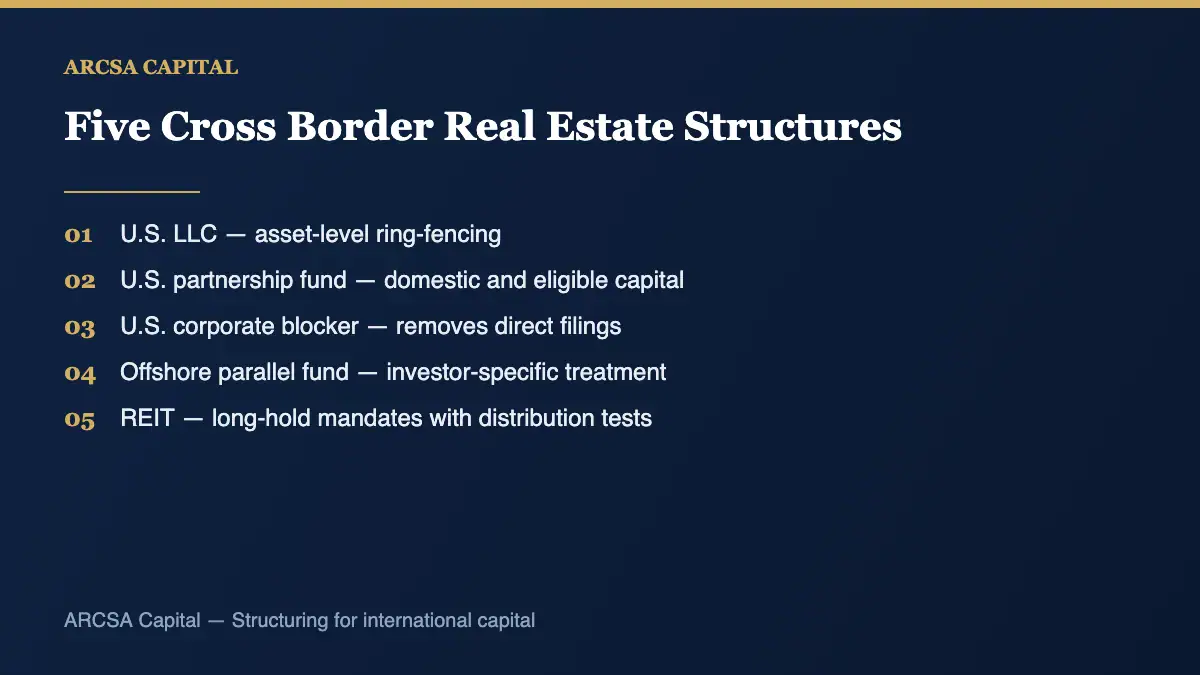
Cross Border Real Estate: 5 Points at a Glance
Structure selection in cross border real estate is a capital question before it is a legal question. The five configurations below cover almost every situation an international allocator will encounter when investing into U.S. residential assets.
- U.S. LLC. Ring-fences liability at the asset level; simple, but exposes foreign owners directly to U.S. filing obligations.
- U.S. partnership fund. Efficient for domestic and eligible capital; produces effectively connected income for foreign partners.
- U.S. corporate blocker. Converts flow-through income into corporate income and shields the investor from direct U.S. filings.
- Offshore parallel fund. Runs alongside the domestic vehicle so each investor class receives the treatment its residence requires.
- REIT structure. Useful in long-hold mandates where distribution requirements and shareholder tests can be met consistently.
No structure is superior in the abstract. In cross border real estate the correct answer is the one that matches the investor’s tax residence, holding period, and exit expectation at the moment of subscription.
What Regulators and Public Filings Reveal About Cross Border Real Estate
Foreign investment into U.S. real property sits inside a specific statutory regime. Withholding on dispositions, effectively connected income rules, treaty positions, and estate tax exposure all apply differently depending on which of the five structures is used.
The practical consequence for cross border real estate is that structure cannot be corrected after subscription. Once capital is committed through the wrong vehicle, the remedies are limited and usually expensive, which is why structuring belongs at the front of the process rather than at closing.
Guidance published by the Internal Revenue Service on withholding, effectively connected income, and reporting obligations for foreign persons is the primary reference for any cross border real estate structure, and it should be read alongside — not instead of — advice from a qualified adviser in the investor’s own jurisdiction.
Common Mistakes Investors Make With Cross Border Real Estate
Most structuring failures in cross border real estate are not exotic. They repeat a small number of avoidable errors.
- Choosing the vehicle after the asset is identified, when the acquisition timetable no longer allows a proper structuring review.
- Applying one structure to an investor base with several different tax residences.
- Ignoring estate tax exposure on directly held U.S. situs assets.
- Assuming a treaty position applies without confirming the limitation-on-benefits requirements.
- Underestimating the ongoing compliance cost of blockers and offshore vehicles relative to the capital deployed.
Each of these is preventable at the design stage. In cross border real estate, structuring cost at the front end is almost always smaller than the tax leakage it prevents.
How to Evaluate Cross Border Real Estate in 30 Days
Week One: Map the Capital
List every investor by tax residence, entity type, and expected holding period. Cross border real estate structures follow from this map, not from the property.
Week Two: Model the Outcomes
Run after-tax return under each candidate structure, including withholding, entity-level tax, and repatriation cost. Compare net outcomes rather than headline returns.
Week Three: Confirm With Local Advisers
Validate the preferred structure with counsel in the investor’s home jurisdiction. A vehicle that is efficient in the United States can be penalised at home.
Week Four: Document and Subscribe
Finalise the fund documents, side letters, and reporting package. Confirm that the cross border real estate structure described in the memorandum matches the entities actually formed.
Reporting and Compliance Obligations in Cross Border Real Estate
Structure determines who files what. A foreign investor holding U.S. property directly assumes personal filing obligations; the same investor behind a corporate blocker generally does not. In cross border real estate this distinction often matters more to the investor than the marginal tax rate itself, because it determines exposure to a foreign tax authority.
Fund-level reporting adds a second layer. Investors should confirm which statements they will receive, in what format, and on what timetable, before subscribing. A cross border real estate vehicle that issues its investor statements six months after year end will complicate filings in most Latin American and European jurisdictions.
Currency is the third consideration. Capital calls, distributions, and reporting may occur in different currencies, and the point at which conversion happens changes the realised return. Well-designed cross border real estate programmes state the conversion policy in the fund documents rather than leaving it to administrative practice.
Aligning the Structure With the Exit
Entry structuring and exit planning are the same exercise viewed from two ends. A vehicle optimised for a three-year disposition behaves differently from one designed for a ten-year hold with refinancing, and cross border real estate investors frequently discover the mismatch only when the first sale occurs.
The practical test is simple: model the full exit under the chosen structure, including withholding at disposition, entity-level tax, distribution to the investor, and repatriation to the home jurisdiction. If the net figure surprises the investor, the structure is wrong for that investor.

Frequently Asked Questions About Cross Border Real Estate
Which structure is best for a Latin American family office?
In most cases an offshore parallel fund or a U.S. corporate blocker, because both remove the direct U.S. filing obligation. The final choice in cross border real estate depends on the family’s residence, the presence of U.S. persons in the structure, and the intended holding period.
Does structure affect the return or only the paperwork?
It affects the return directly. Withholding, entity-level taxation, and repatriation cost can move net proceeds by several percentage points, which is often larger than the difference between two competing sponsors.
Can the structure be changed later?
Rarely without cost. Restructuring a cross border real estate vehicle after assets are acquired usually triggers a taxable event, so the decision should be treated as effectively permanent.
Key Takeaways on Cross Border Real Estate
- Structure follows the capital, never the asset.
- Blockers and parallel funds exist to solve investor-specific problems, not to be used by default.
- After-tax return is the only comparison that matters in cross border real estate.
- The structuring decision is effectively irreversible once capital is deployed.
Approached this way, cross border real estate stops being a tax problem attached to a property decision and becomes what it should be: a design exercise where the vehicle is chosen so that the underlying strategy can deliver its return to the investor intact.
Request a Cross Border Real Estate Structuring Review
We map your residence, holding period and exit expectation to the vehicle that preserves the most after-tax return.
Request InformationOr model your own scenario in the investment simulator
Or receive the ARCSA Capital investment thesis by email, with the entry, stabilisation and exit assumptions behind the strategy:
