

A mispriced asset in Miami rarely stays invisible for long. The spread is usually captured by whoever can identify distress early, underwrite faster than the market, and close with enough legal and operational control to protect downside. That is why distressed real estate opportunities Miami continue to attract sophisticated capital – not because distress is fashionable, but because basis matters, timing matters, and execution decides whether a discount becomes value or simply inherited risk.

For accredited investors, family offices, and cross-border allocators, the real question is not whether distress exists. It does. The real question is which form of distress is investable, at what point in the cycle, and under what governance framework. In a market as visible and globally watched as Miami, public inventory tends to be efficiently priced. The more interesting situations often sit outside the open market, hidden inside time pressure, title complexity, estate transitions, lender fatigue, partnership disputes, deferred maintenance, or owners with balance sheet strain.
Why distressed real estate opportunities Miami still matter
Miami is not a distressed market in the traditional sense. It is a high-demand, supply-constrained, globally bid market with strong lifestyle migration, international capital inflows, and persistent residential demand in prime submarkets. That may sound incompatible with distress, but in practice it creates a sharper distinction between headline pricing and transaction-level reality.
In resilient markets, distress does not always appear as collapse. More often, it appears as dislocation. An owner may need speed rather than price maximization. A property may be functionally obsolete relative to its competitive set. A family may want discretion. A lender may prefer a negotiated solution over a drawn-out enforcement process. In these cases, the opportunity comes from solving a problem the broad market is not structured to solve quickly.
That distinction matters for institutional capital. True edge rarely comes from simply buying a troubled property. It comes from buying a controllable situation with a definable path to repositioning, monetization, and capital recovery. Without that path, distress is just noise with legal fees attached.
Not all distress is attractive capital deployment
Sophisticated investors know that the word distressed is too broad to be useful on its own. There is financial distress, where the asset may be solid but the owner is constrained. There is physical distress, where deferred maintenance or outdated interiors suppress value. There is legal distress, where probate, liens, code issues, or title defects complicate transfer. Then there is structural distress, where the business plan itself is flawed.
The first two categories are often the most attractive, especially in prime residential segments. An asset with temporary ownership pressure and clear renovation economics can be measured, priced, and executed. Legal distress can also create value, but only when handled with exacting diligence and counsel. Structural distress is different. If the location, product type, demand profile, or exit path is impaired, no purchase discount alone solves the problem.
Not every discount qualifies as one of the genuine distressed real estate opportunities Miami offers. This is where less disciplined capital gets trapped. It mistakes price for margin of safety. In reality, the margin of safety is created by a combination of entry basis, legal clarity, capex control, exit velocity, and sponsor discipline.
What separates a real opportunity from a value trap
The strongest distressed real estate opportunities Miami offers tend to share a few traits. First, they exist in submarkets where end-user demand and liquidity remain deep even after a renovation or repositioning period. Second, the source of distress is specific and fixable. Third, the timeline to execution is short enough to preserve IRR discipline and reduce exposure to broader market shifts.
A value trap usually shows the opposite profile. The discount looks dramatic, but the path to resolution is vague. Rehabilitation costs are underestimated. Permitting is treated casually. The exit assumes perfect market conditions. The legal package is incomplete. Or the operator does not fully control the transaction lifecycle.
For serious allocators, speed without precision is not an advantage. It is a risk amplifier. The right operator must be able to source off-market, underwrite with realism, control rehab, anticipate title and compliance issues, and structure exits with discipline. That is not brokerage theater. It is operational architecture.
The role of off-market access
Open-market distressed listings in Miami often attract too much attention to preserve genuine mispricing. Once a broadly marketed asset becomes a public opportunity, competitive bidding can erase the basis advantage quickly. Off-market sourcing remains materially different because it allows access before price discovery becomes crowded.
This is especially relevant in situations involving estate sales, negotiated lender resolutions, family-held assets, or owners seeking confidentiality. In these transactions, relationship networks and local operating presence matter more than advertising reach. Access is not a marketing function. It is a trust and execution function.
Why speed must be paired with governance
For investors tracking distressed real estate opportunities Miami, timing discipline matters as much as access. Many distressed deals are lost or won in compressed timelines. That creates a temptation to shortcut diligence. Institutional capital should resist that instinct. A fast close only creates value if the transaction has already been framed by process, documentation standards, counsel coordination, and decision rights.
Governance is what allows speed to remain intelligent. It defines who can approve, how risk is documented, what thresholds trigger escalation, and how capital is protected if assumptions change midstream. In private real estate, particularly in special situations, governance is not back-office formality. It is part of the asset itself.
Underwriting distressed real estate opportunities Miami: local realism required
Miami rewards conviction, but it punishes generic underwriting. Insurance volatility, municipal compliance, flood considerations, contractor quality, permitting timelines, and neighborhood-level demand shifts all affect execution. A spreadsheet built from national assumptions will miss where the real risk sits.
That is why basis discipline matters so much in prime residential value-add strategies. A sponsor may be correct about long-term Miami demand and still lose money on a single asset if the holding period drifts, renovation costs expand, or the exit window softens. The difference between a compelling deal and a mediocre one can rest on whether the sponsor underwrote the property as an actual local operator rather than a distant capital allocator.
This is also why short-duration monetization strategies can be attractive when executed well. Less time in the asset can mean less exposure to rate shifts, tax changes, carrying costs, and market sentiment. But shorter duration also compresses the margin for operational error. Execution quality must be unusually high.
Cross-border investors should pay attention to structure, not just returns
International investors often enter Miami because they understand the city’s long-term demand profile and legal protections relative to other jurisdictions. That instinct is rational. Still, distressed acquisitions add layers that require more than market optimism.
For non-US capital, entity design, tax treatment, reporting obligations, and fund structure deserve as much attention as the property itself. The same asset can produce very different net outcomes depending on how the investment vehicle is organized and how cash flows are managed. Sophisticated capital does not simply ask, What is the projected return? It asks, Through which structure, under which compliance regime, with what level of auditability and investor visibility?
That institutional lens is not cosmetic. It affects capital preservation. In special situations, the legal wrapper around the asset can be as important as the capex plan inside it.
Where disciplined sponsors create the edge
The strongest sponsors in this segment do not present distress as opportunistic chaos. They treat it as a repeatable discipline. That means a defined sourcing engine, strict underwriting filters, legal and tax coordination, active project oversight, and an exit framework that does not depend on perfect conditions.
ARCSA Capital operates in that institutional lane, where off-market residential special situations are evaluated not as isolated bargains but as part of a controlled investment system. For qualified investors, that distinction matters. A single asset can be interesting. A repeatable process with governance, local execution, and capital controls is where strategy begins to compound.
Miami will continue to produce distress even in strong markets because ownership structures, liquidity needs, and asset quality are never uniform. The advantage belongs to capital that can remain selective. Not every discount deserves attention. Not every urgency deserves money. The most valuable opportunities are usually the ones hidden behind complexity that can be measured, contained, and converted into a cleaner basis than the public market can offer.
Investors evaluating distressed real estate opportunities Miami can also review broader market context through resources such as Florida Realtors market research and the Urban Land Institute, both of which track distressed asset cycles and institutional capital trends relevant to South Florida.
For investors ready to evaluate current off-market situations, ARCSA Capital’s acquisitions team is available via WhatsApp at wa.link/6ttzhe to walk through active opportunities and underwriting criteria.
For sophisticated investors, that is the real appeal of distress in Miami. It is not the drama of buying broken assets. It is the discipline of acquiring resolvable problems with enough control to shape the outcome.
Contents

Access Distressed Real Estate Opportunities With ARCSA Capital
Qualified investors can review our sourcing channels, pre-bid checklist and completed-asset results in South Florida.
Request InformationDistressed Real Estate: 6 Points at a Glance
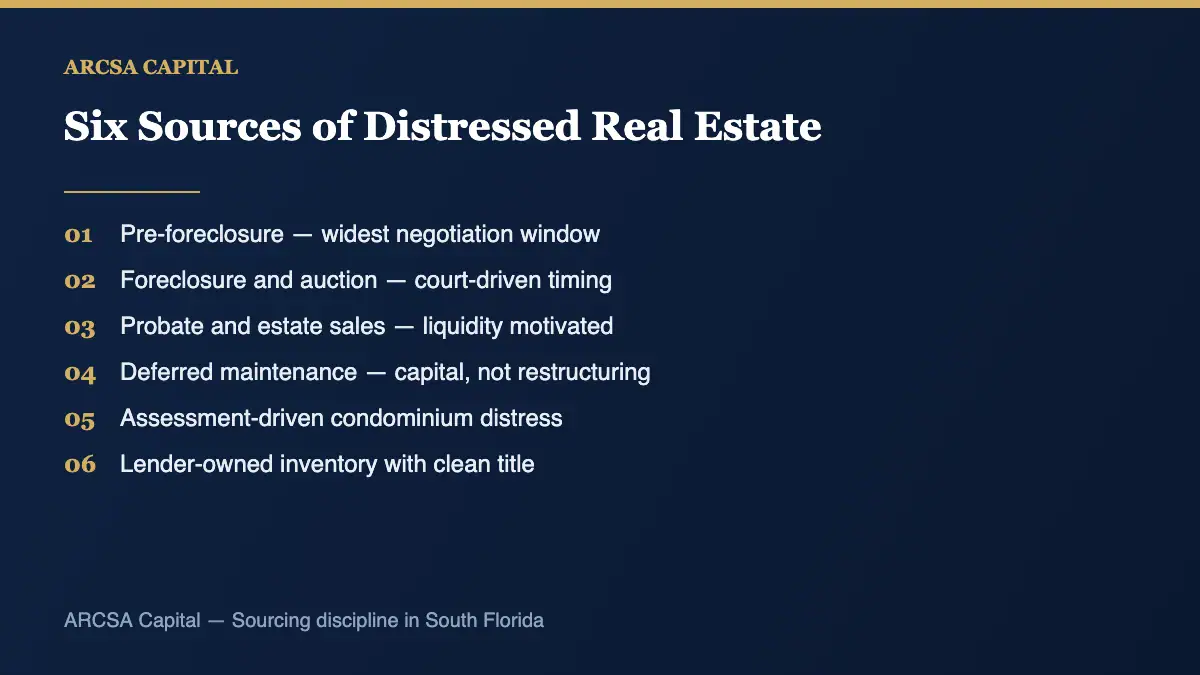
Distressed real estate in Miami arrives from six identifiable sources. Knowing which one produced an opportunity tells an investor more about the risk than the discount does.
- Pre-foreclosure. Owner-motivated sales before the process completes; the widest window for negotiation.
- Foreclosure and auction. Court-driven timelines with limited inspection and no financing contingency.
- Probate and estate sales. Heirs seeking liquidity rather than maximum price.
- Deferred maintenance. Physically distressed but financially sound assets requiring capital, not restructuring.
- Assessment-driven distress. Condominium inventory affected by structural reserve requirements.
- Lender-owned inventory. Assets already taken back, usually with clean title but limited flexibility on price.
Each source of distressed real estate carries a different title, timing and inspection profile. Treating them as one category is the most common analytical error in this strategy.
What Regulators and Public Filings Reveal About Distressed Real Estate
Florida foreclosure procedure is judicial, which means timelines are set by the courts and vary by county. That procedural reality shapes how distressed real estate reaches the market and how much diligence is possible before bidding.
Institutional participation is generally structured through private funds offered to accredited investors. Disclosure is required rather than approval, so the investor carries the burden of verifying both the sponsor and the sourcing claims.
Adviser records and offering filings published by the U.S. Securities and Exchange Commission allow an investor to confirm the platform behind a distressed real estate programme before assessing any individual opportunity.
Common Mistakes Investors Make With Distressed Real Estate
Discount is the most misleading figure in this strategy. These five errors explain most disappointing outcomes.
- Measuring the discount against asking price rather than against defensible market value.
- Bidding at auction without a title search, which is where distressed real estate produces its largest surprises.
- Underestimating the cost of curing deferred maintenance on older coastal inventory.
- Ignoring outstanding assessments, liens and code violations that survive the transfer.
- Assuming occupancy status is straightforward; eviction timelines can exceed the planned holding period.
All five are addressable before bidding. A disciplined distressed real estate operator will have a written pre-bid checklist covering each.
How to Evaluate Distressed Real Estate in 30 Days
Week One: Identify the Source
Establish which of the six channels the pipeline actually comes from, and in what proportion.
Week Two: Test the Discount
Compare the last twenty distressed real estate acquisitions against independent comparables at the time of purchase.
Week Three: Review Title Practice
Examine the title, lien and violation search process, and ask how many acquisitions were abandoned after diligence.
Week Four: Verify Execution
Compare budgeted with actual renovation cost and timeline, and confirm exit routes were identified before bidding.

Frequently Asked Questions About Distressed Real Estate
Is distressed always cheaper?
No. Distressed real estate is cheaper relative to a stabilised comparable only after curing title, physical and occupancy issues. The apparent discount frequently equals the cost of resolution.
Which source offers the best risk-adjusted entry?
Pre-foreclosure and probate, because both allow inspection and negotiation. Auction inventory offers the largest headline discounts and the least information.
How much capital should be reserved?
More than in conventional value-add. Distressed real estate carries a higher probability of discovering additional cost after acquisition, so reserves of fifteen per cent or more of budget are common.
Key Takeaways on Distressed Real Estate
- The source of the distress determines the risk profile more than the discount does.
- Title and lien work is the single highest-value diligence step.
- Occupancy and eviction timelines belong in the holding-period assumption.
- Reserves should be larger than in a conventional renovation programme.
Approached source by source, distressed real estate in Miami becomes a disciplined sourcing strategy rather than an opportunistic search for discounts. The return comes from resolving problems other buyers cannot price, which is a capability question rather than a market one.
What Title Work Reveals in Distressed Real Estate
Title is where distressed real estate separates professionals from opportunists. A property that appears attractively priced can carry municipal liens, code enforcement fines, unpaid association dues, mechanic’s liens or unresolved heirship claims, and several of these survive a transfer.
The practical process is unglamorous: a full title search, a municipal lien search, an association estoppel where applicable, and a review of open permits. Each takes days rather than hours, which is why auction inventory carries higher risk — the timeline rarely allows the complete sequence.
An operator who abandons a meaningful share of distressed real estate opportunities after diligence is demonstrating discipline, not inefficiency. A pipeline with a very high conversion rate usually indicates that diligence is being compressed.
Occupancy, Timelines and the Real Holding Period
- Occupied properties require a legal process that can extend the holding period by months.
- Open permits must be closed before resale, and closing another party’s permit is often slower than pulling a new one.
- Code violations can block a certificate of occupancy even after physical work is complete.
- Association approval requirements in condominium inventory add an additional buyer-side timeline at exit.
Each of these items lengthens the hold rather than raising the cost, and in a short-duration strategy time is the more expensive variable. Distressed real estate underwriting should therefore model the timeline explicitly, with a stated assumption for each of the four items above.
For an allocator, the useful question is not what discount the manager achieves but what the realised holding period has been across completed assets. That single figure captures most of what distinguishes a well-run distressed real estate programme from an optimistic one.
Request Our Distressed Real Estate Pipeline Data
Sourcing mix, realised discounts and holding periods prepared for your investment committee.
Request InformationOr model your own scenario in the investment simulator
Or receive the ARCSA Capital investment thesis by email, with the entry, stabilisation and exit assumptions behind the strategy:
