

A guide to GP LP structures is not merely a legal overview. For a sophisticated investor, it is an examination of who controls capital, who bears risk, how economics are allocated, and what happens when an investment departs from plan. In private real estate, these details often determine whether a partnership operates with institutional discipline or relies on assumptions that become visible only under pressure.
The General Partner-Limited Partner model remains a foundational architecture for private funds because it separates capital ownership from investment authority. Yet the label alone says little. Two vehicles can both be called GP-LP structures while offering materially different protections, reporting standards, tax treatment, liquidity mechanics, and decision rights.
For family offices, institutional LPs, and internationally based accredited investors allocating meaningful capital to U.S. real estate, the governing documents deserve the same scrutiny as the underlying asset. The structure is part of the investment thesis.
Contents
What a GP-LP Structure Actually Allocates
At its core, a Limited Partnership pairs a General Partner with one or more Limited Partners. The GP manages the vehicle. It sources transactions, performs underwriting, directs acquisition and disposition decisions, coordinates financing, supervises asset-level execution, and administers the fund according to its governing documents.
LPs contribute capital and participate economically, generally without taking part in daily management. Their limited liability is tied to preserving that distinction. An LP seeking influence over a manager’s decisions must therefore understand the boundary between appropriate investor protections and actions that could complicate the limited-partner role.
The GP is often an entity rather than an individual. This creates an additional layer of organization around management, personnel, indemnification, and succession. In institutional settings, the GP may sit alongside an investment manager, an adviser, affiliated operating entities, and special purpose entities formed for individual acquisitions. The diagram may look complex, but the relevant question is straightforward: where does authority reside, and who is accountable for each decision?
Guide to GP LP Structures: The Core Legal Documents
The Limited Partnership Agreement is the central contract. It should establish economic rights, governance, restrictions, reporting obligations, transfer provisions, conflicts procedures, and dissolution mechanics with enough precision to remain usable in a contested scenario.
The private placement memorandum, subscription agreement, side letters, management agreement, and asset-level documentation complete the framework. Each serves a distinct function, but they must operate consistently. A favorable provision in a side letter is of limited value if the underlying fund agreement does not permit the GP to provide that election or if disclosure is incomplete.
Sophisticated diligence focuses less on whether documents are lengthy and more on whether they answer difficult questions clearly. What can the GP do without LP consent? Can the investment period be extended? Are affiliates permitted to provide services? How are valuation disputes handled? What information must be delivered, and on what timetable? These are governance questions, not administrative details.
Management Authority and Reserved Matters
A GP needs sufficient authority to execute. In value-add real estate, delayed decisions can erode an opportunity, especially where assets are acquired in distress or through off-market negotiations. Overly broad LP approval rights can create operational friction that is inconsistent with the strategy.
At the same time, unconstrained discretion is not synonymous with institutional quality. Well-designed structures identify reserved matters that warrant elevated review. These may include material changes to investment strategy, amendments to the partnership agreement, related-party transactions, fund extensions, leverage beyond stated parameters, removal of the GP, or dissolution of the vehicle.
The appropriate balance depends on the mandate. A concentrated strategy with shorter realization cycles may require different controls than a multi-year, diversified fund. What matters is that discretion, oversight, and escalation paths are intentionally designed before capital is deployed.

Review ARCSA Capital’s GP LP Structures Before You Commit
Qualified investors can examine our partnership agreement, reserved matters, waterfall mechanics and reporting standards in full.
Request InformationGP Removal and Key-Person Protections
The removal provisions are among the most consequential yet least appreciated terms in a fund structure. LPs should distinguish between removal for cause and removal without cause. Cause-based removal typically addresses fraud, willful misconduct, material breach, or certain regulatory disqualifications. It is essential, but the definition of cause and the voting threshold determine whether the remedy is practical.
No-fault removal is more nuanced. It can offer LPs a mechanism to act if confidence in the manager deteriorates without proving misconduct. However, it may also impair continuity if invoked carelessly. The voting threshold, transition process, compensation consequences, and authority over existing assets should all be defined with precision.
Key-person provisions address a related risk: dependence on named investment professionals. If designated principals cease to devote the required attention to the strategy, investment activity may pause until LPs approve a replacement plan. For a manager built around local sourcing and execution expertise, this protection can be more meaningful than a generic governance committee.
Economics: Alignment Is More Than a Fee Schedule
A GP-LP arrangement works best when economics reward disciplined execution rather than rapid capital deployment for its own sake. The economics generally include management fees, reimbursement of fund expenses, GP commitment, preferred return mechanics, carried interest, and the distribution waterfall.
The waterfall determines the order in which cash moves between LPs and the GP. A typical arrangement may return contributed capital to LPs first, then provide a preferred return, and only thereafter allocate carried interest to the GP. But terminology can conceal substantial differences. A preferred return may be cumulative or non-cumulative, simple or compounded, calculated deal by deal or across the entire fund.
European-style and American-style waterfalls present a fundamental trade-off. A whole-fund, or European-style, waterfall generally requires LPs to recover capital and meet the agreed preference across the portfolio before the GP receives carry. This provides stronger fund-level alignment. A deal-by-deal, or American-style, waterfall may allow the GP to receive carry earlier on successful exits, potentially improving manager economics but requiring careful clawback protections if later investments underperform.
The GP commitment also matters. A meaningful capital contribution does not eliminate risk, but it demonstrates that the manager participates in the same downside framework as its LPs. The right amount depends on the strategy, manager scale, and economics. It should be assessed alongside, not separately from, fees and carry.
Fees, Expenses, and Related-Party Controls
LPs should be able to distinguish management fees from operating expenses and transaction-specific costs. Ambiguity often arises around broken-deal expenses, organizational costs, property management fees, construction oversight, financing fees, legal expenses, and services delivered by affiliates.
Affiliated arrangements are not inherently problematic. A vertically integrated platform may offer greater control over underwriting, rehabilitation, and disposition. The issue is disclosure, pricing discipline, and oversight. Institutional documentation identifies permitted affiliate services, explains the basis of compensation, and establishes procedures for conflicts review.
Tax and Cross-Border Architecture
For international LPs, the legal entity is only one component of the allocation decision. U.S. tax exposure, withholding, filing obligations, state-level considerations, estate planning, and home-jurisdiction tax treatment can materially affect net outcomes.
A domestic partnership may be appropriate for some investors, while others may require a parallel fund or feeder structure. A Cayman parallel fund, when properly designed and coordinated with qualified counsel, can provide an additional institutional framework for non-U.S. capital. It does not remove the need to analyze U.S. real estate tax consequences. Rather, it helps organize investor participation within a structure suited to the relevant investor base and regulatory context.
Tax efficiency should never be presented as a standardized outcome. The right architecture depends on investor status, domicile, treaty considerations, entity classification, expected holding period, financing, and the nature of income generated. An experienced sponsor coordinates legal and tax design early, before subscriptions are accepted and before an acquisition creates irreversible consequences.
Reporting Is a Control System
Quarterly reports are not a courtesy. They are part of the LP’s ability to evaluate whether the GP is executing within mandate. High-quality reporting should connect the original underwriting case to current performance, explain deviations, identify material risks, and distinguish realized results from assumptions or internal marks.
For private real estate, this commonly means visibility into acquisition basis, rehabilitation progress, budget variance, leverage, market conditions, exit assumptions, realized proceeds, and capital account activity. A report that presents only favorable metrics without discussing timing risk, execution risk, or liquidity constraints is not institutional reporting.
LP advisory committees can add another layer of oversight, particularly for conflicts, valuation questions, extensions, and other matters specified in the partnership agreement. Their value depends on mandate and composition. An advisory committee is not a substitute for LP diligence, nor should it become a shadow investment committee that compromises the GP’s ability to act.
Questions Worth Asking Before Commitment
Before entering a GP-LP vehicle, an LP should be able to identify the manager’s authority, the limits on that authority, and the remedies available if governance fails. The following questions are particularly useful:
- Is the investment mandate narrow enough to be measured and broad enough to permit execution?
- How does the distribution waterfall work under both strong and weak portfolio outcomes?
- Which fees, expenses, and affiliate arrangements may be charged to the fund?
- What happens if a key principal departs, the fund requires an extension, or the GP is removed?
- How are conflicts reviewed, valuations supported, and material deviations reported?
The answers should be found in operative documents, not only in marketing materials or informal conversations. A credible manager welcomes that level of review because governance clarity reduces friction once capital is committed.
At ARCSA Capital, the relevant standard is not complexity for its own sake. It is whether the legal, tax, operational, and reporting architecture supports disciplined execution in private Florida residential real estate while preserving clear alignment with sophisticated LP capital.
A well-structured partnership gives the GP room to act decisively and gives LPs a defined basis for trust. That balance is built before the first closing, tested through the investment cycle, and remembered long after the capital is returned.
GP LP Structures: 5 Points at a Glance
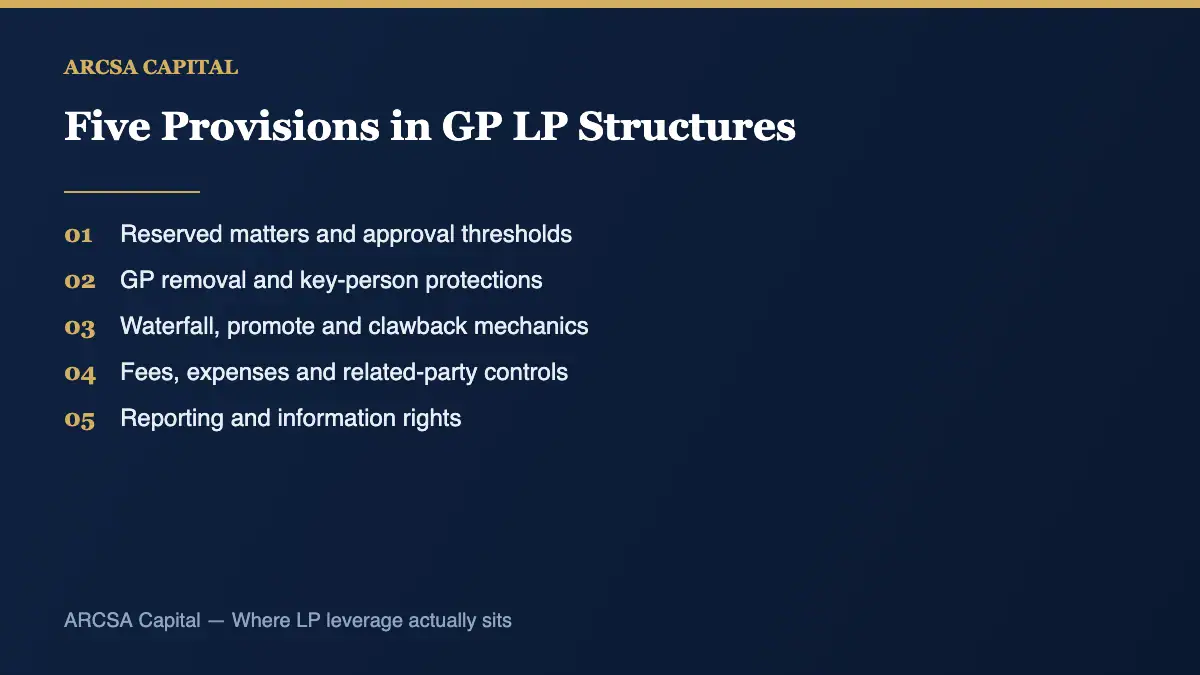
Most of what protects a Limited Partner sits in five provisions. Read together they describe how GP LP structures allocate authority, economics and remedies between the sponsor and the investor.
- Reserved matters. The list of decisions the General Partner cannot take alone; the practical boundary of discretion.
- Removal and key person. The vote threshold to replace the GP and what happens if named principals depart.
- Waterfall and clawback. How profits are shared, whether the promote is net of fees, and how overpayment is recovered.
- Fees, expenses and related parties. What the fund pays, to whom, and under what fairness test.
- Reporting and information rights. What the LP receives, how often, and what can be requested on demand.
Read in isolation, each provision looks standard. Read together, GP LP structures reveal exactly where an investor has leverage and where the sponsor retains unilateral control.
What Regulators and Public Filings Reveal About GP LP Structures
Private real estate funds in the United States are offered under exemptions that require disclosure but not approval. The private placement memorandum describes intent; the limited partnership agreement creates obligation, and only the second is enforceable.
For that reason, diligence on GP LP structures should be conducted on the LPA, subscription documents, side letters and management agreement rather than on the marketing deck. Public filings then confirm that the entities described actually exist and are registered as represented.
Exempt offering filings and adviser records published by the U.S. Securities and Exchange Commission allow an investor to confirm the sponsor entity behind the GP LP structures before the legal review begins.
Common Mistakes Investors Make With GP LP Structures
Investors lose protection in a small number of recurring ways when reviewing fund documents.
- Reading the memorandum instead of the partnership agreement, where the enforceable terms actually live.
- Accepting a removal threshold so high that it can never be reached in practice.
- Overlooking indemnification language that shifts the cost of sponsor misconduct onto the fund.
- Missing an amendment clause that allows material changes to GP LP structures without LP consent.
- Failing to compare side letters, which can grant other investors economics that dilute the rest of the base.
All five are visible on a careful reading. An investor who reviews GP LP structures for remedies rather than for returns will identify them before signing.
How to Evaluate GP LP Structures in 30 Days
Week One: Collect the Documents
Request the LPA, subscription agreement, management agreement, all side letters, and the two most recent audited financial statements.
Week Two: Map Authority
Diagram who approves what and who is paid by whom. Ambiguity in the diagram is ambiguity in the GP LP structures themselves.
Week Three: Model the Waterfall
Run the distribution mechanics under a base case and a downside case, and confirm the clawback is funded and enforceable.
Week Four: Negotiate and Decide
Raise the specific provisions you need adjusted, in writing, before subscription. After closing, GP LP structures are effectively fixed.

Frequently Asked Questions About GP LP Structures
What is the difference between a GP and an LP?
The General Partner manages the fund, takes operating decisions and carries unlimited liability through its entity. Limited Partners provide capital, receive limited liability, and rely on the governance provisions in the partnership agreement for protection.
Is a preferred return the main LP protection?
No. A preferred return orders distributions; it does not protect principal. In GP LP structures, the real protections are reserved matters, removal rights, clawback and information rights.
Can these terms be negotiated?
Yes, particularly for larger commitments and during a first close. Once the fund is fully subscribed, GP LP structures are rarely amended in favour of an incoming investor.
Key Takeaways on GP LP Structures
- The partnership agreement, not the memorandum, defines what an LP can enforce.
- Reserved matters and removal rights are the two provisions that create genuine leverage.
- A promote calculated on gross proceeds transfers risk to the investor.
- GP LP structures should be reviewed for remedies, not for projected returns.
Approached this way, GP LP structures stop being legal boilerplate and become the operating map of the relationship. The investor knows in advance which decisions can be challenged, which cannot, and what recourse exists when the base case does not hold.
How GP LP Structures Differ From Club Deals and Joint Ventures
A club deal distributes decision rights informally among a small group of investors, usually without a governing committee or a written approval matrix. GP LP structures replace that informality with defined authority, which is what allows a vehicle to hold dozens of assets without renegotiating the decision process each time.
Joint ventures sit between the two. They typically grant one partner control over day-to-day operations and reserve major decisions for joint approval, which works with two sophisticated parties but scales poorly. GP LP structures are designed precisely for the situation where many passive investors need protection they cannot negotiate individually.
The practical implication is that an investor should not evaluate these formats on returns alone. The same underlying assets, held through different governance arrangements, produce materially different risk for a passive allocator.
Cross-Border Considerations in GP LP Structures
For a non-U.S. investor, the partnership form creates tax consequences that a domestic investor does not face. Income can be treated as effectively connected, generating filing obligations, and directly held interests may create estate tax exposure. GP LP structures address this through blockers or parallel vehicles rather than by changing the underlying fund.
The choice belongs at the front of the process. Once capital is committed through the wrong entity, restructuring usually triggers a taxable event, so the structuring review should conclude before subscription rather than after the first capital call.
- Confirm which entity you are subscribing into, and where it is domiciled.
- Establish whether distributions arrive gross or net of withholding.
- Verify that the reporting package supports filings in your home jurisdiction.
- Ask whether other investors hold through different vehicles, and what that means for the waterfall.
Answered before commitment, these four points let an investor confirm that the GP LP structures on offer are compatible with their own tax position rather than merely acceptable in the abstract.
Request Our GP LP Structures Documentation
Partnership agreement, fee schedule and governance calendar prepared for institutional legal review.
Request InformationOr model your own scenario in the investment simulator
Or receive the ARCSA Capital investment thesis by email, with the entry, stabilisation and exit assumptions behind the strategy:
