

Public real estate can look efficient until market volatility, correlation, and forced liquidity become part of the equation. The real question in private equity versus REITs is not which vehicle is universally superior. It is which structure gives a sophisticated investor the appropriate level of control, access, duration, and legal visibility for a specific capital mandate.
Contents
For accredited investors, family offices, and institutional Limited Partners, this is a portfolio construction decision. A publicly traded REIT offers daily pricing and immediate access to broad real estate exposure. A private real estate equity vehicle may offer direct operational influence, selective sourcing, and an underwriting process built around individual assets rather than public-market sentiment. Each can serve a purpose. Their differences become decisive when capital preservation and execution quality matter as much as headline yield.
Private Equity Versus REITs: The Structural Difference
A REIT is generally designed to provide investors with exposure to a portfolio of income-producing real estate through a corporate or trust structure. Publicly traded REITs trade on exchanges, meaning their shares can be bought or sold during market hours. Their valuations move continuously, often in response to interest rates, equity-market flows, sector expectations, and broad risk sentiment – not solely because the underlying properties changed in value.
Private real estate equity is structured differently. Capital is committed to a private fund or special-purpose vehicle managed by a General Partner. The manager sources, acquires, finances, operates, improves, and exits assets under a defined investment thesis. Investors participate as Limited Partners, subject to the governing documents, distribution waterfall, reporting standards, and investment period.
That distinction changes the investment experience. A REIT investor owns a liquid security linked to real estate. A private equity investor owns an interest in a controlled investment program, where returns depend more directly on sourcing discipline, asset-level execution, financing structure, and the manager’s ability to monetize an identified opportunity.
Neither structure eliminates risk. REIT liquidity can be valuable, but it also exposes the investor to daily repricing. Private equity can reduce the noise of public markets, but it requires comfort with lockups, manager selection, and less frequent valuation events.
Liquidity Is Not the Same as Optionality
Liquidity is often presented as the defining advantage of REITs. It is an advantage when an institution needs to rebalance rapidly, meet cash obligations, or adjust a public-markets allocation. Yet liquidity also means that an investor can be exposed to abrupt price movements unrelated to a property’s actual operating performance.
Public REITs may trade at substantial discounts or premiums to their net asset value. In periods of rate uncertainty or equity-market stress, a high-quality portfolio can still see its share price decline simply because public investors are selling listed securities. This is not necessarily a flaw. It is the price of daily liquidity.
Private equity trades that daily price discovery for a negotiated capital horizon. Capital is usually committed for a defined period, and distributions occur as assets are refinanced or sold. This can be more suitable for capital that does not need immediate redemption and is intended to compound through a controlled cycle.
For a family office, the appropriate question is not, “Can this be sold tomorrow?” It is, “Will this capital be needed tomorrow, and what do we gain by keeping it outside a daily trading environment?” A liquidity reserve and a long-duration private allocation can coexist. They should not be expected to perform the same function.
Access Determines Much of the Return Profile
Most public REIT investors receive exposure after the assets have been aggregated into a listed platform. They benefit from scale, professional management, and sector diversification, but they do not participate in the original acquisition process. The REIT’s portfolio is visible, standardized, and already priced by public markets.
Private real estate equity can operate earlier in the value chain. The manager may identify off-market assets, distress situations, incomplete renovations, probate-driven sales, or other special situations where the seller’s need for certainty matters as much as price. This access is not broadly available through a public REIT share purchase.
In a Prime Residential Value Add strategy, the central source of value is often the execution gap between acquisition and exit. A manager acquires an asset below its post-rehabilitation potential, applies a defined renovation and repositioning plan, then exits when the asset has been brought back to its intended market position. The underwriting must account for purchase price, scope, permits, carrying costs, transaction friction, financing, and a credible exit valuation.
The opportunity is not merely residential real estate. It is the ability to control the operating sequence. In Miami and selected Florida markets, local presence and repeat access to proprietary deal flow can matter more than broad sector exposure. Arcsa Capital applies this institutional logic to short-cycle, value-add residential opportunities where sourcing, legal architecture, and disciplined exits are treated as one integrated process.

Accredited investors
Private equity versus REITs: test it against your own mandate
We walk accredited investors through how ARCSA Capital approaches private equity versus REITs in practice: entry basis, works period, exit window and governance, with your own allocation policy on the table. No generic deck.
Request informationOr receive the ARCSA Capital investment thesis by email, with the entry, stabilisation and exit assumptions behind the strategy:
General information for educational purposes. Not an offer to sell or a solicitation of an offer to buy securities, nor investment, legal or tax advice.
Valuation: Daily Signals Versus Asset-Level Evidence
REIT valuations are visible every trading day. That transparency is useful, but a share price is a market signal rather than a direct appraisal of every underlying property. Investors should distinguish between price transparency and valuation precision.
Private funds typically value assets periodically using internal methodologies, third-party support where appropriate, and realized transaction evidence. This process is less immediate, yet it can be more closely tied to property-specific milestones: acquisition basis, rehabilitation completion, comparable sales, leasing performance, financing changes, and executed exits.
Less frequent valuation should never mean less rigorous valuation. Institutional private equity requires a reporting framework that makes the investment legible to an LP. That includes asset-level status, capital deployed, material budget variances, exit assumptions, realized proceeds, and an explanation of any changes to the underwriting case.
The relevant standard is not whether an investor can see a price every minute. It is whether the investor can understand how value is being created, what assumptions support it, and who has authority over capital decisions.
Income, Growth, and Tax Architecture
REITs are commonly associated with current income. Many are structured to distribute a significant portion of taxable income, which can appeal to investors seeking recurring cash flow. However, distributions may vary with operating results, asset sales, financing costs, and sector conditions. They should be evaluated for source, sustainability, and tax treatment rather than viewed as a fixed outcome.
Private equity may prioritize a different return profile. A value-add fund can seek to create value through acquisition basis, renovation, operational repositioning, and disposition rather than through long-term dividend payments. Depending on the strategy, cash flows may be irregular but tied to realized asset events. A short duration may also permit reinvestment of returned capital, although reinvestment opportunities and results remain dependent on market conditions and execution.
Tax considerations require equally careful review. REIT dividends, public securities gains, private fund allocations, depreciation, and cross-border ownership can produce materially different outcomes. International investors should examine withholding, entity classification, state-level exposure, reporting obligations, and the fund’s legal structure with qualified tax counsel. A Cayman parallel fund or other cross-border architecture may be relevant for certain investors, but suitability depends on the investor’s jurisdiction and facts.
Tax efficiency is not a marketing accessory. For institutional capital, it is part of the underwriting.
Governance Is the Divider Many Investors Miss
The quality of the manager is central in private equity because the investor is delegating authority over selection, leverage, execution, and exits. A compelling target return does not compensate for weak governance, ambiguous conflicts, or incomplete reporting.
Before committing to a private real estate vehicle, an LP should examine four areas:
- The General Partner’s acquisition authority, investment committee process, and exceptions policy.
- The legal separation of fund assets, manager assets, and property-level entities.
- The reporting cadence, valuation methodology, audit practices, and treatment of related-party transactions.
- The fee structure, distribution waterfall, leverage limits, key-person provisions, and alignment of GP capital with LP capital.
These are not legal formalities. They determine whether a manager can act with discipline when a project runs over budget, a buyer delays closing, or a market assumption changes. In private markets, governance is part of downside protection.
REIT investors delegate governance differently. They rely on a board, public disclosures, securities regulation, and the discipline of public shareholders. This framework can be effective, but individual investors have little influence over specific acquisitions or dispositions. Private funds may offer greater visibility into a defined strategy, while public REITs offer a more standardized and diversified governance model.
When Each Allocation Can Make Sense
A REIT can be appropriate for an investor who values liquidity, broad sector diversification, public disclosure, and the ability to change exposure quickly. It can also serve as a liquid real estate sleeve within a larger multi-asset portfolio.
Private real estate equity may be better suited to capital with a longer planning horizon, a tolerance for illiquidity, and a preference for direct exposure to a manager’s sourcing and operating capabilities. It becomes particularly relevant when the investor seeks access to transactions that are not offered through the public market and wants the return case tied to a defined value-creation plan.
The decision is rarely binary. A sophisticated allocation can hold listed real estate for liquidity and private real estate for asset-level control, differentiated sourcing, and potential insulation from daily market pricing. The correct mix depends on cash needs, tax position, risk tolerance, existing real estate exposure, and the governance standards expected from every manager.
Capital deserves more than a category label. Before choosing a vehicle, ask where value is actually created, how it is measured, who controls the critical decisions, and whether the structure remains coherent when conditions are less accommodating. That is where an allocation becomes architecture rather than exposure.
Key takeaways on private equity versus REITs
Both routes give exposure to property, but they behave differently inside a portfolio. This summary sets out the structural differences an allocator should weigh before choosing between private equity real estate and listed REITs.
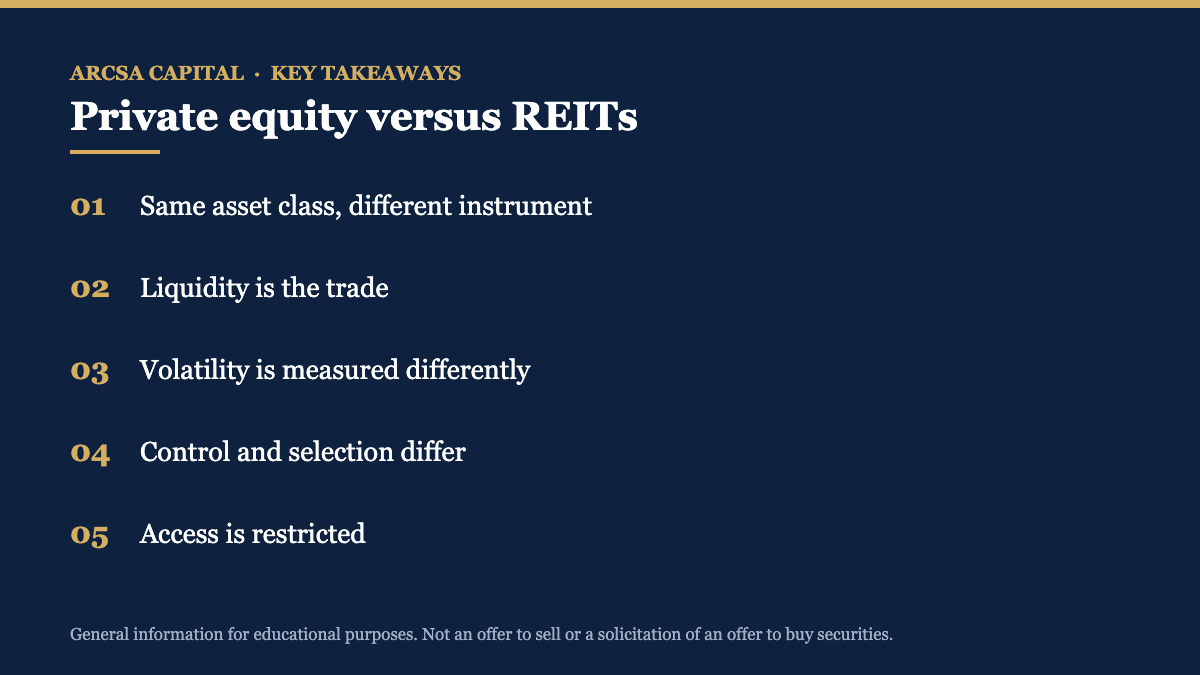
- Same asset class, different instrument. A REIT is a listed security priced every day by the stock market. Private equity real estate is an ownership interest priced by appraisal and, finally, by the sale of the assets.
- Liquidity is the trade. REIT shares can be sold in seconds. Private equity interests generally cannot be sold at all before the vehicle exits, and investors should be compensated for that constraint, not surprised by it.
- Volatility is measured differently. REIT prices move with equity markets and interest-rate expectations. Private valuations move slowly, which lowers reported volatility without lowering the underlying property risk.
- Control and selection differ. A private equity manager chooses specific assets and executes a business plan. A REIT investor buys a diversified, already-assembled portfolio and its management team.
- Access is restricted. REITs are available to the general public. Private equity real estate offered under Regulation D is limited to accredited investors, whose status must be verified under Rule 506(c).
Frequently asked questions about private equity versus REITs
What is the difference between private equity real estate and a REIT?
A REIT is a company that owns or finances income-producing property and distributes most of its taxable income to shareholders; listed REITs trade on an exchange. Private equity real estate pools capital in an unregistered vehicle, such as a limited partnership or LLC, to acquire, improve and sell specific assets. The first is a liquid security with daily pricing; the second is an illiquid partnership interest with a defined strategy and term.
Why would an investor accept the illiquidity of private equity?
Because some strategies cannot be run inside a listed vehicle. Buying distressed or mispriced residential assets one by one, renovating them and selling them requires discretion, speed and tolerance for uneven cash flows. Investors who can commit capital for the full term may gain access to that kind of execution-driven return, with the corresponding risk that results fall short of the target.
Are REITs less risky than private equity real estate?
They carry different risks. REITs add stock-market volatility and sensitivity to interest rates, and they can trade well above or below the value of their properties. Private equity concentrates risk in fewer assets, a single manager and a fixed horizon, and offers no exit on demand. Neither is safer in general; suitability depends on the investor’s horizon, liquidity needs and capacity for loss.
Can both belong in the same portfolio?
Yes. Many allocators use REITs for liquid, diversified exposure and private equity for targeted strategies where manager skill is expected to matter. The proportion depends on how much of the portfolio can remain locked up and on the investor’s ability to perform due diligence on private sponsors.
What should be reviewed before choosing a private equity real estate fund?
The offering documents, the fee and distribution structure, the sponsor’s realized results, leverage limits, valuation policy and the process for verifying accredited status. Any target return is an objective based on assumptions, not a commitment, and investors may lose part or all of their capital.
Important disclosures
Not an offer. This article is for informational and educational purposes only and does not constitute an offer to sell, a solicitation of an offer to buy, or a recommendation of any security. No offer is or will be made except pursuant to definitive subscription documentation delivered to investors whose accredited status has been verified.
Exempt offering; no regulatory approval. Interests in vehicles managed by ARCSA Capital are not registered under the Securities Act of 1933 and are offered in reliance on an exemption under Regulation D. Neither the SEC nor any other federal or state authority has reviewed, endorsed or approved this offering or passed upon its merits; any representation to the contrary is unlawful. ARCSA Capital is not registered as an investment adviser or as a broker-dealer. Participation is limited to accredited investors as defined in Rule 501(a), whose status is verified with documentation before any subscription — self-certification is not sufficient and is not accepted.
Target returns. Any return figure presented is an underwriting objective based on strategy assumptions and market conditions at the date of publication. It is not a promise, not fixed income and not a commitment to distribute. Actual results may differ materially. Past performance, whether of ARCSA Capital or of affiliated entities, is not indicative of future results.
Risk and liquidity. Private real estate investing involves substantial risk, including the total loss of capital: market, execution, liquidity, leverage, valuation, regulatory and tax risk. Interests are illiquid, subject to transfer restrictions, and no secondary market exists or is expected to develop.
Forward-looking statements; no advice. This article may contain forward-looking statements, inherently subject to risks and uncertainties; no assurance is given as to any projection or scenario. Nothing here is investment, legal or tax advice, and reading it creates no advisory or fiduciary relationship. Consult your own advisers before making any investment decision. Full disclosures: Legal Hub.
