

When sophisticated capital looks at Florida, it is rarely chasing headlines. It is studying basis, legal structure, liquidity timing, and manager control. That is where real estate investment funds in Florida begin to separate into two very different categories: vehicles built for marketing, and vehicles built for disciplined capital allocation. The distinction is not always visible in the offering documents — it becomes apparent only when you examine the manager’s track record under adverse conditions.
For accredited investors, family offices, and cross-border allocators, Florida remains compelling for reasons that go well beyond migration trends. The state offers deep transaction flow, international demand, favorable tax positioning relative to many other US jurisdictions, and a residential market that still produces inefficiencies for operators with genuine local access. But the quality of the opportunity is not determined by geography alone. It is determined by the fund architecture, the underwriting discipline behind each acquisition, and the manager’s demonstrated ability to control the full investment cycle from sourcing to exit.
Whether you are evaluating real estate investment funds in Florida for the first time or reallocating from underperforming vehicles, the selection criteria must begin with legal structure, not projected returns. The right institutional investment strategy starts with understanding what the fund is actually built to do — and who controls capital decisions when market conditions shift against the original thesis.
Table of Contents
What Makes Real Estate Investment Funds in Florida Different From Generic Vehicles
Not all fund structures are designed with the same priorities. The distinction between core-plus, value-add, and opportunistic mandates determines everything from holding periods to leverage tolerance to the kind of local operational capacity the manager must maintain. According to CBRE’s U.S. Real Estate Market Outlook, demand for structured investment vehicles in Sun Belt markets continues to accelerate — but so does the gap between top-quartile and median-quartile returns. Manager selection is the primary driver of that gap, not geography or asset type selection.

For allocators examining real estate investment funds in Florida within a broader portfolio context, the key variable is the manager’s sourcing advantage and execution discipline. Without those two elements, opportunistic quickly becomes speculative. JLL’s private equity real estate research consistently shows that manager selection drives more variance in outcomes than market selection at the asset class level. This holds particularly true in high-velocity markets like South Florida where execution speed and local network depth determine entry quality on off-market transactions.
In Florida, this distinction is especially important. The most crowded transactions often happen in marketed processes where pricing efficiency leaves little room for error. By contrast, off-market or special-situation residential acquisitions can create meaningful entry discounts and shorter monetization windows — but only if the sponsor has local intelligence, legal precision, and construction control at every stage of the value-creation process. Deals won on marketing materials alone rarely survive contact with operational reality in a competitive market.
Sophisticated operators managing real estate investment funds in Florida have increasingly focused on operational infrastructure as the primary differentiator. Execution at scale — across acquisitions, renovations, and exits — requires vendor relationships, municipal knowledge, and construction supervision that no financial model can replicate. NAR’s commercial real estate research highlights how Florida’s transaction volume remains among the highest nationally, underscoring why operational depth separates consistent performers from the broader field over full market cycles.
How to Evaluate a Florida Real Estate Fund Manager Before Allocating Capital
Legal architecture matters as much as operational capacity. Whether a fund is structured as an LLC, LP, or a more complex series structure affects everything from investor protections to tax pass-through efficiency to the ease of recourse if a manager deviates from stated strategy. Allocators evaluating real estate investment funds in Florida should always request a full legal opinion on the operating agreement — not just the offering memorandum summary. The two documents often tell different stories about control rights, fee structures, and exit discretion. Review our updated Target Annual Returns framework to understand how we approach capital distribution under strict risk parameters.
Beyond the legal documents, evaluating a manager’s historical deal-level performance is essential. Ask specifically about deals that did not go according to plan — how the manager communicated with investors, how losses were managed, and whether the operating agreement gave investors any meaningful recourse. A manager who has never faced adversity is not necessarily strong; they may simply be early in their cycle. The strongest real estate strategies for wealth managers are built by operators who have experienced market stress and constructed systems specifically to navigate it with capital intact.

For that reason, some of the strongest real estate investment funds in Florida are not the largest by headline assets under management. They are the ones with repeatable operational rhythm, strict deal selection criteria, and enough local market command to identify and act on opportunities before the broader institutional market prices them efficiently. Size can create its own blind spots, particularly in the mid-market residential and mixed-use segments where differentiated local access matters most.
Florida-Specific Risks Sophisticated Investors Should Not Ignore
No serious discussion of Florida is complete without addressing risk with full candor. Insurance is an obvious pressure point, particularly in coastal markets. A manager’s underwriting must account not only for current premiums but for the realistic possibility of significant repricing as climate-related actuarial models evolve. The SEC’s guidance on private placement investments reinforces that accredited investors evaluating any fund structure should fully scrutinize the risk disclosures — including market-specific exposures that generic fund language may aggregate or understate in ways that obscure the actual risk profile.
The same applies to property taxes after reassessment and to construction budgets in labor-constrained submarkets. Liquidity is also frequently misunderstood — Florida is active, but active does not mean liquid at every price point or in every cycle. A fund that cannot execute a clear exit strategy under rate environment stress is not a vehicle — it is a structurally deferred problem with attractive projected returns on the cover page.
Understanding the SEC’s accredited investor framework is essential before entering any private fund structure. Evaluating real estate investment funds in Florida through that lens — with full diligence on the manager, the legal structure, and the asset-level underwriting — is what separates capital preservation from capital at risk. Every allocation decision should begin with the question: what does this manager do better than anyone else in this specific market?
ARCSA Capital operates exclusively within this institutional framework. Our real estate investment funds in Florida are structured for accredited investors who prioritize legal precision, manager accountability, and defensible underwriting over headline yield projections. Every fund vehicle we manage is designed to withstand the scrutiny of the most demanding institutional allocation process — because that is the only standard worth building to.
📷 Cover image: free-to-use photo. Source: Pexels.com. Available under the Pexels License.

Comparing Real Estate Investment Funds in South Florida?
ARCSA Capital sources off-market, quotes insurance before bidding and reports to investors quarterly with gross-to-net reconciliation.
Request InformationReal Estate Investment Funds: 7 Points at a Glance
Florida attracts more private capital than almost any other state, and that abundance is precisely why selection matters. The seven points below are what separates real estate investment funds that survive a full cycle from those that only look good during the raise.
- Basis discipline over market thesis. Everybody can recite the Florida migration story. Real estate investment funds that perform buy below replacement cost anyway, because the thesis is already in the price of anything marketed.
- Insurance quoted, not estimated. Windstorm and flood premiums have repriced dramatically. A Florida underwriting built on a premium from three years ago is not conservative, it is obsolete.
- Association and structural risk priced in. Since Florida tightened inspection and reserve requirements, condominium exposure inside real estate investment funds must be modeled with the assessment, not around it.
- Fixed-rate financing with headroom. Debt maturing inside the business plan horizon converts a property strategy into a refinancing bet the investor never agreed to take.
- Construction controlled in-house or contracted firmly. Permitting timelines and contractor capacity are the two variables that most often break a Florida business plan.
- Independent administration and audit. Sponsor-struck valuations are the mechanism through which losses stay invisible until they are unrecoverable.
- Concentration disclosed honestly. Several assets in one corridor is a single bet, and real estate investment funds that describe it as diversification are describing something else.
Every one of these is verifiable before subscription. That is the practical test: the strongest real estate investment funds leave an evidence trail, and a sponsor who resists producing it has answered the question before you asked it.
What Regulators and Public Filings Reveal About Real Estate Investment Funds
Private real estate investment funds in the United States are almost always offered under Regulation D, which means no regulator reviewed or approved the offering and the investor protection comes from documents the sponsor drafted. That single fact should reorder diligence toward the limited partnership agreement and away from the presentation.
Public filings still resolve a great deal in the first hour. A Form D shows when the offering began and how much has genuinely been raised, and an adviser filing discloses assets under management, conflicts and disciplinary history. Discrepancies between what a sponsor tells regulators and what appears in the deck are the most efficient red flag available.
Florida then adds a verification layer that almost nobody uses. Deeds, mortgages, permits and code enforcement records are public at county level, so a claimed track record can be confirmed property by property. When real estate investment funds present twelve completed repositions, the records either exist or they do not.
Offering filings, adviser registrations and enforcement history for any United States sponsor are searchable through the U.S. Securities and Exchange Commission, and confirming them should precede a commitment to any private fund rather than follow it.
what-makes-florida-different-for-real-es
Four characteristics separate this market from the rest of the country, and each one changes how a fund should be underwritten rather than simply where it should buy.
demand-that-comes-from-several-economies
South Florida draws capital and residents from Latin America, the northeast United States and Europe simultaneously. That diversity does not prevent price declines, but it shortens the periods during which an asset cannot be sold at any reasonable price. For real estate investment funds, the practical benefit shows up as exit optionality rather than as higher appreciation.
insurance-as-a-primary-underwriting-vari
In most markets insurance is a modest line item. In coastal Florida it can rival property taxes as the largest operating expense, and it varies enormously by elevation, construction type, roof age and claims history. Two apparently comparable buildings can carry premiums that differ by a multiple, which is why real estate investment funds operating here quote insurance before they bid rather than after.
condominium-law-that-reprices-older-inve
Florida tightened structural inspection and reserve funding requirements for condominium associations, and the effect on values has been uneven. Buildings with funded reserves and completed inspections command a premium; those facing large assessments trade at a discount that is often larger than the assessment itself. That dispersion is an opportunity for funds that read reserve studies and a trap for those that do not.
tax-treatment-that-improves-net-outcomes
The absence of a state income tax improves after-tax results for operators and investors, and continues to attract both. It is a genuine advantage, but it is also the most widely known fact about the state, which means it is fully reflected in pricing. Real estate investment funds that present it as their edge are describing a condition, not a strategy.
Taken together these four factors explain a pattern visible across cycles: in Florida, the spread between the best and worst performing real estate investment funds is unusually wide. The market rewards operational competence in insurance, construction and association management far more than it rewards a correct macro view, and those capabilities are exactly what an investor should be verifying.

Common Mistakes Investors Make With Real Estate Investment Funds
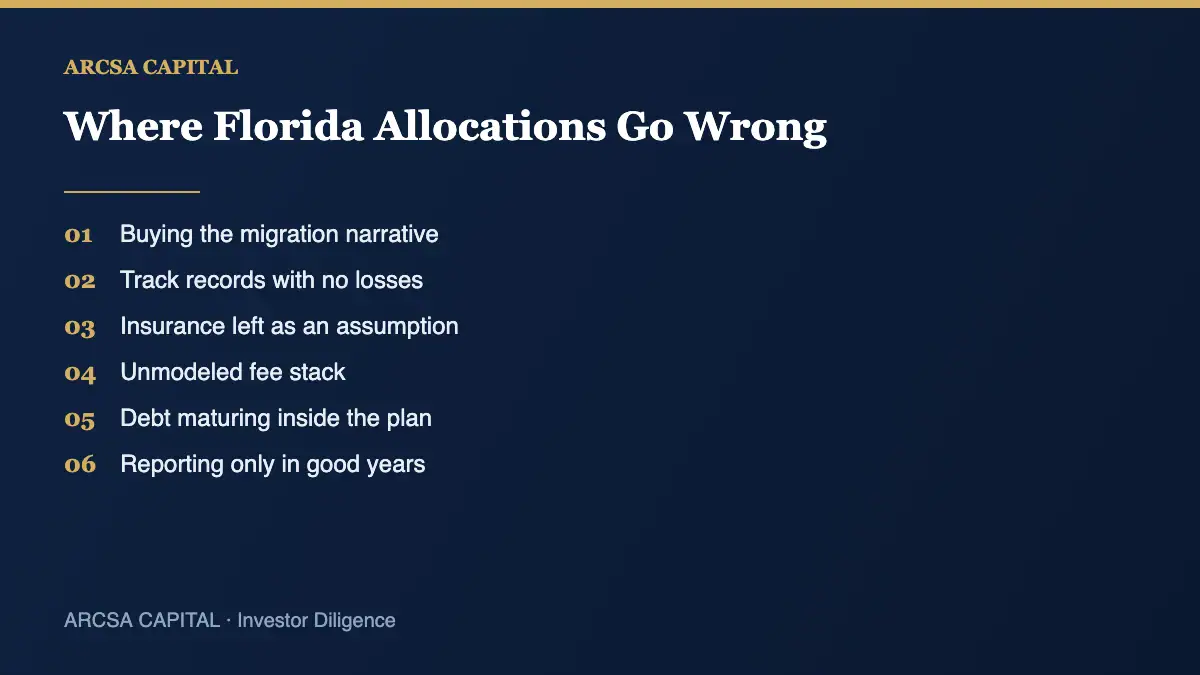
These six errors account for most disappointing outcomes among Florida allocations, and none of them require market expertise to detect.
- Buying the migration narrative rather than the asset. Population growth supports demand; it does not make an overpriced entry work.
- Accepting a track record with no realized losses. Across a full cycle that reads as incomplete disclosure, not excellence.
- Leaving insurance as an assumption. In Florida this line item alone can move a projected return by several hundred basis points.
- Ignoring the fee stack. Acquisition, construction, asset management and disposition fees compound, and real estate investment funds rarely present them together in one table.
- Overlooking the debt maturity wall. Financing that matures before the business plan completes is the most common cause of a forced sale.
- Treating quarterly reporting as optional. Managers who report irregularly during good years report nothing during bad ones.
The connecting theme is that Florida rewards operators and punishes tourists. Real estate investment funds run by teams who control construction, insurance and leasing in this specific market behave differently under stress than those who allocate into it from elsewhere.
How to Evaluate Real Estate Investment Funds in 30 Days
Week 1 — Verify the sponsor and the filings
Confirm the entity, locate the offering filing, check adviser status and read the risk factors. That section is written by lawyers to be accurate, which makes it the most informative part of the document.
Week 2 — Reconstruct the track record from county records
Take three claimed transactions and confirm them against deeds and permits. Real estate investment funds with a genuine Florida operating history welcome the exercise, and it takes less than a day.
Week 3 — Rebuild the cost stack yourself
Model insurance at current quoted rates, taxes at reassessed value, association dues and a maintenance reserve. Compare your number with the sponsor pro forma and ask about every gap.
Week 4 — Stress the plan and meet the operators
Request the model with exit values down twenty percent and financing costs up two hundred basis points, then speak with whoever runs construction rather than with the capital raiser.
Frequently Asked Questions About Real Estate Investment Funds
Why do so many real estate investment funds concentrate in Florida?
Demand diversity and tax treatment. Florida draws capital and residents from Latin America, the northeast United States and Europe at the same time, and the absence of a state income tax improves after-tax outcomes for both operators and investors. The consequence is competition, which makes sourcing the real differentiator.
How much does insurance actually affect returns here?
Enough to decide the outcome. Coastal and older inventory has seen premiums multiply, and in some coastal assets insurance now rivals property tax as the largest operating expense. Any Florida model without a current bindable quote is an estimate wearing the clothes of an underwriting.
Are condominiums riskier than single-family in this market?
Different rather than uniformly riskier. Florida tightened structural inspection and reserve funding requirements, so condominium assets carry assessment risk that must be modeled explicitly. Real estate investment funds that underwrite the reserve study rather than the amenity list handle that exposure well.
What minimum commitment is typical?
Most private vehicles accept accredited or qualified investors from around two hundred fifty thousand dollars, with co-investments sometimes lower. The minimum describes the vehicle, not the quality of the process behind it.
Key Takeaways on Real Estate Investment Funds
- Florida demand is real and already priced in, so entry basis remains the variable that decides returns.
- Insurance and association exposure must be quoted and modeled, never assumed.
- Verify realized exits against county records before evaluating any projection.
- Independent administration and audit are screening gates rather than preferences.
- The strongest real estate investment funds in this market are operators first and allocators second.
ARCSA Capital operates a South Florida real estate platform with off-market sourcing, committee underwriting, in-house construction management and quarterly investor reporting. Reviewing a live transaction with its underwriting and documents attached is the fastest way to compare it against other real estate investment funds you are considering.
Review a Live Transaction Before Choosing Between Real Estate Investment Funds
See the underwriting, the insurance quote, the fee stack and the realized track record.
Request InformationImportant disclosures
Not an offer. This article is for informational and educational purposes only and does not constitute an offer to sell, a solicitation of an offer to buy, or a recommendation of any security. No offer is or will be made except pursuant to definitive subscription documentation delivered to investors whose accredited status has been verified.
Exempt offering; no regulatory approval. Interests in vehicles managed by ARCSA Capital are not registered under the Securities Act of 1933 and are offered in reliance on an exemption under Regulation D. Neither the SEC nor any other federal or state authority has reviewed, endorsed or approved this offering or passed upon its merits; any representation to the contrary is unlawful. ARCSA Capital is not registered as an investment adviser or as a broker-dealer. Participation is limited to accredited investors as defined in Rule 501(a), whose status is verified with documentation before any subscription — self-certification is not sufficient and is not accepted.
Target returns. Any return figure presented is an underwriting objective based on strategy assumptions and market conditions at the date of publication. It is not a promise, not fixed income and not a commitment to distribute. Actual results may differ materially. Past performance, whether of ARCSA Capital or of affiliated entities, is not indicative of future results.
Risk and liquidity. Private real estate investing involves substantial risk, including the total loss of capital: market, execution, liquidity, leverage, valuation, regulatory and tax risk. Interests are illiquid, subject to transfer restrictions, and no secondary market exists or is expected to develop.
Forward-looking statements; no advice. This article may contain forward-looking statements, inherently subject to risks and uncertainties; no assurance is given as to any projection or scenario. Nothing here is investment, legal or tax advice, and reading it creates no advisory or fiduciary relationship. Consult your own advisers before making any investment decision. Full disclosures: Legal Hub.
