


A private real estate offering can present an elegant investment thesis, institutional legal documents, and attractive projected returns while still leaving the central question unanswered: how to evaluate sponsor alignment when capital is committed for years, decisions are delegated, and information is inherently asymmetric.
For sophisticated Limited Partners, sponsor alignment is not a branding exercise or a reference to the sponsor’s personal investment in the vehicle. It is the architecture that determines whether the General Partner is rewarded for preserving capital, executing with discipline, communicating adverse developments early, and realizing value at the right moment. It should be visible in economics, governance, underwriting authority, reporting, and behavior under pressure.
Contents
How to Evaluate Sponsor Alignment Before Commitment
The first test is simple: identify what the sponsor earns, when it earns it, and what must happen before those economics become meaningful. A sponsor whose compensation is primarily detached from investor outcomes may have incentives to grow assets under management, extend holding periods, or pursue transactions that increase fees without proportionately improving net returns.
That does not mean management fees are inherently misaligned. In institutional private real estate, a reasonable management fee funds sourcing, underwriting, asset management, compliance, investor reporting, and the operating infrastructure required to protect a portfolio. The question is whether the fee design is proportionate to the mandate and whether performance-based compensation is structured around actual distributions and clearly defined investor priority returns.
A disciplined review separates gross asset-level performance from net LP economics. Ask to see the full waterfall, not merely the headline carry percentage. Determine whether there is a preferred return, a catch-up provision, deal-by-deal carry, or an aggregate whole-fund calculation. Each can be appropriate in a particular strategy, but each distributes risk differently between the GP and its investors.
For a short-duration value-add strategy, timing deserves special scrutiny. If the model depends on acquiring distressed or special-situation residential assets, rehabilitating them, and executing accelerated exits, the incentive framework should not encourage a rushed sale simply to crystallize carried interest. Equally, it should not reward holding an asset past its optimal disposition window merely to preserve management fees. Sponsor alignment exists when the sponsor has a credible process for making that trade-off, documenting it, and reporting it.
Follow the Sponsor’s Capital
Evaluating sponsor alignment requires looking beyond how much the GP has committed and examining the terms on which that commitment is made. A sponsor may invest capital through a different share class, receive preferential liquidity, finance its commitment through arrangements that dilute its economic exposure, or retain discretionary rights that alter the practical risk it bears.
Ask whether the sponsor’s capital is invested on substantially the same economic terms as LP capital. If terms differ, the distinction should be disclosed plainly and justified. There may be legitimate reasons for differentiated economics, particularly in complex cross-border structures, but opacity is not one of them.
The quality of the commitment also matters. A large commitment from a sponsor with substantial net worth can indicate conviction. A smaller contribution may still be meaningful when the sponsor’s principal reputation, operational franchise, and future fund-raising capacity are directly exposed to performance. The relevant question is whether a poor outcome would create a material consequence for the decision-makers, not whether a single percentage meets an arbitrary threshold.
Look beyond the sponsor entity and identify the individuals with authority over acquisitions, leverage, renovations, dispositions, and exceptions to the underwriting model. Their personal and professional exposure should be clear. In a concentrated strategy, a committee structure with defined approvals can provide more protection than reliance on one principal’s informal judgment.
Examine Decision Rights, Not Just Disclosures
A polished quarterly report is useful, but reporting does not substitute for governance. Examining decision rights is a structural dimension of sponsor alignment that LPs often underweight. Investors should understand which decisions the GP can make unilaterally and which require advisory committee review, investor consent, or an independent valuation process.
The most consequential provisions often sit deep in the operating agreement or limited partnership agreement. They include related-party transactions, borrowing limits, changes to investment criteria, extensions of the fund term, valuation methodology, conflicts of interest, key-person events, and the ability to recycle proceeds. These provisions establish the sponsor’s true operating perimeter.
A sponsor with broad discretion is not necessarily unsuitable. Opportunity-driven strategies often require speed, especially when sourcing off-market assets in Miami or other supply-constrained Florida submarkets. Yet speed must coexist with boundaries. The strongest structures define investment parameters in advance, establish escalation procedures for material deviations, and maintain an auditable record of approvals.
Pay particular attention to conflicts. Does the sponsor manage adjacent vehicles with overlapping mandates? Can an asset be allocated among funds at the sponsor’s discretion? Are construction, brokerage, property management, financing, or advisory services provided by affiliates? Depending on the offering structure, sponsors subject to SEC oversight must disclose these arrangements in prescribed forms. The disclosure should explain pricing, approval rights, and how conflicts are resolved.
Testing sponsor alignment before your next allocation?
ARCSA Capital documents general partner capital, conflicts and asset level reporting so investors can verify rather than assume.
Request InformationTest Alignment Through the Underwriting Process
Sponsor alignment is operational before it is contractual. A sponsor can have a well-designed waterfall yet still create risk through aggressive acquisition assumptions, under-reserved rehabilitation budgets, weak title diligence, or insufficient controls over third-party vendors.
Request a clear view of the underwriting discipline. The objective is not to obtain proprietary sourcing information or to second-guess every assumption. It is to determine whether the sponsor has a repeatable decision framework and whether its downside cases are treated as real operating scenarios rather than presentation-page footnotes.
In prime residential value-add investing, this includes acquisition basis, comparable sales methodology, renovation scope, contingency reserves, permitting exposure, carrying costs, financing assumptions, liquidity assumptions, and exit sensitivity. A sponsor should be able to explain which variables it controls directly and which are subject to market conditions.
The distinction is material. A GP may control purchase discipline, project oversight, legal structuring, and disposition readiness. It cannot control interest-rate movements, insurer requirements, buyer demand, municipal processing times, or sudden changes in local liquidity. Sponsor alignment improves when the GP communicates this distinction with precision and avoids converting forecasts into implied certainty.
Evaluating Sponsor Alignment in a Private Real Estate Fund?
ARCSA Capital structures its economics, governance, and reporting to align with LP outcomes at every stage of the investment cycle.
Speak with Our TeamReview the Reporting Standard Before There Is a Problem
Most relationships look aligned when assets are performing. The revealing moment is when a renovation is delayed, a buyer retrades, a title matter emerges, or an exit must be postponed. Investors should assess whether the sponsor’s reporting framework is designed to deliver inconvenient facts early enough for governance to be meaningful.
Institutional reporting should address realized and unrealized performance separately, explain material variances against the original underwriting, disclose leverage and liquidity, and identify any changes to timing or business plan. It should also distinguish sponsor commentary from third-party facts, including valuation support and material legal or regulatory developments.
For international investors, this standard should extend to tax and entity-level transparency. A parallel fund structure, for example, may offer legitimate planning efficiencies, but it also requires clarity regarding investor eligibility, tax reporting, governance, cash flows, and the relationship between vehicles. Cross-border sophistication is valuable only when it reduces ambiguity rather than adding another layer of it.
Questions That Reveal the Quality of Alignment
Before allocating capital, an LP or advisor should be able to obtain direct, specific answers to several questions:
- What portion of GP economics is earned before LPs receive distributions, and what portion depends on realized performance?
- Is the GP commitment invested on comparable terms, and who ultimately bears that exposure?
- Which decisions can change the original investment mandate, and what approvals are required?
- How are conflicts, related-party services, and allocation decisions between vehicles documented?
- What has the sponsor done in prior investments when timing, costs, or liquidity moved against the original plan?
- What information will be reported, how frequently, and who validates valuations, financial statements, and material compliance matters?
The quality of the response matters as much as the response itself — and is itself a measure of sponsor alignment. Precise answers, supporting documentation, and a willingness to address adverse scenarios suggest an institutional culture. Deflection, undefined discretion, or excessive reliance on headline returns should be treated as information in its own right.
Alignment Is a System of Accountability
No legal document eliminates investment risk. Nor does a GP commitment make a strategy suitable for every investor. Sponsor alignment must be assessed in the context of the vehicle’s liquidity profile, concentration, leverage, tax considerations, term, and the investor’s own mandate.
For capital seeking access to private real estate opportunities unavailable in the open market, the sponsor is not merely a manager of assets. It is the steward of underwriting discipline, legal order, operational execution, and investor trust. Firms such as ARCSA Capital are evaluated not only by their ability to source and reposition assets, but by whether the full investment structure makes prudent behavior the economically rational choice.
The most valuable diligence outcome is not complete certainty. It is a clear view of who holds discretion, who bears consequences, and whether the sponsor’s incentives remain aligned with capital preservation when the transaction becomes difficult.
Invest With a Team Whose Interests Are Aligned With Yours
ARCSA Capital provides family offices and institutional investors with direct access to value-add real estate — with clear sponsor alignment built into every fund structure we operate.
Speak with Our TeamSponsor Alignment: 8 Points at a Glance
Alignment is the word every private fund deck uses and very few define. The eight points below convert sponsor alignment from a marketing claim into a set of provisions an investor can read, verify and, where necessary, negotiate.
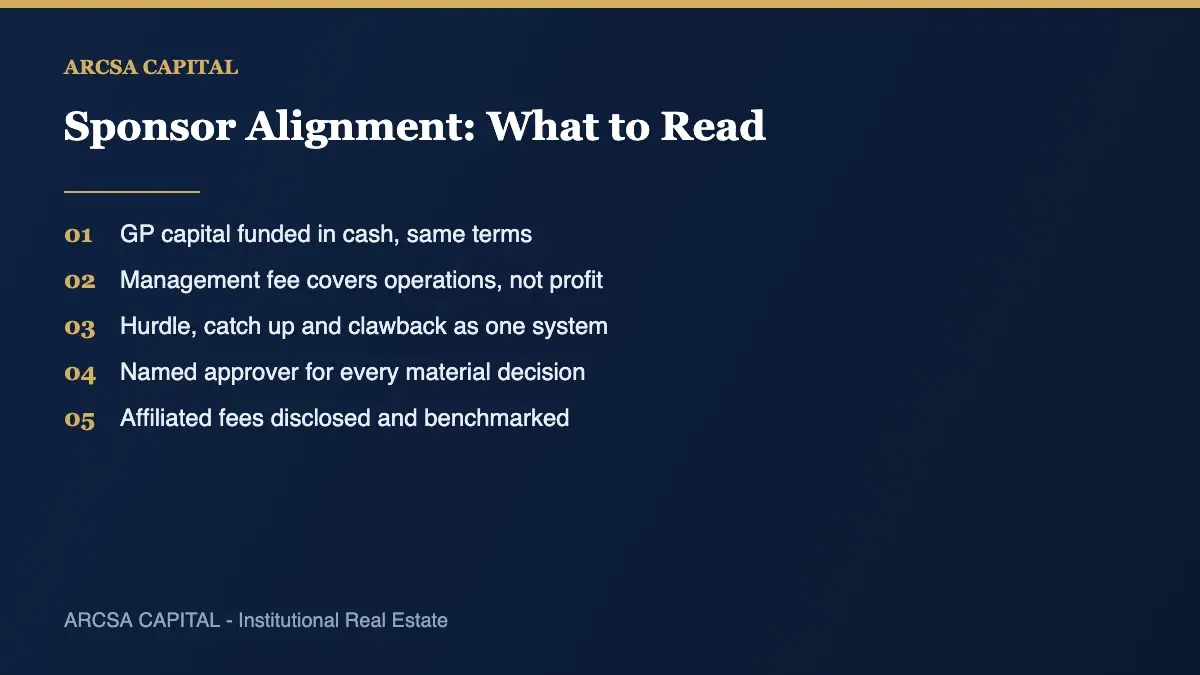
- Committed capital. Real sponsor alignment starts with meaningful general partner capital at risk on the same terms as limited partners, funded in cash rather than credited through fees.
- Fee architecture. Management fees should cover operations, not create profit, so that the sponsor earns primarily through performance.
- Waterfall design. Hurdle, catch up and clawback provisions determine whether the sponsor is paid before or after investors receive their capital back.
- Decision rights. Who approves an acquisition, a change of scope, an extension or a sale tells you more about alignment than any narrative section.
- Conflict policy. Affiliated service providers, co investment allocation and cross fund transactions must be disclosed and governed in writing.
- Reporting cadence. Timely reporting including bad news is the operational expression of sponsor alignment.
- Key person and removal provisions. Alignment that cannot survive a departure or be enforced is not alignment.
- Track record transparency. Realized outcomes, including the disappointing ones, disclosed at the transaction level.
Together these eight points describe alignment as a system rather than a sentiment. A sponsor may be honest and capable and still be structurally misaligned, which is precisely why sponsor alignment is assessed through documents instead of through impressions formed in a meeting.
What Regulators and Public Filings Reveal About Sponsor Alignment
Private funds sold to qualified investors are governed by federal rules on private offerings, conflicts disclosure and fiduciary conduct. Those rules require that conflicts be disclosed and, in many cases, consented to, which means the offering documents are the primary evidence of how sponsor alignment is actually structured rather than how it is described.
Adviser filings and disclosure documents are also public in many cases. Where a sponsor or an affiliate is a registered investment adviser, the disclosure brochure describes fee practices, affiliated relationships and disciplinary history. Reading that document alongside the private placement memorandum frequently reveals divergences worth raising directly.
Public records support the same exercise at the asset level. Recorded deeds, mortgages, liens and permit histories let an investor verify acquisition prices, capital deployed and timelines independently, which converts a track record from a claim into a set of facts.
Before subscribing, confirm how the sponsor discloses conflicts, allocates opportunities and reports performance. The investor guidance published by the U.S. Securities and Exchange Commission sets out what proper disclosure looks like and is a practical benchmark for testing sponsor alignment.
Common Mistakes Investors Make With Sponsor Alignment
Investors rarely misjudge a sponsor because information was unavailable. They misjudge because the wrong evidence was weighted most heavily.
- Accepting a stated general partner commitment without confirming that it is funded in cash rather than waived fees.
- Reading the headline carried interest while ignoring the hurdle, the catch up and whether a clawback exists.
- Treating a strong personal relationship with the principals as a substitute for structural sponsor alignment.
- Overlooking affiliated property management, construction or brokerage fees paid at the asset level.
- Ignoring how co investment opportunities are allocated among the sponsor, its affiliates and the fund.
- Assuming that reporting will improve after closing when the agreement requires only annual disclosure.
- Failing to test what happens if a key person leaves or if investors want to remove the manager.
Each of these items is discoverable before wiring capital. The purpose of a sponsor alignment review is not to find a perfect structure but to know precisely where the friction sits and to price it consciously.
How to Evaluate Sponsor Alignment in 30 Days
Week 1 – Read the economics end to end
Work through management fee, acquisition and disposition fees, affiliated service fees, hurdle, catch up, carried interest and clawback as a single system. Model a mediocre outcome as well as a strong one. Sponsor alignment is revealed by who is paid, and how much, when results are merely acceptable.
Week 2 – Map the decision rights
List every decision that materially affects outcomes and identify who approves it. Acquisitions, budget overruns, hold extensions, refinancing and sales should each have a named approver and, where appropriate, an advisory committee consent. Concentrated discretion without oversight is the most common structural weakness.
Week 3 – Verify the track record independently
Select four completed transactions and confirm acquisition price, capital deployed, permits, timeline and sale price through public records. A sponsor with genuine alignment will provide the addresses and encourage verification rather than offer aggregated figures only.
Week 4 – Interrogate the conflicts
Ask directly which affiliates are paid by the fund, at what rates, and how those rates compare to market. Ask how a transaction is allocated when two vehicles could pursue it. The quality of the answers, and the willingness to put them in writing, is the practical test of sponsor alignment.

Frequently Asked Questions About Sponsor Alignment
How much general partner capital indicates genuine alignment?
There is no universal threshold, but the commitment should be material relative to the principals own net worth rather than relative to the fund size alone. A large percentage of a small fund can mean less than a modest percentage backed by real personal exposure. Ask how it is funded and whether it is subject to the same fees.
Is a preferred return enough to ensure sponsor alignment?
It helps, but it is only one component. A preferred return combined with a full catch up, no clawback and substantial affiliated fees can still leave a sponsor well compensated in a mediocre outcome. The provisions must be evaluated together rather than individually.
Are affiliated service providers always a problem?
No. Vertically integrated sponsors often deliver better execution precisely because construction and management sit in house. The issue is disclosure and pricing. Affiliated fees should be disclosed, benchmarked and, ideally, subject to advisory committee review.
What reporting should investors require?
Quarterly reporting at minimum, with asset level detail, variance against underwriting and audited annual financial statements prepared by an independent auditor. Sponsor alignment is visible in whether difficult quarters are reported with the same clarity as strong ones.
What is the strongest single indicator?
Behavior when results disappoint. Ask for an example of a transaction that underperformed and how the sponsor communicated and responded. The answer, and whether it can be corroborated with an existing investor, tells you more than any provision read in isolation.
Key Takeaways on Sponsor Alignment
- Sponsor alignment is a system of provisions, not a statement of intent.
- General partner capital should be funded in cash and exposed on the same terms.
- Evaluate hurdle, catch up, clawback and affiliated fees together, never separately.
- Decision rights and advisory committee consent matter as much as economics.
- Verify the track record through public records rather than through summaries.
- Reporting quality in a bad quarter is the clearest behavioral evidence.
- Know where the friction is and price it consciously instead of hoping it disappears.
ARCSA Capital structures its vehicles around documented sponsor alignment, with general partner capital at risk, disclosed conflicts and asset level reporting across prime residential investments in Miami and selected Florida submarkets. This article is general information and does not constitute legal, tax or investment advice.
Sponsor alignment you can read in the documents
Speak with our team about structure, governance and reporting across prime residential assets in South Florida.
Request InformationOr model your own scenario in the investment simulator
Or receive the ARCSA Capital investment thesis by email, with the entry, stabilisation and exit assumptions behind the strategy:
