

Not every private transaction is a disciplined opportunity. An institutional off market acquisition process begins long before a letter of intent. It is built on local intelligence, repeat counterparties, legal readiness, and a disciplined view of what the asset can become after acquisition. In Miami and select Florida residential submarkets, this means evaluating properties affected by deferred maintenance, estate transitions, partnership disputes, incomplete renovations, or owners requiring certainty over publicity.
The distinction matters. A seller may accept a lower headline price in exchange for a credible close, limited contingencies, privacy, and a buyer able to absorb operational complexity. But that does not make every private transaction a superior opportunity. Off-market sourcing reduces competition. It does not eliminate risk. An institutional-grade process treats both as separate variables.
Contents
What Defines an Institutional Off Market Acquisition Process
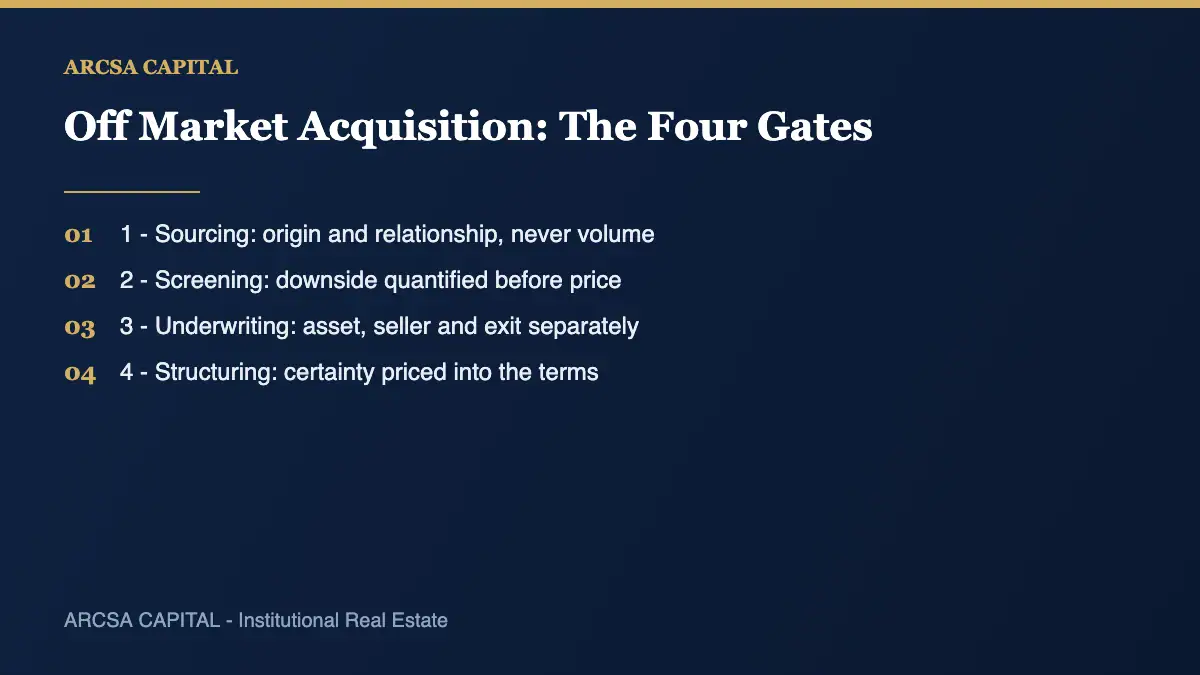
An institutional off market acquisition process is not a transaction methodology. It is a system — applied consistently across sourcing, screening, underwriting, structuring, and execution. Each stage exists to reduce the probability of acquiring an asset whose risks cannot be adequately priced or controlled. The absence of market competition does not create value by itself. Value is created through the quality of analysis and control over execution.
The difference between a disciplined program and an opportunistic approach shows most clearly when markets tighten. An institutional process has defined screens that allow a manager to decline transactions when underwriting cannot be completed with confidence — regardless of sourcing advantage or prior relationship. That restraint is not caution. It is capital discipline, and it protects the portfolio across multiple cycles.
Sourcing Before the Opportunity Becomes Visible
Institutional sourcing operates in private channels — relationships with local attorneys, estate and probate representatives, asset managers, distressed owners, and operators managing incomplete repositionings. These counterparties are not using listing platforms. They value discretion, speed, and a buyer who can close without improvisation. Building access to this pipeline requires years of local presence and a track record of performing without complications.
The off-market residential sourcing advantage is real, but temporary. A transaction sourced privately still requires that the basis, execution path, and exit be underwritten to the same standard as a public-market purchase. The first stage of the off market acquisition process is confirming that the private sourcing advantage is not being used to rationalize a transaction that could not survive institutional scrutiny.
Initial Screening: Speed Without Speculation
Initial screening has one objective: determine whether an asset warrants deeper diligence. A concise preliminary model tests the relationship between acquisition price, closing costs, rehabilitation capital, carrying costs, transaction expenses, and conservative sale assumptions. It also tests time. For a value-add strategy targeting 5- to 6-month exits, a delay in permitting, procurement, or resale can change the economics materially. Time is a core underwriting variable, not an administrative detail.
At this stage, the key question is not whether the property is attractive. It is whether the downside can be measured. A prime address may fail the screen if renovation scope is uncertain, the title chain is irregular, the ownership structure creates closing risk, or the expected buyer pool is too narrow at exit. The initial screen exists to eliminate these situations before capital is committed, not after.

Evaluating an off market acquisition opportunity in South Florida?
ARCSA Capital sources, underwrites and executes prime residential transactions with institutional control from first contact to exit.
Request InformationUnderwriting the Asset, the Seller, and the Exit
A disciplined off market acquisition process underwrites three separate issues: the physical asset, the transaction counterparty, and the exit market. Each has its own variables, and each must be assessed independently before they are evaluated together. Conflating these issues is where acquisition errors typically originate.
Physical and Operational Diligence
Physical diligence covers structural integrity, mechanical systems, permit history, lien exposure, title chain, and scope validation. The renovation plan must be stress-tested against local permitting timelines, subcontractor availability, and sequencing risk. A scope that appears straightforward can expand materially when actual conditions are confirmed. Contingency reserves are not a conservative preference — they are a structural requirement for any honest underwriting.
Counterparty and Legal Diligence
Seller motivation and transaction structure require the same scrutiny as the physical asset. Estate situations, partnership disputes, and distressed ownership introduce counterparty risk that affects closing certainty. A clean diligence timetable, legal readiness, and a credible operating plan can matter more to a seller than an incremental bid. The acquisition structure must protect the buyer’s ability to walk away when diligence changes the facts — regardless of how much has been invested in the evaluation.
Exit Underwriting
Exit underwriting tests the resale market at the expected completion date, not at current conditions. Buyer pool depth, financing availability, competing inventory, and seasonal patterns all affect sale timelines and achievable price. Conservative exit assumptions are not pessimism — they are the mechanism by which the acquisition price is validated. If the exit cannot support the basis at a realistic price, the acquisition should not proceed.
Request the ARCSA Capital off market acquisition process documentation
Qualified investors can review sourcing methodology, underwriting standards, and transaction history through a confidential investor conversation.
Request InformationStructuring for Control and Certainty
Contract terms are the point at which sourcing advantage is converted into legal control. An institutional buyer negotiates inspection periods, financing contingencies, title requirements, and closing conditions that allow the full diligence scope to be completed without improvising under seller pressure. The objective is not to overpay for access. It is to structure an agreement that creates control while preserving the right to withdraw when diligence changes the facts.
This balance depends on the situation. A highly distressed asset may justify a tighter inspection period with more protective conditions. A clean, time-sensitive seller may require a shorter path to closing supported by pre-arranged legal, title, and capital coordination. Institutional readiness becomes a competitive advantage because it allows speed without improvisation. Operational transparency in this phase protects all parties.
Post-Closing Execution Is Part of Acquisition
For ARCSA Capital, control of the full investment cycle is central to the off market acquisition process. Sourcing, underwriting, rehabilitation oversight, disposition planning, and investor reporting cannot operate as disconnected functions. The acquisition decision must already account for the operational path that follows it. A property that cannot be repositioned with precision within the planned budget and timeline did not meet the underwriting standard — regardless of how it was sourced.
Post-closing execution covers contractor selection and supervision, permitting management, procurement sequencing, quality control at completion, and disposition strategy including pricing, staging, and buyer pool activation. Each is a managed activity, not a passive outcome. The value-add thesis does not close at acquisition. It closes at a documented, verified resale.
Questions Sophisticated Investors Should Ask
Before evaluating any manager’s off market acquisition process, sophisticated investors should request documentation that supports — not describes — the claims being made. Track record should include specific assets, acquisition prices, rehabilitation costs, sale prices, and timelines. SEC regulatory status and offering documentation should be verified independently. Any return targets should be explained in terms of the underlying assumptions rather than stated as a projection.
Questions that distinguish institutional programs from transactional operators: Does the manager underwrite exit conservatively or optimistically? What is the documented contingency reserve policy? How does the program respond when a specific asset underperforms? What legal entity holds each asset, and how are investor interests protected structurally? An institutional value-add framework answers each of these before capital is committed.
Evaluate the ARCSA Capital off market acquisition process
ARCSA Capital provides qualified investors with complete documentation of its sourcing methodology, underwriting standard, and historical transaction performance.
Schedule a ConversationOff Market Acquisition: 8 Points at a Glance
Before capital moves, most allocators want the sequence compressed into something they can verify line by line. The eight points below summarize how an institutional off market acquisition desk travels from first contact to funded closing, and what should be documented at each stage.
- Sourcing. A durable off market acquisition pipeline is built from repeat counterparties: probate and estate attorneys, receivers, lenders working out positions, family offices and a small group of local brokers who transact privately.
- Screening. Every candidate is measured on quantified downside first and headline price second, because a discount that cannot be defended in a slow market is not a margin of safety.
- Underwriting. The physical asset, the transaction counterparty and the exit market are underwritten as three independent risks before they are ever evaluated together.
- Legal readiness. Title chain, lien exposure, permit history and entity structure are cleared before the letter of intent is signed, not renegotiated afterwards.
- Structuring. Deposit schedule, contingency scope and closing certainty are the real currency of an off market acquisition, and they are what a motivated seller is actually buying.
- Execution. Renovation scope, permitting calendars and verified contractor capacity are priced into the entry basis on day one rather than treated as upside.
- Governance. Investment committee approval, third party diligence and a written rejection rationale sit on file for every transaction reviewed, whether closed or declined.
- Exit. The resale buyer pool, the realistic price band and historical absorption are defined before the property is bought, never discovered after the renovation is complete.
Read together, these eight points explain why two transactions that look identical on a spreadsheet can produce very different realized returns. In this segment the discipline sits in the sequence and in the willingness to stop, not in the size of the discount negotiated at the table.
What Regulators and Public Filings Reveal About Off Market Acquisition
Private transactions are not unregulated transactions. Federal securities rules governing private offerings, state licensing and disclosure requirements, anti money laundering reporting and beneficial ownership registration all apply the moment pooled institutional capital is involved. A credible off market acquisition process documents compliance while the deal is live rather than reconstructing a paper trail months later when an investor or an auditor asks.
Public records are also the most reliable counterweight to a seller narrative. County property records, recorded liens, code enforcement histories and permit files routinely contradict what a motivated owner describes in conversation. An off market acquisition team that reads primary sources instead of summaries eliminates the majority of the surprises that otherwise appear between contract and closing.
Reporting standards matter just as much after the purchase. Investors should expect the same variance reporting on a private purchase that they would receive on a syndicated deal: projected basis against realized basis, projected timeline against actual permitting, and a plain explanation whenever the two diverge.
Investors evaluating a sponsor should confirm how private offerings, investor qualification and ongoing reporting are handled before allocating to any off market acquisition strategy. The disclosure framework published by the U.S. Securities and Exchange Commission is the baseline against which every serious private real estate manager is measured.
Common Mistakes Investors Make With Off Market Acquisition
Most losses in this segment do not come from a bad market. They come from repeatable process errors that an investment committee should have caught before funds were wired.
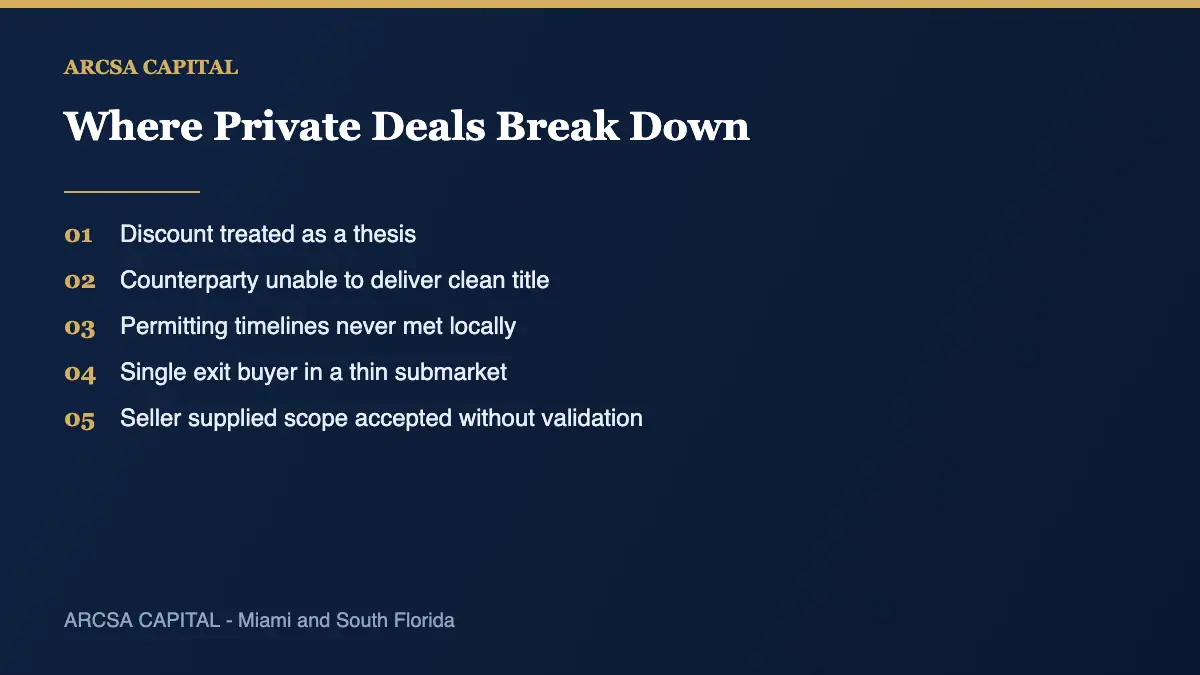
- Treating a discount as a thesis. A low entry price is an outcome, not an off market acquisition strategy.
- Underwriting the property carefully while ignoring whether the counterparty can legally deliver clean title on the agreed date.
- Assuming permitting and inspection timelines that the local jurisdiction has never actually met.
- Relying on a single exit buyer profile in a submarket with thin historical absorption.
- Accepting the seller supplied contractor bid instead of commissioning independent scope validation.
- Ignoring unpermitted work, open code violations or irregular additions that must be legalized before resale.
- Confusing speed with certainty. A fast off market acquisition without legal readiness is simply an early loss.
Every item on that list is avoidable with a written checklist and a committee that is willing to say no. The strongest off market acquisition programs decline far more transactions than they approve, and they can show you exactly why.
How to Evaluate Off Market Acquisition in 30 Days
Week 1 – Map where the deal flow actually comes from
Ask the sponsor to name the introducing party for each of its last twelve transactions. A pipeline built on repeat professional relationships behaves very differently from one assembled through cold outreach or paid lead generation. Concentration in a single source is a risk worth pricing, because relationships end and an off market acquisition program built on one channel is fragile.
Week 2 – Test the screening discipline
Request the rejection log. A credible desk can show the deals it walked away from and the specific reason for each. If almost everything reviewed was eventually purchased, the screen is decorative rather than functional, and the off market acquisition process is really a buying process with extra vocabulary.
Week 3 – Audit one closed file end to end
Read a complete file: sourcing origin, screening memo, title work, lien search, independent scope validation, permit record, closing statement and post closing budget variance. The gap between projected basis and realized basis on a completed off market acquisition is the single most honest number a sponsor can hand you.
Week 4 – Stress the exit assumption
Confirm who buys the finished asset, in what price band, and how long comparable properties took to clear in that submarket over the last four quarters. An off market acquisition is only complete when the exit has been demonstrated, and liquidity assumptions should be tested against slow quarters rather than the strongest one on record.
Frequently Asked Questions About Off Market Acquisition
Is an off market acquisition always cheaper than a listed purchase?
No. The discount, when it exists, compensates the buyer for speed, closing certainty and operational complexity. Some private transactions price at or above comparable listings because the seller is buying privacy and a clean process rather than resolving urgency, and paying for that is rational only when the buyer can actually deliver it.
How long does an institutional off market acquisition take to close?
Thirty to sixty days is typical in Florida residential submarkets when title is clean and the ownership entity is straightforward. Estate transitions, partnership disputes, deferred association obligations and unpermitted work extend that materially, and those timelines should be modeled before the letter of intent rather than discovered afterwards.
What documentation should an investor expect to see?
A complete file: sourcing origin, screening memo, third party diligence, title and lien review, independent scope validation, structuring rationale and post closing variance reporting. Anything less is a narrative rather than a verifiable record of the transaction.
Can an individual investor replicate this process?
Parts of it. What individuals rarely replicate is the counterparty network and the legal readiness that allow an off market acquisition to close on the seller timetable instead of the buyer timetable. That capability is built over years and it is the reason sellers accept a private process at all.
How does this approach behave in a slower market?
Better than a competitive bidding strategy, provided the underwriting was honest. When transaction volume falls, sellers place a higher value on certainty, and a disciplined off market acquisition desk sees more opportunities at more defensible pricing while less prepared buyers are still waiting for financing.
Key Takeaways on Off Market Acquisition
- An off market acquisition reduces competition. It does not reduce risk, and the two should never be confused.
- Sourcing quality, not deal volume, determines results across a full cycle.
- Underwrite the asset, the seller and the exit as three independent problems.
- Legal readiness before the letter of intent is what makes closing certainty credible.
- Permitting calendars and contractor capacity belong in the entry basis, not in the upside case.
- A written rejection log is the clearest evidence of a disciplined off market acquisition program.
- The exit buyer must be identified before the asset is purchased, not after the renovation is finished.
ARCSA Capital applies this off market acquisition framework across prime residential assets in Miami and selected Florida submarkets, with institutional control over sourcing, structuring and execution. This article is general information and does not constitute legal, tax or investment advice.
Bring institutional discipline to your next off market acquisition
Speak with our team about sourcing, structuring and execution across Miami and selected Florida submarkets.
Request InformationOr model your own scenario in the investment simulator
Or receive the ARCSA Capital investment thesis by email, with the entry, stabilisation and exit assumptions behind the strategy:
