

Understanding how institutional capital protection frameworks operate is the difference between capital that compounds and capital that requires rescue. Capital is rarely lost because an investor lacked a return target. It is lost when acquisition discipline weakens, authority becomes unclear, liquidity assumptions go unchallenged, or reporting arrives after the decision window has closed. A guide to institutional capital protection frameworks begins there: not with a promise of immunity from risk, but with the architecture that makes risk visible, allocated, monitored, and governed before it becomes permanent impairment.
For accredited investors, family offices, and institutional Limited Partners allocating to private real estate, capital protection is not a single legal clause or an insurance policy. It is a system of interlocking controls spanning the vehicle, the asset, the operator, the underwriting process, and the exit strategy. The quality of that system determines whether a sponsor can preserve decision-making integrity when market conditions become less forgiving.
Table of Contents
What Institutional Capital Protection Actually Means
Institutional capital protection is the deliberate design of downside controls around a private-market allocation. It recognizes that real estate is illiquid, operationally intensive, and exposed to financing, legal, market, and execution risk. The objective is not to eliminate those exposures. No credible private equity manager should imply otherwise. The objective is to prevent avoidable loss, constrain unacceptable exposure, and preserve optionality when an original business plan must change.
A sound framework works across three levels. At the asset level, it addresses basis, title, condition, renovation scope, insurance, carrying costs, and exit liquidity. At the fund level, it defines governance, cash controls, valuation methodology, conflicts management, concentration limits, and investor reporting. At the manager level, it tests whether the General Partner has local operating command, documented decision rights, and enough alignment to treat investor capital as permanent reputation capital.
This distinction matters in Prime Residential Value Add strategies. The asset may be residential, but the discipline must be institutional. A short-duration repositioning plan can reduce exposure to long holding periods and changing leasing assumptions, yet it introduces a different demand for precision: acquisition diligence, rehabilitation control, and disposition execution must occur without tolerance for operational drift. That is the logic embedded in every well-designed institutional capital protection framework.
The Institutional Capital Protection Frameworks: Seven Control Layers
1. Entry Price Is the First Line of Defense
Protection begins before closing. The most durable source of downside resilience is acquiring an asset at a disciplined basis, with a valuation case that does not depend on optimistic appreciation or a perfect exit environment. Entry price discipline is Layer 1 of any credible institutional capital protection framework.
For off-market and special-situation residential opportunities, the underwriting should separate observable facts from assumptions. Comparable sales, repair scope, title status, taxes, insurance, financing costs, closing expenses, and time-to-sale assumptions need independent treatment. A manager should also pressure-test the exit value against a slower sale, a lower price per square foot, and a wider buyer discount.
The central question is not whether the asset has upside. It is whether the investment remains defensible if upside arrives later than planned. An attractive acquisition can absorb execution variance. An aggressively priced acquisition generally cannot.

How is institutional capital protection structured in your allocation?
ARCSA Capital documents basis, structure, governance and execution control so investors can verify each protective layer.
Request Information2. Legal Structure Must Match the Investor Base
Institutional protection requires a vehicle designed for the jurisdiction, investor profile, and tax posture involved. This includes clear subscription procedures, offering disclosures, partnership or operating agreements, transfer restrictions, capital-call mechanics, distribution waterfalls, and defined remedies for default or misconduct.
International capital adds another layer. A structure appropriate for a U.S. taxable investor may not be appropriate for a non-U.S. investor, a family office with multiple entities, or a cross-border allocation subject to reporting obligations in several jurisdictions. Parallel fund structures can provide operational and tax-planning flexibility, but they do not create a universal solution. Their value depends on investor-specific counsel, proper administration, and consistency between governing documents and actual operations.
The relevant standard is clarity. Sophisticated investors should understand where capital sits, who has authority over it, how fees are calculated, what happens in a wind-down, and how conflicts are disclosed and managed. Legal engineering is valuable only when it produces enforceable alignment.
3. Governance Cannot Be Delegated to Marketing
A polished investment memorandum is not governance. Governance—as defined by SEC fiduciary standards—is the operating discipline that controls who can approve acquisitions, amend budgets, authorize related-party transactions, extend hold periods, or deviate from underwriting.
The strongest private real estate platforms establish decision thresholds before capital is deployed. Material changes in scope, budget overruns, refinancing decisions, and sale timing should follow documented approval paths. For larger institutional relationships, advisory committee rights or tailored reporting covenants may be appropriate, depending on the vehicle and the nature of the mandate.
Just as important is conflict management. A General Partner may face competing incentives among speed of deployment, asset-management fees, transaction volume, and investor outcomes. The framework should identify these tensions directly and establish controls around allocation, affiliate engagement, valuation, and expenses. Silence on conflicts is not sophistication. It is an information gap.
4. Asset-Level Execution Needs Independent Verification
Value-add real estate produces returns through execution, not simply ownership. That makes project controls central to capital protection. The manager should maintain verifiable budgets, scopes of work, draw approvals, vendor selection standards, insurance requirements, and documented change-order procedures.
In a rapid residential repositioning cycle, small errors compound quickly. Underestimating municipal delays, repair requirements, carrying costs, or buyer concessions can erode the economics of an otherwise sound transaction. The appropriate response is not excessive bureaucracy. It is timely evidence: photographic progress records, invoice validation, budget-to-actual reporting, milestone tracking, and exception escalation.
Control of the full operating cycle has particular value here. When sourcing, underwriting, renovation oversight, and disposition are fragmented across unrelated parties, the investor receives more handoffs and less accountability. An integrated operator can shorten information flow and assign responsibility more clearly, provided that internal controls remain real rather than ceremonial. This full-cycle control is a defining feature of institutional capital protection frameworks applied to value-add real estate.
Institutional capital protection frameworks are built before the deal is presented.
Talk to the ARCSA Capital team about how we structure downside protection across every control layer of our Miami Value Add strategy.
Book a Consultation5. Liquidity Assumptions Must Be Treated as Risk Variables
Private real estate is not a daily-liquid allocation. A capital protection framework must therefore distinguish planned duration from actual liquidity. A projected three- to four-month disposition cycle can be strategically attractive, especially when it allows capital to be recycled across multiple opportunities, but timing remains subject to buyer demand, title resolution, construction completion, and market conditions.
The disciplined approach is to model delay. Underwriting should reserve for additional carrying periods, sale-price reductions, and alternative disposition paths. It should also avoid relying on a single buyer profile or a single financing environment. When the exit plan has only one path, the investment has less optionality than the presentation may suggest.
For LPs, this means reviewing not only projected return metrics but also liquidity gates, reinvestment authority, distribution policy, and the manager’s discretion to extend or modify the holding period. Capital protection improves when the rules for an imperfect exit are understood before the capital is committed.
6. Reporting Is a Control System, Not a Courtesy
Institutional reporting should give investors enough visibility to identify variance early. This does not require a flood of unread dashboards. It requires disciplined reporting on the variables that govern risk: capital deployed, asset-level basis, budget variance, renovation status, days held, expected exits, realized sales, leverage where applicable, reserve levels, and material legal or operational events.
Valuation requires equal care. Private assets are not protected by marking them optimistically. A credible methodology distinguishes realized value from internal estimates and explains assumptions behind any reported net asset value. When markets move, transparency about changed assumptions is more valuable than forced confidence.
For international investors, reporting also serves a practical purpose. It provides the documentation trail required for internal investment committees, fiduciaries, accountants, and cross-border tax advisers. Traceability is part of the asset.
7. Alignment Must Survive the Downside Case
The final layer is economic alignment. Investors should understand how the manager is compensated across acquisition, management, disposition, and performance. Fees are not inherently misaligned. Poorly structured fees are. A framework should reward prudent realization, not merely capital deployment or transaction velocity.
Manager co-investment can be meaningful, but it is not a substitute for governance. The more useful question is whether the General Partner’s incentives, reputation, and operating model remain aligned when an asset underperforms, a sale is delayed, or a difficult decision must be made. Capital protection is tested in those moments, not during a favorable quarter. Alignment structures are not incidental—they are the final test of whether an institutional capital protection framework was designed to protect investors or to protect the manager.
Due Diligence Questions That Reveal the Quality of the Framework
These questions probe how seriously the manager has built their institutional capital protection frameworks. Before allocating, sophisticated investors should ask how the manager defines a material deviation from underwriting; who approves additional capital; how expenses and affiliate relationships are disclosed; what reserve assumptions are maintained; and how valuations are reconciled to actual exits. They should also request clarity on custody of funds, bank-account controls, insurance coverage, litigation procedures, investor communications, and the protocol for a delayed or impaired asset.
The answers matter, but so does the manner in which they are delivered. A manager operating at institutional standard should be able to explain its controls precisely, without relying on broad assurances or selectively favorable case studies. Precision is a signal of operating maturity.
Protection Is Designed Before the Opportunity Arrives
The standard for institutional capital protection frameworks is not how they perform in favorable markets—it is how they hold in adverse ones. At ARCSA Capital, the investment case in Miami and Florida residential opportunities is grounded in controlled sourcing, disciplined underwriting, operational oversight, and a legal and reporting architecture suited to sophisticated cross-border capital. The opportunity may be off-market. The governance should never be opaque.
The strongest allocation decision is not the one built around the most ambitious projected outcome. It is the one where the investor can identify the downside, understand the authority structure, verify the reporting trail, and decide that the manager’s discipline deserves a place in a long-term capital plan.
Discover how ARCSA Capital applies institutional capital protection frameworks to every Miami allocation.
Our investment approach combines price discipline, legal structure, independent governance, and full-cycle execution—designed before the opportunity arrives.
Connect with ARCSA CapitalInstitutional Capital Protection: 7 Points at a Glance
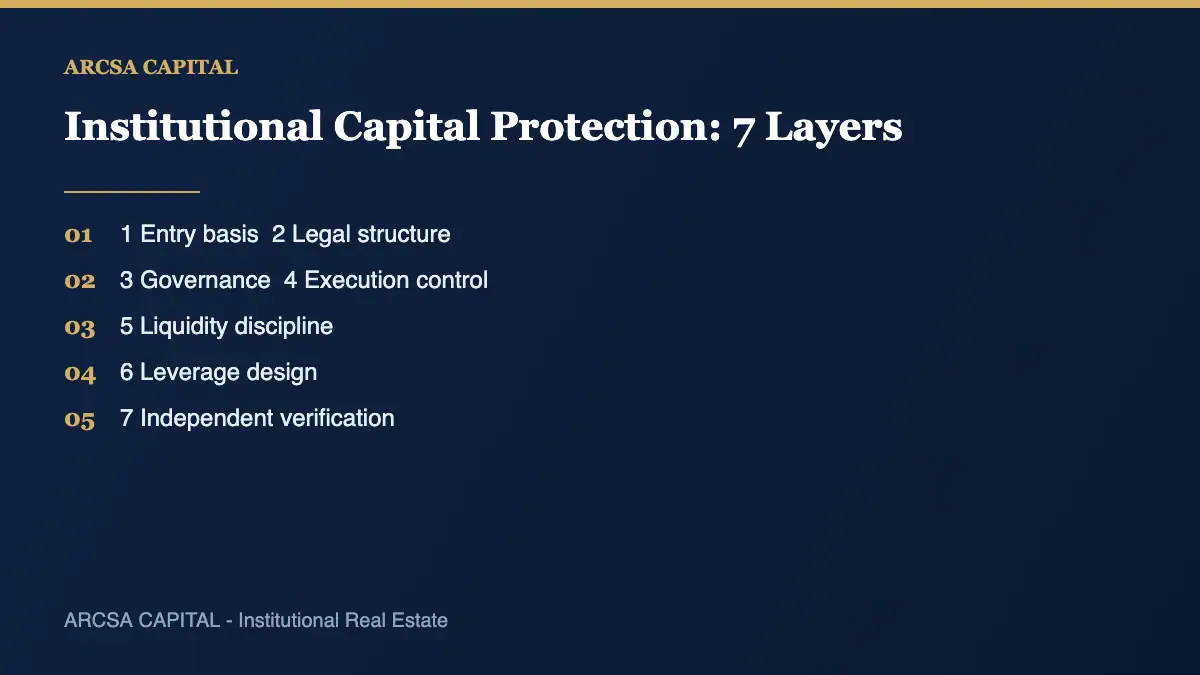
Capital protection is frequently sold as a promise and almost never structured as one. The seven points below describe what institutional capital protection actually consists of in a private real estate vehicle, and how each layer can be verified before subscription.
- Entry basis. The first layer of institutional capital protection is the price paid, because a disciplined basis absorbs error that no legal document can.
- Legal structure. The vehicle, jurisdiction and investor class must match the capital being accepted, with limited liability preserved at every level.
- Governance. Investment committee approval, advisory committee consent rights and defined removal provisions convert protection from intent into procedure.
- Execution control. Construction management, scope validation and permitting capability held in house so that cost variance is contained rather than reported.
- Liquidity discipline. Hold period, extension mechanics and distribution policy modeled against slow quarters instead of the strongest one on record.
- Leverage design. Fixed rate, long dated, non recourse debt where possible, with covenants read and refinancing risk priced.
- Independent verification. Third party administration, external audit and independent valuation, because unverified reporting is not protection.
Read together, these seven layers describe institutional capital protection as a system of controls rather than a promise about outcomes. No single layer is sufficient, and a sponsor that emphasizes one while omitting the others is describing a feature, not a framework.
What Regulators and Public Filings Reveal About Institutional Capital Protection
Private funds accepting outside capital operate under federal rules governing private offerings, investor qualification, conflicts disclosure and fiduciary conduct. Those obligations are the legal floor beneath any claim about institutional capital protection, and the offering documents rather than the marketing material are where the actual protections are written.
Custody, valuation and administration requirements matter just as much in practice. Independent administration, an external auditor and a documented valuation policy prevent the sponsor from being the only source of truth about its own performance, which is the structural weakness behind most private fund failures.
Asset level protection is also verifiable through public records. Recorded mortgages, liens, permit files and code enforcement histories reveal whether a portfolio carries encumbrances or unresolved obligations that would surface only at exit. That verification belongs in the diligence process, not after the fact.
Investors should confirm how a sponsor qualifies investors, discloses conflicts and reports results before relying on any protective claim. The investor guidance published by the U.S. Securities and Exchange Commission is a practical benchmark for testing whether institutional capital protection is documented or merely asserted.
Common Mistakes Investors Make With Institutional Capital Protection
Protection fails in predictable ways. In almost every case the weakness was visible in the documents before the capital was committed.
- Accepting the word assured in any form. In private real estate, institutional capital protection is structural, never contractual certainty of return.
- Confusing a preferred return with downside protection. A preference determines payment order, not whether capital survives.
- Relying on insurance or a personal indemnity without reading the coverage limits and enforcement mechanics.
- Ignoring recourse provisions and covenant triggers in the debt stack.
- Allowing the sponsor to serve as administrator, valuer and reporter simultaneously.
- Modeling an exit that requires the strongest absorption quarter on record.
- Treating diversification across assets in one submarket as diversification.
Each of these errors is a documentation problem before it is a market problem. A sponsor committed to institutional capital protection will show you exactly which risks remain and where they sit.
How to Evaluate Institutional Capital Protection in 30 Days
Week 1 – Read the structure
Map the entities, the jurisdictions and the flow of capital from subscription to asset. Confirm limited liability at each level and identify who holds title. Institutional capital protection begins with knowing precisely what an investor owns and what stands between that interest and a creditor.
Week 2 – Test the basis and the debt
Compare acquisition pricing to independent comparables and read the loan documents rather than the summary. Note maturity dates, covenants, recourse carve outs and refinancing assumptions. A protective structure with fragile debt is not protective.
Week 3 – Verify the control layer
Identify the administrator, the auditor and the valuation policy, and confirm each independently. Ask how construction scope is validated and who approves change orders. Execution control is the layer of institutional capital protection that investors most often assume rather than verify.
Week 4 – Stress the downside
Model a slower exit, a higher insurance load, a permitting delay and a refinancing at less favorable terms, simultaneously. The purpose is not to predict but to identify which layer absorbs the shock first and whether any layer fails outright.

Frequently Asked Questions About Institutional Capital Protection
Does institutional capital protection mean capital cannot be lost?
No. It means the structure is designed so that ordinary adverse events do not translate directly into permanent loss. Entry basis, legal structure, governance, execution control and conservative leverage each absorb a portion of the variance. Any sponsor describing certainty of return is describing something the asset class cannot deliver.
How does entry price function as protection?
A disciplined basis creates room for error. If the acquisition price already reflects renovation scope, permitting delay and carry, then a slower market compresses profit rather than principal. This is the least discussed and most effective layer of institutional capital protection.
Is non recourse debt always preferable?
Generally yes at the investor level, because it isolates loss to the asset. What matters equally is maturity and covenant design. Non recourse debt maturing during a tight credit window can still force a sale at the worst possible moment.
What role does independent valuation play?
It prevents the sponsor from marking its own performance. Independent valuation makes underperformance visible early, when it can still be managed, and it is a precondition for any credible institutional capital protection claim.
How should an investor treat assurances offered by a sponsor?
Read who is actually obligated and what assets stand behind the obligation. A promise from an entity without substance provides comfort rather than protection, and its practical value should be assessed as close to zero unless the balance sheet is disclosed.
Key Takeaways on Institutional Capital Protection
- Institutional capital protection is a system of layers, never a promise.
- Entry basis is the first and most effective protective layer.
- Legal structure and limited liability must be verified entity by entity.
- Governance converts protective intent into enforceable procedure.
- Independent administration, audit and valuation are non negotiable.
- Debt maturity and covenants matter as much as leverage levels.
- Stress the downside across several variables at once, not one at a time.
ARCSA Capital builds institutional capital protection into structure, basis and execution across prime residential investments in Miami and selected Florida submarkets. This article is general information and does not constitute legal, tax or investment advice.
Institutional capital protection you can verify layer by layer
Speak with our team about structure, leverage and independent verification across prime residential assets in South Florida.
Request InformationImportant disclosures
Not an offer. This article is for informational and educational purposes only and does not constitute an offer to sell, a solicitation of an offer to buy, or a recommendation of any security. No offer is or will be made except pursuant to definitive subscription documentation delivered to investors whose accredited status has been verified.
Exempt offering; no regulatory approval. Interests in vehicles managed by ARCSA Capital are not registered under the Securities Act of 1933 and are offered in reliance on an exemption under Regulation D. Neither the SEC nor any other federal or state authority has reviewed, endorsed or approved this offering or passed upon its merits; any representation to the contrary is unlawful. ARCSA Capital is not registered as an investment adviser or as a broker-dealer. Participation is limited to accredited investors as defined in Rule 501(a), whose status is verified with documentation before any subscription — self-certification is not sufficient and is not accepted.
Target returns. Any return figure presented is an underwriting objective based on strategy assumptions and market conditions at the date of publication. It is not a promise, not fixed income and not a commitment to distribute. Actual results may differ materially. Past performance, whether of ARCSA Capital or of affiliated entities, is not indicative of future results.
Risk and liquidity. Private real estate investing involves substantial risk, including the total loss of capital: market, execution, liquidity, leverage, valuation, regulatory and tax risk. Interests are illiquid, subject to transfer restrictions, and no secondary market exists or is expected to develop.
Forward-looking statements; no advice. This article may contain forward-looking statements, inherently subject to risks and uncertainties; no assurance is given as to any projection or scenario. Nothing here is investment, legal or tax advice, and reading it creates no advisory or fiduciary relationship. Consult your own advisers before making any investment decision. Full disclosures: Legal Hub.
