

Capital rarely fails from lack of opportunity. It fails from entering the wrong structure. A serious guide to accredited investor real estate vehicles begins there – not with return marketing, but with vehicle selection. For accredited investors, family offices, and cross-border allocators, the wrapper around the asset often matters as much as the asset itself.
Real estate can look deceptively simple from a distance. A building is tangible, a market is observable, and leverage appears familiar. Yet once capital moves into private transactions, the true questions become more exacting: who controls the deal, where liability sits, how reporting is handled, what tax friction exists, how exits are managed, and whether governance matches the size of the check. A well-chosen vehicle can create clarity, protection, and operational precision. A poor one can turn an otherwise attractive asset into an administrative burden.

A practical guide to accredited investor real estate vehicles
At the accredited level, real estate exposure generally falls into a handful of structures: direct ownership, joint ventures, syndications, private funds, REITs, and debt-based vehicles. Each serves a different purpose. None is universally superior. A useful guide to accredited investor real estate vehicles is defined not by which structure sounds most institutional, but by which one matches the investor’s capital posture, timeline, and governance requirements. The right choice depends on your need for control, tolerance for illiquidity, tax profile, reporting standards, and confidence in the operator.
Direct ownership offers maximum control and maximum responsibility. For some investors, that is the point. You determine hold period, financing, business plan, and exit. You also assume concentration risk, execution risk, legal exposure, and the burden of local oversight. Direct ownership may work well for investors with operating infrastructure, local market intelligence, and the desire to remain close to every decision. It is often less attractive for global families and institutional-style LPs who value delegated execution and formal governance over hands-on control.
Joint ventures sit one step removed from direct ownership. In a JV, capital is typically paired with an operating partner who sources, manages, and exits the investment. This can be efficient when the alignment is real and the authority matrix is clear. It can also become messy if decision rights are vague, reporting standards are inconsistent, or the sponsor treats institutional capital like passive money without institutional protections. JVs reward selectivity. They are often strongest when the investor has enough scale to negotiate governance directly rather than accept sponsor paper as presented.
Syndications are common because they give accredited investors access to deals that would be difficult to source independently. In a typical syndication, a sponsor acquires a single asset or a small portfolio, raises equity from investors, and manages the execution. This vehicle can be attractive for investors who want deal-by-deal discretion. You can evaluate each opportunity individually rather than commit blind-pool capital.
That flexibility comes with trade-offs. Syndications can create administrative sprawl if an investor builds exposure through many separate deals, each with its own documents, timelines, reporting cadence, tax package, and risk profile. Sponsor quality also varies widely. In this segment, sophistication is often claimed more often than demonstrated. Underwriting discipline, legal architecture, reserve policy, and exit realism matter more than polished decks.
Private funds as the institutional version of access
For larger allocators, private real estate funds are often the most coherent vehicle. A professionally structured fund centralizes governance, reporting, capital calls or subscriptions, and execution under a defined mandate. It can also create portfolio diversification across assets, timing windows, and operating cycles.
The key distinction is strategy specificity. A fund with a narrow, disciplined mandate tends to offer more predictability than one that can buy almost anything. A Prime Residential Value Add strategy in targeted submarkets, for example, is very different from a broad opportunistic fund with style drift. Investors should ask whether the manager has true repeatability in sourcing, underwriting, and monetization, or whether the strategy depends on occasional brilliance.
Private funds also shift the investor experience from asset selection to manager selection. That is a meaningful change. Once capital is entrusted to a fund, the durability of the operator becomes central. You are underwriting process, controls, legal discipline, compliance culture, and the manager’s ability to preserve downside while compounding upside across multiple cycles.
For international investors, this structure can be especially compelling when paired with thoughtful legal and tax engineering. U.S. exposure through institutional-grade entities, audited controls, and cross-border structuring can reduce friction and improve visibility. For the right investor, the value is not only economic. It is procedural. Capital is easier to steward when the architecture is deliberate.
Public REITs and private REITs occupy a different category. Public REITs offer liquidity, daily pricing, and easy portfolio implementation. They are useful when an investor wants real estate exposure without private market lockups. But they also behave more like securities than private assets. Correlation to public markets can rise when diversification is most needed.
Private REITs may reduce public market volatility, but they require close scrutiny of valuation methodology, redemption terms, fees, and underlying asset quality. They can fit certain portfolios, especially where income orientation matters, but they should not be mistaken for a substitute for high-conviction private equity real estate strategies.
Debt vehicles deserve separate treatment. Many accredited investors focus instinctively on equity, but private real estate credit can offer a different risk-return profile. Senior debt, mezzanine debt, and preferred equity can sit higher in the capital stack and may provide stronger downside protection than common equity. That does not make them safer in every case. Loan-to-value discipline, borrower quality, collateral coverage, jurisdiction, and enforcement rights all matter. In weaker structures, the appearance of seniority can create false comfort.
Institutional Access. Engineered Structure.
This guide to accredited investor real estate vehicles points to private funds as the most coherent framework for serious capital — designed for governance, precision, and multi-cycle durability.
Arcsa Capital structures residential value-add exposure for cross-border families and institutional allocators — with audited controls, legal architecture, and full cycle transparency.
Talk to Our Investment Team →What sophisticated investors should evaluate first
The most useful guide to accredited investor real estate vehicles is not organized by labels alone. It is organized by selection criteria. Vehicle choice should begin with five questions.
First, how much control do you actually want? Many investors say they want control when they really want veto rights, transparency, and disciplined execution by someone else. Those are different things. Full control can be expensive, time-consuming, and operationally distracting.
Second, how much illiquidity can your balance sheet tolerate? Private real estate rewards patient capital, but not all illiquidity is compensated equally. A three-year hold in a tightly governed fund is different from capital trapped in a poorly managed deal with unclear exit mechanics.
Third, what type of reporting do you require? At this level, reporting is not a courtesy. It is part of risk management. Investors should expect institutional accounting, document integrity, tax clarity, and operational traceability. Informal updates and sponsor anecdotes are not a substitute.
Fourth, where does legal and tax exposure sit? This is especially relevant for non-U.S. investors and cross-border families. Entity structure, withholding, estate considerations, and parallel fund design can materially affect net outcomes. The SEC’s accredited investor framework defines eligibility thresholds, but it does not dictate vehicle suitability — that determination belongs to the investor and their advisors. A strong investment can still become inefficient if the vehicle is poorly built.
Fifth, can the manager repeat the strategy under different market conditions? Many real estate businesses perform well in rising markets. This question is fundamental to any honest guide to accredited investor real estate vehicles. Far fewer demonstrate discipline in sourcing off-market opportunities, controlling basis, executing renovations, and exiting on compressed timelines with consistency. Repeatability is what separates a transaction from an operating platform.
Matching the vehicle to the investor
Investors with substantial operating capability may still prefer direct ownership or bespoke JVs, particularly when they want concentrated exposure and control over timing. Investors seeking curated, institutional-grade access often gravitate toward private funds because the governance burden is lower and the investment process is more orderly.
Wealth managers and advisors typically prioritize structures that can withstand due diligence, support clean reporting, and fit within broader asset allocation mandates. Family offices often look deeper, focusing on legal durability, tax efficiency, and whether the sponsor’s culture reflects capital stewardship rather than asset gathering. International investors usually place even greater value on local execution paired with cross-border structural intelligence.
This is where premium managers distinguish themselves. Not by promising simplicity, but by reducing avoidable complexity. The best vehicles are designed so that capital can move with precision, risks are known rather than guessed, and investor protections are embedded before the first dollar is deployed.
A credible sponsor in this segment should show more than market conviction. It should show underwriting discipline, documented processes, regulatory seriousness, and a transparent relationship between strategy and structure. In private real estate, elegance is not cosmetic. It is architectural.
If you are evaluating where to place serious capital, start with the vehicle before the headline return. The asset may generate performance, but the structure determines how that performance is governed, protected, and ultimately realized. In sophisticated real estate investing, that is not a technical detail. It is the first test of judgment. Every element of this guide to accredited investor real estate vehicles points to the same conclusion: the vehicle is the strategy, not the container for it.
Structured for Serious Allocators
Apply this guide to accredited investor real estate vehicles to evaluate a platform engineered for institutional precision — from legal architecture through disciplined exits.
Arcsa Capital offers cross-border investors access to residential value-add strategies with proprietary sourcing, stress-tested underwriting, and SEC-compliant fund structure.
Talk to Our Investment Team →Comparing real estate vehicles for an accredited allocation?
ARCSA Capital structures institutional access to prime residential assets with defined governance and asset level reporting.
Request InformationContents
Real Estate Vehicles: 7 Points at a Glance
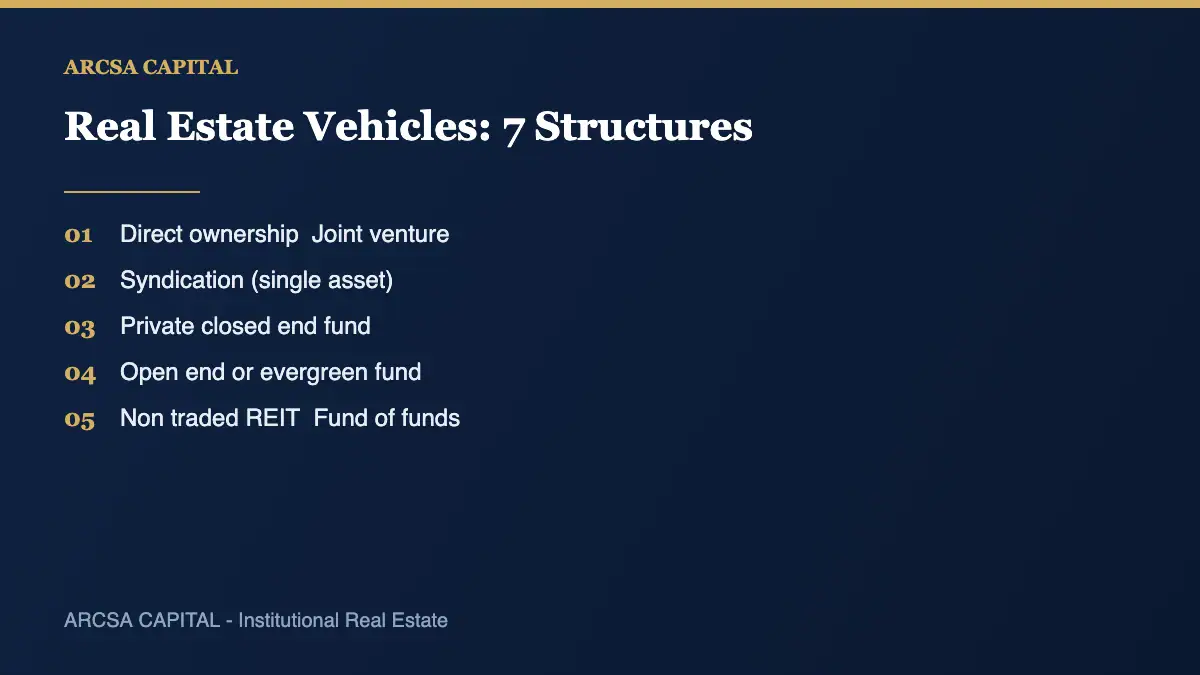
Accredited status opens access to real estate vehicles that are closed to the general public, but access is not the same as suitability. The seven real estate vehicles below cover most of what an accredited investor will actually be offered, with the trade off each one carries.
- Direct ownership. Maximum control and maximum workload. The investor is the sponsor, the asset manager and the guarantor, which suits few allocators once portfolios grow.
- Joint venture. Shared economics with an operating partner, negotiated deal by deal. Among real estate vehicles this offers strong alignment and weak diversification.
- Syndication. A single asset offered to a group of investors. Simple to understand, but concentration risk and sponsor quality dominate the outcome entirely.
- Private closed end fund. A pooled vehicle acquiring multiple assets under one mandate, with defined term, governance and reporting. The institutional standard for accredited capital.
- Open end or evergreen fund. Continuous subscription and periodic redemption, offering more flexibility at the cost of valuation complexity and potential redemption queues.
- Non traded REIT. Broad diversification and administrative simplicity, with fee layers and liquidity mechanics that deserve careful reading before subscribing.
- Fund of funds. Diversification across managers, useful for a first allocation, with an additional fee layer that must be justified by genuine selection skill.
No structure in this list is inherently superior. Real estate vehicles are selected by matching control, diversification, liquidity, tax treatment and workload to the investor circumstances, and the most frequent mistake is selecting for headline return rather than for fit.
What Regulators and Public Filings Reveal About Real Estate Vehicles
Accredited investor status is defined by federal rule and is the gateway to most private real estate vehicles. It rests on income, net worth or professional qualification, and a sponsor relying on a private offering exemption must verify that status in a documented way rather than accept a self certification without support.
The exemption a sponsor relies upon shapes what it may do. Some exemptions permit general solicitation with stricter verification, others prohibit advertising entirely. Knowing which applies tells an investor how the offering was marketed and what verification to expect, and it is disclosed in the offering documents.
Disclosure obligations differ sharply across real estate vehicles. A registered non traded REIT files publicly, while a private fund discloses only to its investors. That difference is often the single most practical distinction between real estate vehicles, because it determines how much can be verified independently before committing.
Before subscribing to any private structure, confirm the exemption relied upon, how accredited status is verified and what continuing disclosure is provided. The investor guidance published by the U.S. Securities and Exchange Commission is the reference point for comparing real estate vehicles on disclosure and investor protection.
Common Mistakes Investors Make With Real Estate Vehicles
Selection errors are more damaging than manager errors, because the wrong structure cannot be corrected by good execution.
- Choosing for headline return rather than for control, liquidity and workload actually required.
- Treating a syndication as diversified because the sponsor owns other assets elsewhere.
- Overlooking fee layers in fund of funds and non traded real estate vehicles.
- Assuming redemption rights in an evergreen structure will function during a stressed market.
- Ignoring the tax profile of the vehicle relative to the investor own residency and entity.
- Committing to a closed end term longer than the investor liquidity horizon.
- Accepting quarterly reporting without asset level detail because the structure is passive.
Each of these is a decision made before capital moves, and each is reversible only at significant cost afterwards. Structure selection deserves at least as much time as manager selection.
How to Evaluate Real Estate Vehicles in 30 Days
Week 1 – Define the constraints
Write down the liquidity horizon, the acceptable workload, the tax profile and the concentration limit before looking at any offering. Real estate vehicles should be filtered against those constraints first, which usually eliminates most of the list immediately.
Week 2 – Compare structures, not sponsors
Place two or three candidate real estate vehicles side by side on control, diversification, liquidity, fee layers, reporting and tax treatment. This comparison is frequently skipped because sponsors present their own structure as the only relevant one.
Week 3 – Read the governing documents
Move to the partnership agreement, the offering memorandum and the most recent investor report. Focus on term, extension options, redemption mechanics, fee schedule, waterfall and decision rights, which is where real estate vehicles differ most in practice.
Week 4 – Test the exit
Model how capital is actually returned in each structure: asset sale, redemption queue, secondary transfer or refinancing. Then model the same exit in a slower market. The structure that survives that test with the least discretion is usually the right one.

Frequently Asked Questions About Real Estate Vehicles
What does accredited investor status actually allow?
It permits participation in private offerings that are not registered for public sale, which includes most private funds and syndications. It is a gateway rather than an endorsement, and it says nothing about whether a particular structure is suitable for a specific investor.
Which structure suits a first private allocation?
For many investors a private closed end fund with a defined mandate, independent administration and asset level reporting offers the best balance among real estate vehicles: professional execution, diversification across several assets and governance that can be verified before committing.
How should fees be compared across structures?
Model the total load rather than the headline rate: management fee, acquisition and disposition fees, affiliated service fees, organizational expenses, carried interest and, in layered real estate vehicles, the fees charged at both levels. Compare the totals under a merely acceptable outcome.
Are non traded REITs liquid?
Only partially, and usually subject to caps and suspension rights. Redemption programs in real estate vehicles of this type are typically limited by quarter and can be reduced or halted, which is exactly when investors most want to use them. Read the mechanics rather than the summary.
Does a longer term always mean better returns?
No. A longer term gives a manager more flexibility to wait for a favorable exit, which can help, but it also extends the period during which the investor has no access to capital. The term should match the investor horizon, not the manager preference.
Key Takeaways on Real Estate Vehicles
- Access and suitability are different questions; accredited status only answers the first.
- Filter real estate vehicles against liquidity, workload, tax and concentration limits first.
- Compare structures side by side before comparing sponsors.
- Model the total fee load, including layered fees, under an average outcome.
- Read redemption and extension mechanics rather than the marketing summary.
- Match the term to your horizon, not to the manager preference.
- Independent administration and asset level reporting should be non negotiable.
ARCSA Capital offers accredited investors institutional access to prime residential real estate in Miami and selected Florida submarkets through structured vehicles with documented governance and asset level reporting. This article is general information and does not constitute legal, tax or investment advice.
Choose real estate vehicles that match your constraints
Speak with our team about structure, term and reporting before your next private allocation.
Request InformationOr model your own scenario in the investment simulator
Or receive the ARCSA Capital investment thesis by email, with the entry, stabilisation and exit assumptions behind the strategy:
