

A capital call memo can be elegant. A quarterly report can be detailed. Neither substitutes for a private fund audit performed by an independent accounting firm with access to the underlying books, bank activity, legal entities, valuation support, and allocation records. For sophisticated Limited Partners, the audit is not a ceremonial annual exercise. It is one of the few formal moments when a fund’s financial narrative is tested against evidence.
Contents
In private real estate, this distinction carries weight. Value is often created through sourcing, acquisition discipline, rehabilitation execution, capital structure, and disposition timing. The investment thesis may be compelling, but institutional confidence depends on whether the vehicle’s accounting, governance, and reporting architecture can withstand independent scrutiny.
A private fund audit is a control mechanism, not a marketing document
An audit is designed to provide an auditor’s opinion on whether the fund’s financial statements are presented fairly, in all material respects, under the applicable accounting framework. It does not certify that every investment will perform as expected, eliminate market risk, or validate a sponsor’s future return targets. Those are fundamentally different questions.
What it does provide is independent examination of the financial statements and selected supporting evidence. Depending on the engagement and the fund structure, this may include testing cash balances, reviewing capital account activity, assessing expense allocations, examining investment ownership records, evaluating valuation methodologies, and reconciling distributions or proceeds from realized transactions.
For an LP, this matters because private funds operate through layers of judgment. A residential value-add strategy may hold assets through special purpose vehicles, use property-level operating accounts, engage contractors, receive sale proceeds through closing agents, and allocate management costs across entities. Without disciplined accounting, even a sound investment operation can produce reporting that is difficult to verify.
The audit introduces a structured challenge process. Management makes representations; the auditor requests support, tests selected items, evaluates accounting treatment, and considers whether material misstatements may exist. The result is not operational omniscience. It is a meaningful layer of financial accountability.
Where a private fund audit creates the most value
The highest-value audit work is rarely the most visible. It often sits beneath the headline numbers, in areas where incentives, complexity, or judgment can create risk.
Valuation discipline
Private real estate is not priced continuously on a public exchange. Fund valuations can involve third-party appraisals, broker opinions, comparable sales, discounted cash flow assumptions, acquisition costs, renovation budgets, expected exit timing, and market conditions at the reporting date.
An auditor does not replace the investment committee or determine the strategy. However, the audit process can evaluate whether management’s valuation approach is consistent with the governing documents and financial reporting standards, whether significant assumptions are supported, and whether disclosures adequately explain valuation uncertainty.
For a fund executing shorter hold periods, valuation should be particularly deliberate. The closer an asset is to acquisition, rehabilitation completion, or disposition, the more important it becomes to distinguish between realized economics, contracted economics, and estimates. Sophisticated LPs should expect this distinction to be visible in the financial record.
Allocation of expenses and fees
Expense allocation is a central governance issue in private funds. Investors should be able to understand which costs are borne by the management company, which are charged to the fund, and how shared costs are allocated across parallel vehicles, co-investment structures, or property-level entities.
The concern is not that a fund incurs legitimate expenses. Legal work, administration, tax compliance, audit fees, insurance, due diligence, property operations, and transaction costs can be appropriate depending on the partnership agreement and offering materials. The issue is whether those charges are authorized, consistently applied, accurately recorded, and disclosed with sufficient clarity.
An audit can test expense categories and related-party transactions. This is especially relevant where the manager controls multiple entities involved in sourcing, asset management, construction oversight, financing, or administration. Clear documentation protects both the sponsor and the LP base.
Cash, capital accounts, and distributions
Cash is simple only when the legal structure is simple. In a private real estate fund, investor commitments, capital calls, acquisition deposits, renovation payments, financing proceeds, sale proceeds, reserves, and distributions may move through several controlled accounts and entities.
A rigorous audit examines whether cash balances reconcile, whether capital activity is properly recorded, and whether distributions align with the fund’s governing waterfall. For LPs, this is essential because performance reporting means little if capital account records do not accurately reflect contributions, fees, allocations, and realized proceeds.
The same logic applies to side letters and bespoke institutional terms. If an investor has negotiated provisions affecting economics, reporting, or transfer rights, the fund’s administrative infrastructure must be capable of honoring those terms without compromising the integrity of the broader partnership records.
Audit quality depends on scope, independence, and timing
Not all audits offer the same degree of comfort. A credible private fund audit begins with the independence and capability of the accounting firm, but it also depends on the quality of the fund’s own books and controls.
A manager that reconstructs records only at year-end creates unnecessary friction and risk. A manager with disciplined monthly closes, formal approval authorities, segregated bank access, documented valuations, property-level reconciliations, and a controlled general ledger enters the audit from a position of order.
Timing also matters. Investors should understand the fund’s fiscal year, the expected delivery schedule for audited financial statements, and whether tax reporting will follow within a reasonable timeframe. Delays can occur for valid reasons, particularly when a fund has complex investments, cross-border investors, or late-arriving underlying financial data. Still, repeated delays without a precise explanation warrant attention.
A qualified opinion, emphasis-of-matter paragraph, or going-concern disclosure should not be treated as automatic disqualification. Each has a specific meaning that requires context. A sophisticated LP evaluates the underlying cause, management’s response, and whether the issue affects the investor’s ability to assess the vehicle’s financial condition.

Accredited investors
Private fund audit: test it against your own mandate
We walk accredited investors through how ARCSA Capital approaches a private fund audit in practice: entry basis, works period, exit window and governance, with your own allocation policy on the table. No generic deck.
Request informationOr receive the ARCSA Capital investment thesis by email, with the entry, stabilisation and exit assumptions behind the strategy:
General information for educational purposes. Not an offer to sell or a solicitation of an offer to buy securities, nor investment, legal or tax advice.
What cross-border investors should examine closely
For international capital, the audit is only one component of a broader diligence framework. The fund’s legal structure, tax reporting process, withholding procedures, investor classification, and parallel-fund mechanics require separate review with qualified legal and tax advisers.
A Cayman parallel vehicle, for example, may be designed to accommodate certain non-U.S. investors or institutional mandates. Its presence does not eliminate the need for clear accounting boundaries. LPs should be able to determine which entity owns the investment, which entity bears expenses, how allocations are made, and how financial information is consolidated or presented across the structure.
The standard should be precision, not opacity. Cross-border architecture can be highly efficient when it is properly documented, consistently administered, and aligned with the investor’s particular tax profile. It becomes a source of avoidable risk when structure is used as a substitute for disclosure.
Questions that distinguish a serious audit process
Before committing capital, an LP or adviser should ask direct questions that test both the audit engagement and the manager’s operating maturity:
- Which independent firm audits the fund, and under which accounting standards are the financial statements prepared?
- Are audited statements provided annually to all eligible investors, and what is the expected delivery timeline?
- How are real estate assets valued between acquisition and exit, particularly when a project is under renovation or under contract for sale?
- Which expenses may be charged to the fund, and how are related-party costs or shared expenses allocated?
- How are investor capital accounts, waterfall calculations, and distribution records independently reconciled?
- How does the reporting process address parallel funds, special purpose entities, and non-U.S. investor requirements?
The quality of the response is as revealing as the response itself. Institutional managers can explain their controls without evasion, identify where judgment is involved, and provide a clear boundary between audited facts, unaudited operating updates, and forward-looking projections.
The audit belongs within a larger governance architecture
An audit is powerful, but it is not a complete due diligence program. It is retrospective by nature and generally performed on financial statements after a reporting period closes. It will not replace legal review of the partnership agreement, analysis of the investment strategy, underwriting review, background diligence, or an assessment of a manager’s sourcing and execution capabilities.
The strongest private fund platforms treat the audit as one element of an integrated governance architecture. That architecture includes carefully drafted fund documents, independent administration where appropriate, controlled cash processes, documented investment committee decisions, transparent valuation policies, regulatory awareness, and reporting that gives LPs a coherent view of capital deployment.
For a manager operating in Miami and across Florida’s prime residential market, operational traceability is particularly valuable. Off-market acquisitions and special situations can create an information advantage, but they also require tighter internal evidence trails. The more differentiated the sourcing, the more disciplined the documentation must be.
At ARCSA Capital, institutional discipline is not an accessory to the investment strategy. It is part of the architecture that allows sophisticated capital to evaluate opportunity, control exposure, and preserve decision-making clarity across the life of a fund.
The practical question for an LP is not simply whether a fund has an audit. It is whether the audit sits within a culture where records are current, valuations are defensible, conflicts are disclosed, and capital movements can be traced without ambiguity. That is where financial reporting stops being a compliance artifact and becomes evidence of stewardship.
Key takeaways on a private fund audit
Independent review is one of the few external checks available to investors in unregistered vehicles. This summary explains what it covers, what it does not, and how limited partners can use it.
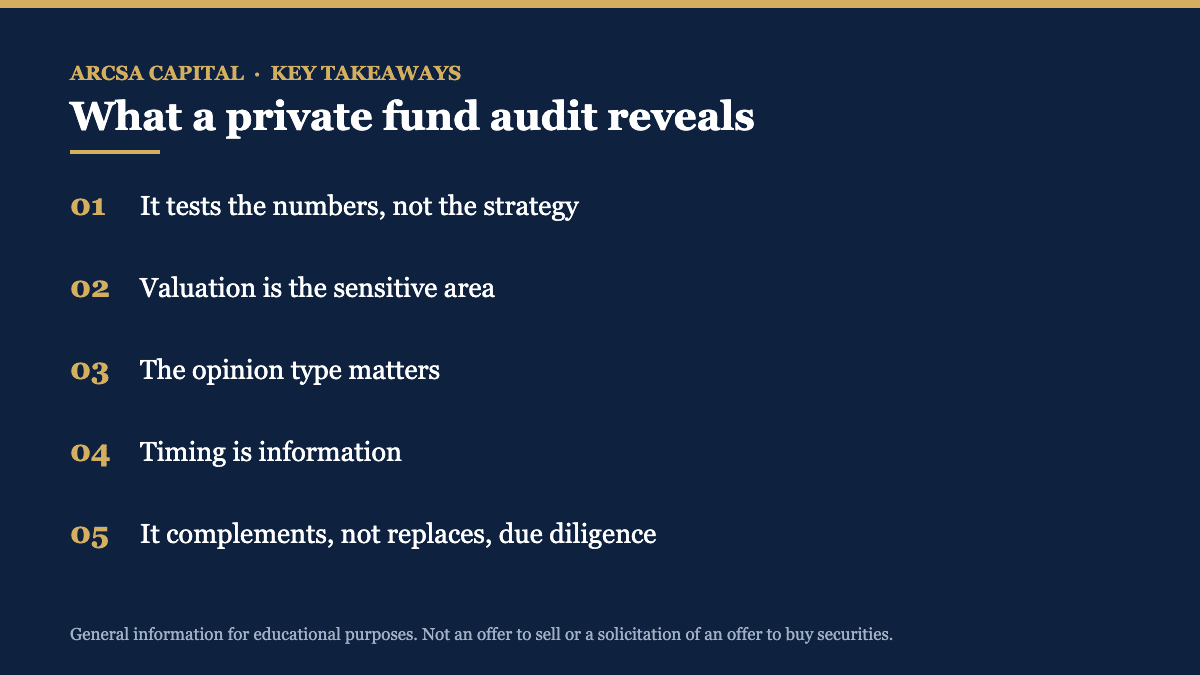
- It tests the numbers, not the strategy. An auditor gives an opinion on whether the financial statements are fairly presented. It does not judge whether the investments were wise.
- Valuation is the sensitive area. For illiquid assets, reported values rest on assumptions. The notes on valuation methods deserve the closest reading.
- The opinion type matters. An unqualified opinion, a qualified one and a disclaimer say very different things. LPs should read the opinion page first.
- Timing is information. Statements delivered late, or a change of auditor without explanation, are signals worth a question.
- It complements, not replaces, due diligence. Operational controls, legal structure and sponsor integrity still need the investor’s own review.
Frequently asked questions about a private fund audit
What does a private fund audit cover?
The auditor examines the fund’s financial statements: assets, liabilities, income, expenses, capital accounts and the accompanying notes. The work includes confirming cash and ownership of assets, testing transactions, reviewing fee and expense calculations against the fund documents, and assessing the reasonableness of valuations. The result is an opinion addressed to the fund’s investors or governing body.
Are private real estate funds required to have an audit?
It depends on the structure and the manager’s regulatory status. Registered investment advisers commonly obtain audits to comply with the custody rule, and many fund documents require annual audited statements regardless. Other vehicles have no such obligation. Investors should check what the offering documents commit to, and whether any audit has actually been performed yet.
What can an audit not tell an LP?
It does not guarantee the absence of fraud, confirm that target returns will be met, or evaluate the quality of underwriting. It is performed after the period ends and relies partly on information provided by management. It is strong evidence about reported figures and weak evidence about future performance.
Which sections should an LP read first?
The auditor’s opinion, the valuation policy note, related-party transactions, fees and expenses, and subsequent events. Related-party notes reveal payments to affiliates of the sponsor. Subsequent events can disclose sales, losses or disputes that occurred after the balance sheet date.
How should the word “audited” be used in marketing?
Carefully. Saying that processes or returns are “audited” can mislead if only the annual financial statements were examined, or if no engagement has been completed. Accurate language identifies what was reviewed, by whom and for which period. LPs are right to ask for the report itself.
Important disclosures
Not an offer. This article is for informational and educational purposes only and does not constitute an offer to sell, a solicitation of an offer to buy, or a recommendation of any security. No offer is or will be made except pursuant to definitive subscription documentation delivered to investors whose accredited status has been verified.
Exempt offering; no regulatory approval. Interests in vehicles managed by ARCSA Capital are not registered under the Securities Act of 1933 and are offered in reliance on an exemption under Regulation D. Neither the SEC nor any other federal or state authority has reviewed, endorsed or approved this offering or passed upon its merits; any representation to the contrary is unlawful. ARCSA Capital is not registered as an investment adviser or as a broker-dealer. Participation is limited to accredited investors as defined in Rule 501(a), whose status is verified with documentation before any subscription — self-certification is not sufficient and is not accepted.
Target returns. Any return figure presented is an underwriting objective based on strategy assumptions and market conditions at the date of publication. It is not a promise, not fixed income and not a commitment to distribute. Actual results may differ materially. Past performance, whether of ARCSA Capital or of affiliated entities, is not indicative of future results.
Risk and liquidity. Private real estate investing involves substantial risk, including the total loss of capital: market, execution, liquidity, leverage, valuation, regulatory and tax risk. Interests are illiquid, subject to transfer restrictions, and no secondary market exists or is expected to develop.
Forward-looking statements; no advice. This article may contain forward-looking statements, inherently subject to risks and uncertainties; no assurance is given as to any projection or scenario. Nothing here is investment, legal or tax advice, and reading it creates no advisory or fiduciary relationship. Consult your own advisers before making any investment decision. Full disclosures: Legal Hub.
