

A property can appreciate, produce cash flow, and still deliver very different outcomes to two investors in the same capitalization stack. That distinction is the center of real estate equity versus debt. For sophisticated private capital, the question is not which structure is universally superior. It is which contractual position matches the asset’s basis, business plan, duration, liquidity profile, and downside case.
Contents
In institutional real estate, capital structure is not an administrative detail negotiated after the investment decision. It is part of the investment thesis itself. Seniority, covenants, control rights, payment priority, and exit timing can matter as much as the property address or projected renovation margin.
Real Estate Equity Versus Debt Starts With Priority
Debt is a contractual claim. The lender provides capital under defined terms and is generally entitled to interest, principal repayment, and specified protections before equity holders receive distributions. In a default or liquidation, debt typically sits ahead of equity in the capital stack. Its return profile is usually more bounded, but its legal priority is more clearly defined.
Equity is an ownership interest. Equity investors participate in the residual value of an asset after operating costs, taxes, lender obligations, and other senior claims have been satisfied. That residual position can create material upside when a manager acquires below intrinsic value, executes a disciplined repositioning, and exits into sufficient demand. It also absorbs the first economic losses when assumptions prove incorrect.
This is why headline return comparisons can be misleading. A debt position with a lower stated return may be appropriate when capital preservation, payment seniority, and predictable duration are the governing priorities. An equity position may merit a higher target return because it carries greater exposure to execution, valuation, market timing, and residual risk.
The essential question is not whether debt is conservative and equity is aggressive. A poorly documented loan against an inflated asset can be riskier than a carefully structured equity investment acquired at a meaningful discount to replacement cost. Risk is produced by the full architecture of the transaction, not by a label alone.
The Economics Behind Equity and Debt
A lender’s return is generally driven by the loan amount, interest rate, fees, amortization terms, prepayment provisions, and repayment event. The lender does not normally participate fully in the appreciation created by a successful renovation or an accelerated sale. Its mandate is contractual performance, supported by collateral and enforceable remedies.
An equity investor’s outcome is driven by the difference between total capital invested and total value realized at exit, along with any interim distributions. This makes underwriting far more sensitive to purchase price, rehabilitation scope, carrying costs, sales velocity, taxes, insurance, and the realism of the exit valuation.
For a value-add residential strategy, execution can be the primary driver of equity returns. Acquiring an off-market asset in distress is only the first decision. The manager must validate title, estimate the true cost to cure deferred maintenance, control construction draws, manage permits where applicable, maintain insurance discipline, and create an exit path before capital is committed.
A short-duration business plan can change the calculus. If a sponsor expects to acquire, rehabilitate, reposition, and monetize an asset within several months, debt may be used as a tool to preserve equity capital or enhance capital efficiency. Yet leverage also introduces refinancing risk, interest expense, covenant pressure, and a hard maturity date. If disposition timing slips, the debt clock does not pause.
Control Is a Form of Risk Management
Sophisticated allocators often focus on return targets first. Control rights deserve equal scrutiny. A senior lender may have reporting rights, collateral rights, cash management provisions, and remedies following a default. An equity investor may hold voting rights or advisory rights, but those rights vary widely across limited partnership, limited liability company, and other private fund structures.
The practical distinction is especially relevant in special situations. When an asset encounters a title complication, contractor dispute, permit delay, insurance claim, or slower-than-expected disposition, who can make decisions? Who can replace a vendor, approve additional capital, extend a loan, or direct a sale? Documents should answer these questions before they become operational problems.
For limited partners and family offices, governance is not a ceremonial feature. It is the mechanism that separates informed exposure from blind exposure. Clear delegation of authority, conflict-management policies, valuation methodology, reporting cadence, and audited financial controls can materially improve visibility into how capital is being deployed.

Accredited investors
Real estate equity versus debt: test it against your own mandate
We walk accredited investors through how ARCSA Capital approaches real estate equity versus debt in practice: entry basis, works period, exit window and governance, with your own allocation policy on the table. No generic deck.
Request informationOr receive the ARCSA Capital investment thesis by email, with the entry, stabilisation and exit assumptions behind the strategy:
General information for educational purposes. Not an offer to sell or a solicitation of an offer to buy securities, nor investment, legal or tax advice.
Underwriting the Downside Before the Upside
The quality of a real estate investment is often revealed by its downside underwriting. A disciplined analysis should begin with a conservative view of value, not the most favorable comparable sale. It should account for a slower exit, higher rehabilitation cost, increased financing expense, and lower buyer demand than the base case anticipates.
For debt, the central protections often include loan-to-value or loan-to-cost discipline, the quality and liquidity of collateral, sponsor recourse, reserve requirements, insurance coverage, and the enforceability of security documents. A lender should understand not just the projected repayment source, but the secondary repayment path if the original business plan underperforms.
For equity, the analysis extends further into the operating plan. Is the purchase basis sufficiently protected? Is the renovation scope independently validated? Are contingency reserves meaningful or cosmetic? Does the manager have local sourcing, construction oversight, and disposition capability rather than outsourcing each critical stage to disconnected counterparties?
At ARCSA Capital, the emphasis on controlling the acquisition, underwriting, rehabilitation, repositioning, and monetization cycle reflects a core institutional principle: execution risk should be actively managed, not merely modeled. In private residential real estate, the distance between an underwriting assumption and an economic result is often the quality of operating control.
When Equity Can Be the More Compelling Allocation
Equity may be appropriate when the investment has a clear value-creation catalyst and the manager has demonstrated capacity to execute it. A material discount to market value, a defined rehabilitation plan, supply-constrained residential demand, and an accelerated sale strategy can create a return profile that debt alone cannot capture.
Equity also gives the investor participation in upside that may result from superior sourcing. Off-market access matters because broadly marketed assets can compress returns before a buyer has even completed diligence. In contrast, a manager with established local relationships may identify motivated sellers, distressed situations, or operationally mismanaged properties before they enter the open market.
That opportunity comes with a higher burden of diligence. Equity should not be treated as a passive bet on Florida appreciation or a generic allocation to residential property. It is a decision to underwrite a manager’s judgment, legal structure, operating discipline, and ability to exit under changing market conditions.
When Debt May Better Protect the Mandate
Debt can be more appropriate when an investor’s primary objective is contractual income, seniority of claim, and a narrower range of outcomes. It may also suit an allocation that seeks real asset collateral without assuming the full variability of ownership economics.
However, debt protection is only as strong as the underlying documentation and collateral value. A high coupon does not compensate for weak lien priority, an aggressive valuation, an undercapitalized borrower, or unclear remedies. For international investors, the legal analysis should also address governing law, entity structure, tax treatment, reporting obligations, and the path to enforcement across jurisdictions.
The right debt investment is not simply one with a favorable stated rate. It is one where the lender can identify precisely what it owns, what sits ahead of it, what can impair repayment, and what happens if the sponsor’s original timeline fails.
Capital Structure Should Follow the Business Plan
The most rigorous private real estate allocations begin with a business plan and then select the capital structure that supports it. Stable income-producing assets with dependable cash flow may support debt differently than transitional assets requiring renovation and rapid disposition. A short-duration value-add strategy may benefit from limited, carefully matched financing, while an overlevered structure can turn a manageable delay into a forced decision.
For accredited investors, institutional limited partners, and cross-border family offices, the decision should also fit the broader portfolio. Equity and debt can serve distinct roles: one may provide access to value creation and residual upside; the other may provide seniority and contractual return characteristics. Neither substitutes for full diligence.
The most useful framing is therefore not equity or debt as competing abstractions. It is whether the capital position gives you appropriate protection, visibility, alignment, and economic participation for the specific asset and manager under review. Capital that appears elegant on a term sheet is only valuable when the underlying operation can carry its promises through to exit.
Key takeaways on real estate equity versus debt
The choice between real estate equity and debt is a choice about priority, control and the shape of the outcome. The summary below is meant as a working reference for an allocator comparing the two positions in the same capital stack.
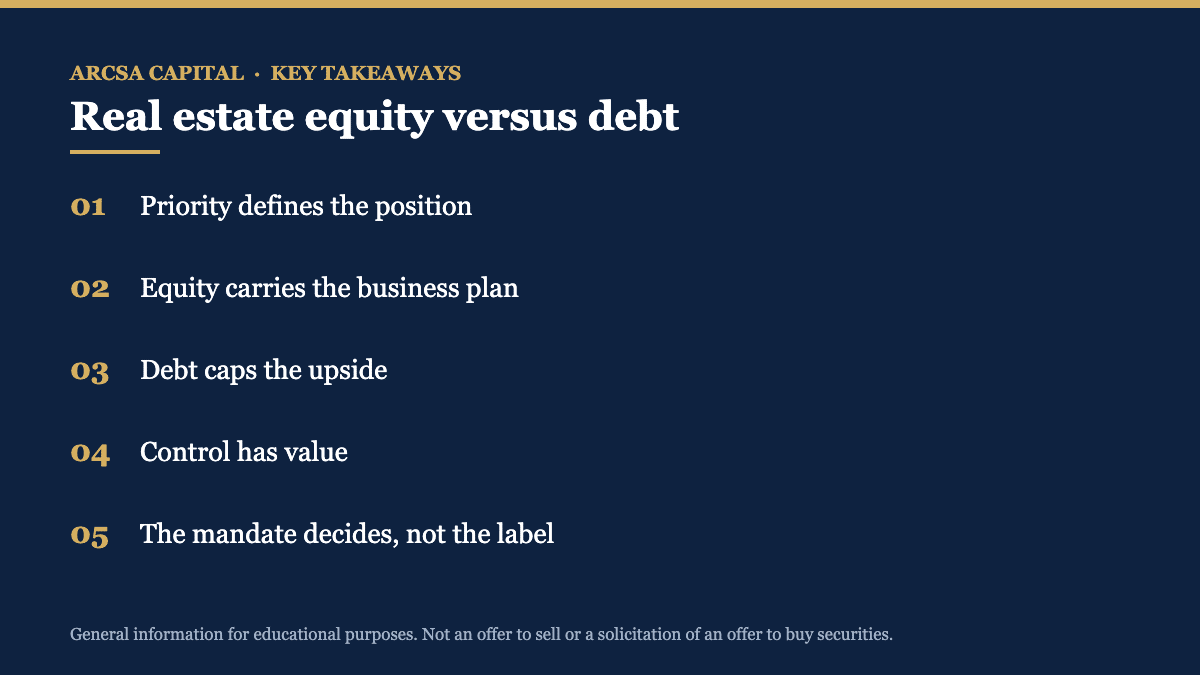
- Priority defines the position. Debt is paid first and has a contractual claim; equity is paid last and owns the residual. Every other difference between the two follows from that order of payment.
- Equity carries the business plan. The equity holder absorbs cost overruns, delays and price changes before the lender does. That is why equity underwriting has to be more demanding than the underwriting a lender performs.
- Debt caps the upside. A lender earns interest and fees and nothing more, however well the asset performs. An allocator who wants participation in value creation needs an equity position, and has to accept the variability that comes with it.
- Control has value. Equity usually decides on works, timing and exit; debt acquires control only after a default. Governance rights should be read as carefully as the economic terms.
- The mandate decides, not the label. Neither position is safer in the abstract. The right one depends on the horizon, the liquidity needs and the loss tolerance of the capital being invested.
Frequently asked questions about real estate equity versus debt
What is the main difference between real estate equity and debt?
Equity is ownership and debt is a loan. The equity investor owns a share of the asset or of the vehicle that holds it, and earns whatever is left after costs and lenders are paid. The debt investor lends against the asset and earns a contractual return, normally secured by a mortgage. Equity therefore has an open-ended outcome in both directions, while debt has a defined return.
Is debt always safer than equity?
No. Debt sits higher in the capital stack, but a loan made at a high loan-to-value, against an asset with a weak exit, can lose money while a conservatively bought equity position in a different deal does not. Seniority protects only to the extent that the value of the collateral holds and enforcement is practical. Investors should compare the specific basis, leverage and sponsor, not the labels.
When does an equity allocation make more sense?
When value is created by execution rather than by waiting: buying below replacement cost, renovating, repositioning and selling. In those strategies most of the return comes from the spread between basis and exit, and only the equity holder participates in it. Equity also suits capital with a multi-year horizon that does not need current income.
When might debt fit the mandate better?
When the priority is a defined return, a shorter duration or lower volatility, and the investor accepts a capped result. Private debt can also suit capital that needs periodic income. The trade-off is that the lender depends on the borrower’s execution without sharing in the gain.
How should an LP evaluate a fund that invests through equity?
By asking how the entry basis is set, how much leverage sits ahead of the equity, how works budgets are controlled, and how realized results compare with the original underwriting. Target returns are objectives, not promises. The offering documents, not a summary, define the terms. For primary-source material on exempt private offerings and investor protections, readers can consult the U.S. Securities and Exchange Commission.
Accredited investors
Ready to go deeper on real estate equity versus debt?
Request the offering documents or speak with the team. Every conversation starts with your mandate, your questions and the verification steps required under Rule 506(c).
Request informationOr model your own scenario in the investment simulator
Or receive the ARCSA Capital investment thesis by email, with the entry, stabilisation and exit assumptions behind the strategy:
General information for educational purposes. Not an offer to sell or a solicitation of an offer to buy securities, nor investment, legal or tax advice.
Important disclosures
Not an offer. This article is for informational and educational purposes only and does not constitute an offer to sell, a solicitation of an offer to buy, or a recommendation of any security. No offer is or will be made except pursuant to definitive subscription documentation delivered to investors whose accredited status has been verified.
Exempt offering; no regulatory approval. Interests in vehicles managed by ARCSA Capital are not registered under the Securities Act of 1933 and are offered in reliance on an exemption under Regulation D. Neither the SEC nor any other federal or state authority has reviewed, endorsed or approved this offering or passed upon its merits; any representation to the contrary is unlawful. ARCSA Capital is not registered as an investment adviser or as a broker-dealer. Participation is limited to accredited investors as defined in Rule 501(a), whose status is verified with documentation before any subscription — self-certification is not sufficient and is not accepted.
Target returns. Any return figure presented is an underwriting objective based on strategy assumptions and market conditions at the date of publication. It is not a promise, not fixed income and not a commitment to distribute. Actual results may differ materially. Past performance, whether of ARCSA Capital or of affiliated entities, is not indicative of future results.
Risk and liquidity. Private real estate investing involves substantial risk: market, execution, liquidity, leverage, valuation, regulatory and tax risk. Interests are illiquid, subject to transfer restrictions, and no secondary market exists or is expected to develop.
Forward-looking statements; no advice. This article may contain forward-looking statements, inherently subject to risks and uncertainties; no assurance is given as to any projection or scenario. Nothing here is investment, legal or tax advice, and reading it creates no advisory or fiduciary relationship. Consult your own advisers before making any investment decision. Full disclosures: Legal Hub.
